Tuesday, February 4, 2014

Update on Pope Francis Regarding the Way


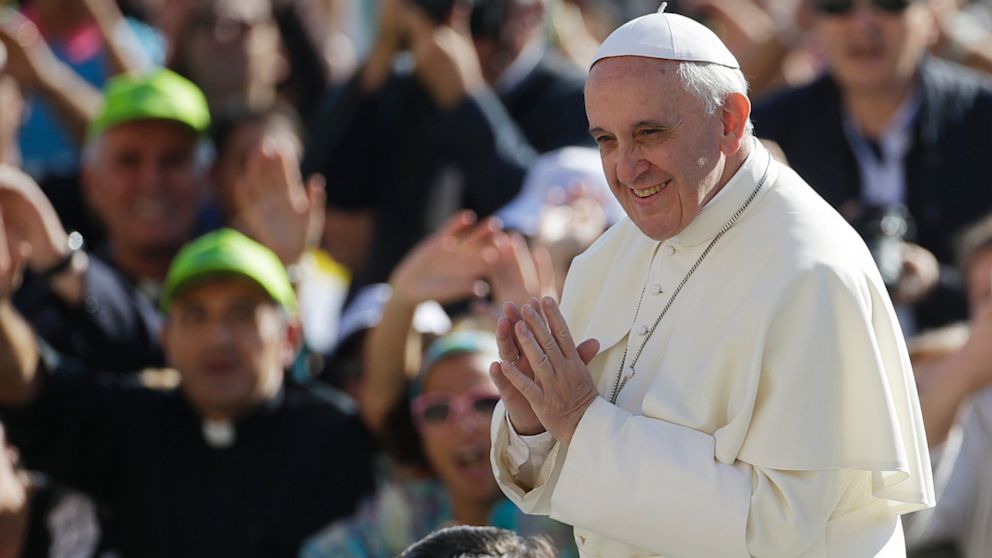
PHOTO: Pope FrancisAccording to ABC News: 

Benedict was mostly concerned about alleged liturgical abuses in the movement and had instructed the Congregation for the Doctrine of the Faith to study whether its Masses violated church regulations, according to a 2012 report in L'Espresso magazine.  Francis has reportedly called off the study ordered by Benedict, and he made no mention in his remarks Saturday about liturgical problems.   

It was Pope Francis who called off the study.  The Pope did not give any reason as to why he called off the study, so anyone can speculate what those reasons might be.  At any rate, the Neocatechumenal Way is estimated to consist of approximately 1 million members and growing. If this is truly not part of God's plan in the Catholic Church, I'm sure that the Neocatechumenal Way would fall apart.  But if it is part of God's plan, it will remain part of the Catholic Church and continue to grow.  As the Bible says:  

Acts 5:39 But if it is from God, you will not be able to stop these men, you will only find yourselves fighting against God." 

As many know from news reports, the Way has been met with much criticism. Bishops in Japan, Nepal, Philippines and elsewhere in Asia and Europe have tried to limit the Way's activities by shutting down their seminaries.  The Bishop in Japan wanted to suspend the Way's activities for five years, and the Archbishop in the Philippines went so far as to forbid the community from seeking new recruits and revoked existing members' right to teach catechism lessons.  Accusations are thrown and answers are being demanded while the majority of the members of the Way remained silent.   

In light of all these persecutions, Pope Francis encouraged the members of the Way to be patient and merciful to all that they encounter.   

Source:

http://abcnews.go.com/Health/wireStory/pope-tells-missionary-group-respect-culture-22327060 


In The Face of Persecution.

Is the Neocatechumenal Way being persecuted?  Unfortunately, yes they are being persecuted despite that they had the support of Francis I, Benedict XVI, and John Paul II.  The strongest support from the Vatican came with the approval of the organization's Statutes in 2008 and its Catechetical Directory in 2010.  The former Pope Benedict XVI (currently called Pope Emeritus), has already approved of the Way's prayers, including the non-liturgical celebrations. And the Church is the only one who has the authority to approve these things because she is the one who was granted the authority by Christ to "bind and loose."  So, how is the Way being persecuted?  

First of all, there are many official anti-Way websites about them. This is akin to having anti-Catholic websites created by Protestants.  One of the top reasons that these website cite for their anti-Way campaign is the liturgies. According to the instructions from the Holy See: 

On the manner of receiving Holy Communion, a period of transition (not exceeding two years) is granted to the Neocatechumenal Way to pass from the widespread manner of receiving Holy Communion in its communites (seated, with a cloth-covered table placed at the center of the Church instead of the dedicated altar in the santuary) to the normal way in which the entire Church receives Holy Communion.  This means that the Neocatechumenal Way must begin to adopt the manner of distributing the Body and Blood of Christ that is provided in the liturgical books.   

This instruction was speaking about how the Way received Holy Communion.  In the past, members of the Way received Holy Communion sitting down....but that was in the past.  This has already been corrected.  The members have been receiving the Body and Blood of Christ standing up just as they do in the Church. Anyone who attended the Eucharistic celebration of the Way already knows that the members receive the Body and Blood of Jesus Christ standing up.  

Some of these websites do not even update their information and still remain in the year 2005 or 2006; and thus, continue to accuse the Neocatechumenal Way of disobeying the Pope.  

While it is true that some members of the Way have retaliated against their persecutors, the members were told that the best response is silence.  (See my blog about Christopher Hitchens' attack on Mother Teresa.)  One of the things taught in the Catholic faith is humility in the face of persecution. Unfortunately, we are all humans and the virtue of humility is weak in some people. 

Pride and arrogance is very strong in all of us regardless of whether one walks in the Way or not.  Those with pride often look for an audience and count the numbers of people supporting them.  Those with pride retaliate with insults against their persecutors.  Those with humility do not count the numbers of support and are not afraid to stand alone.  Those with humility knows that what matters is that God stands with him/her.  With that kind of support, one finds peace in the face of persecution.   


Monday, February 3, 2014

Humility Is Truth

Christopher Hitchens was an atheist (or antitheist) because he was against all religion.  He held many controversial stances during his life, but the most controversial one was his campaign against Mother Teresa.  

Hitchens accused Mother Teresa of being a willing political tool for the Vatican, a corrupt person who stole millions of dollars from the poor, and a suppressor of the poor. These are some of the allegations that Hitchens made against Mother Teresa:  

1.  She accepted donations from shady sources including infamous 3rd world dictators and embezzled funds.  She also associated with various questionable figures, and took sides in Indian politics.  

2.  She used very little of the donations for actual charity.  Much of the donations she received went to either missionary work or the general RCC funds, even when earmarked for charity.  The exact proportion is unknown because she refused to release any information except where absolutely required by law. 

According to Wikipedia, "Hitchens views Teresa's organization as a cult which promotes suffering and does not help those in need.  He states that the impression the general public has about Teresa's work is the opposite of reality, and that this is more the fault of the mass media than of Teresa herself.  In his view, the idea that someone, somewhere is helping the poor of the world appealed to western viewers and quieted the conscience."  

In all these attacks, Mother Teresa remained silent, and she did not release any documents to prove herself.  She remained humble.  She followed the example of Christ.  Instead, the Order she founded prayed for Christopher Hitchens (See website below).  This is the example that people walking in the Way should follow.  However, because of free will, not everyone follows this good example.  We all have free will, and sometimes we make the wrong choices.  

Theresa of Avilla stated that "Humility is truth."  Mother Teresa remained humble despite that her organization was called "a cult."  The truth was found in her rather than in Christopher Hitchens. In the same way, Christ also remained silent when accusations of blasphemy were thrown at Him.  The truth was found in Christ because He remained humbled as He was being persecuted.  

Missionaries from the Way are being sent out to different countries, where persecution is real. Christ calls these missionaries to be the light of the world and the salt of the earth, so that all who see the Light of Christ in them will glorify God.  If one cannot handle the little persecution one face on this island, how can one handle the real persecution when one is sent to a country where Christians are being martyred?      


The Great Mission


Pope Francis emphasized "evangelization" as a top priority in the Church. During the World Youth Day in Brazil, the Pope criticized Brazil's Church for the exodus of Catholic followers.  The Pope blamed the exodus on a long list of failings by the church and and leaders sometimes caught up by intellectualism over rigid rules - a church that is "too distant" or "too cold."   

According to Brazilian census data, the number of Catholics decreased from 125 million in 2000 to 123 million in 2010, with the Church's share of the total population dropping from 74% to 65%.  During this same time period, the number of evangelical Protestants and Pentecostals has risen from 26 million to 42 million, which is an increase of 15% to 22% of the population in 2010.

After hearing the Pope's message of evangelization, the Neocatechumenal Way took the Pope's advise.  They took to the streets, going into the public squares to spread the news of God's love and mercy.  The Way chose certain public places to evangelize. This was very different from going out on two by twos.  In this type of evangelization, our communities chose an area, which is a huge field.  The area is close enough to a road traffic light where people in their cars were able to see and hear us....especially when the traffic light turns red.  Members of the Way also invited guests to these public squares to listen to Christ's love and mercy for each one of us.  The role of evangelization does not belong solely to the priest, but to every baptized Catholic.  According to Pope Francis in his letter, which is published in the Vatican website:  

The Second Vatican Council emphasized in a special way how the missionary task, that of broadening the boundaries of faith, belongs to every baptized person and all Christian communities; since "the people of God lives in communities, especially in dioceses and parishes, and becomes somehow visible in them, it is up to these to witness Christ before the nations" (Ad Gentes, 37).  Each community is therefore challenged, and invited to make it's own, the mandate entrusted by Jesus to the Apostles, to be his "witnesses in Jerusalem, throughout Judea and Samaria and to the ends of the ends of the earth" (Acts 1:8) and this, not as a secondary aspect of Christian life, but as its essential aspect: we are all invited to walk the streets of the world with our brothers and sisters, proclaiming and witnessing to our faith in Christ and making ourselves heralds of his Gospel.  


http://www.vatican.va/holy_father/francesco/messages/missions/documents/papa-francesco_20130519_giornata-missionaria2013_en.html


This Great Mission took place on Guam and all over the world.  In some cases, it can have an unexpected impact on a person.  According to one Catholic news report on the Great Mission (you can read the rest of the news report in the weblink below):  


Great Mission Launches

bishop blesses communities
The woman found the flier lying in the gutter.
“Your life will change, you will be happier,” the paper declared. “Christ loves you! He loves you, even though you may be a sinner.”
It was just the message she needed that day—the day she had planned to kill herself.
She attended the event—“The Great Mission,” the flier called it—and told the others who gathered there that her life was in chaos so deep that she could see no way but death to resolve it.
“That’s why I’m here. You gave me hope,” she said. “Today, you saved my life.”
It all happened in the parking lot of a Westminster grocery store where the brothers and sisters of the Neocatechumenal Way had gathered for The Great Mission, a project inaugurated by the Year of Faith.
Around the world, it’s estimated that the Great Mission was carried out in over 10,000 public squares—11 of them in Orange County. Members of the neocatechumenate community volunteered during the five Sundays of the Easter season to reach out to people in a public area—perhaps the parking lot of a shopping center or a restaurant, perhaps a park—and invite them to a 75-minute gathering including mid-afternoon prayers, testimony from people walking the Way, a group dialogue, and catechesis.
It can be nerve-wracking to approach strangers with an evangelistic mission, neocatechumenates admit, but their involvement in the Neocatechumenal Way prepared them for the Great Mission. The Way—a process of ever-deepening catechesis—is made up of individuals in small communities who “walk” together, gathering weekly for a celebration of the Word and the Eucharist, and monthly for a convivence (or day retreat). Together the group moves from phase to phase: from the pre-catechumenate to the first and second scrutinies, from the catechumenate to traditio, redditio, and election. In each phase, they add to their Christian activities—praying from the breviary each morning, for example, saying the rosary every day, and going door-to-door in pairs to share their experience of Christ.
Response to such neocatechumenal outreach can certainly vary, but the Great Mission was well received, says Frank Canlas, who carries the title of “the responsible” for neocatechumenate communities at Yorba Linda’s Santa Clara de Asis and San Clemente’s Our Lady of Fatima.
“The response from the people when we went out to invite them to this Mission was surprise that the Catholic Church was coming to them. They were surprised that the church is reaching out to them,” he recalls.
Two By Two Experience

What I find remarkable during the seven years that I was walking in the Way are the fruits.  Many families have chosen to be open to life.  Some families have 5-14 children.  There are also families who have chosen to adopt children.  

Most remarkable of all are the youth who are in the Way.  We get about 100 youth eager to join scrutacio, where they read and meditate on the word of God (Bible).  Many single people walking in the Way are also choosing to remain celibate until marriage. 

Another impressive thing are the missionaries.  Many of the seminarians and priests do missionary work. Lay people are also doing missionary work as single persons or as families. There are mission families being sent out on missions, and many of these missionaries have learned to speak different languages.     

My first time going out to spread the Good News was a fearful experience. Even the thought of going from door to door brought fear to my heart.  "What if they mistake us for Jehovah Witnesses?"  I kept asking myself.  In my head, I imagined doors slamming in my face.  This fear of rejection is my reason for not wanting to evangelize the first time I started walking.  I also remember what I did when Jehovah Witnesses came knocking on my door........I pretended I was not home.  

It is not very common for Catholics to evangelize the way the Jehovah Witnesses and Mormons have been doing.  In fact, it is very rare.  Yet, did not Christ authorize His Church to go out and spread the Gospel? Nevertheless, this experience taught me a valuable lesson.  Today, I now entertain those Jehovah Witnesses who come knocking on my door.  I do not turn them away nor do I pretend not to be at home.  I learned to dialogue with them....but that is another story.    

My first two by two experience (yes, we go in pairs just like the Apostles) was in Yona. It was an area where most low income families live. The houses there were very standard and all looked the same.   We went door to door asking if they want to hear a song or to say a prayer for someone in their family.  Many of these people received us in their homes, and most of them chose to hear a song.  Luckily, one of us brought a guitar. A few chose a prayer, which we did.  One family even offered us food and drinks, which was very nice of them. 

My second experience was not too long ago.  This time, we went to a much more affluent neighborhood.  Most of the homes in that neighborhood were very nice and well-kept.  We spent about two hours in that neighborhood, but only three people received us.  We were rejected by everyone else including the home that has a sign outside the door stating, "This is a Catholic home." I guess they thought we were Jehovah Witnesses.    

More on Mission Families in the Neocatechmenal Way.

The following article came from this website:  


Parenting and evangelizing unite in one vocation
By Agnieszka Krawczynski
Mary Johnson (back, second from right) and her husband Jim (to her left) pose with a Neocatechumenal Way community in Hong Kong. Originally from Ireland, the Johnsons spent 10 years working in the diocese of Hong Kong and teaching English. "We left everything just to be the presence of Jesus among the people," Jim said. Photo submitted.
The B.C. Catholic

Few parents dream of quitting their jobs, leaving their homes, packing up their children, and flying to foreign countries to evangelize. For four families, Vancouver is their "foreign country."

"I feel it was a vocation," said Carmel Deasy, now a member of Blessed Sacrament Parish. Originally from Ireland, she and her husband, Donal, attended a retreat with other families in the Neocatechumenal Way and offered themselves as lay missionaries. They spent the next 15 years in Taiwan before coming to Vancouver.

"We went in the spirit of the Gospel," Carmel said, with few possessions and little idea of what they would do when they arrived in 1995.

Families in mission live as they did at home: with jobs, a home, etc., but with the added task of helping the local bishop or priest with whatever he has invited them to do. Currently more than 700 families are participating in worldwide mission work as part of the Neocatechumenal Way.

For the Deasys, this was leading faith formation and catechesis in a Taipei parish.

"Doing God's will is simple, but not easy," Carmel said. It took the Deasy family almost three years to settle in. The new language and culture posed significant challenges, and their seven children were the only foreigners in Chinese schools.

She started seeing the effects of her work when her children's schoolmates became attracted to the Neocatechumenal community. "Now about eight or 10 of their friends with no other contact with the Church are waiting for baptism," she said.

"Lord knows who is going to be touched by your witness as a Catholic."

Jim and Mary Johnson spent 10 years on a similar mission in a nearby Asian country. Also from Ireland, the couple and their children flew to Hong Kong after volunteering to evangelize in that diocese.

"We left everything just to be the presence of Jesus among the people," Jim said. "It's the life of Christianity in action."

A family in mission typically stays in one place as long or short as there is need. After 10 years in Hong Kong, the Johnsons were invited to Vancouver, at the same time as the Deasys.

Their new task? "Evangelization of Chinese immigrants in Richmond," Carmel explained. Having lived in Asia for so long, both families were familiar with the culture and language of the growing immigrant community when they arrived in 2000.

The Johnsons are creating a series of talks for lapsed and doubting Catholics with Father Paul Chu, pastor of Canadian Martyrs Parish. Both families are also involved in the Neocatechumenal Way communities at Blessed Sacrament Parish and Guardian Angels Parish in Vancouver.

"We're here as long as God wants," Jim noted.

Lay missionary Ramona Belanger, a mother of 12, finds her biggest motivation is gratitude to God.

"The reason to do this was to be grateful to the Lord, to say thank-you to Him," she said. Born in Rome, Belanger was an avid student and earned a master's degree in languages. But school "didn't give life," she said.

Ramona immigrated to Quebec after she married. She and her husband became active in the Neocatechumenal Way, and found money and possessions did not satisfy their souls. They decided to offer themselves as lay missionaries.

The Belangers offered to go for nine or 10 consecutive years before Father Vittorio Scomparin presented a need for French-speaking missionaries on Canada's west coast. They sold everything to come here on mission in 2002.

"I do this out of love for Jesus Christ," Ramona explained. "I know that if He wants me to spread the good news, I will." She admitted balancing mission work and family responsibilities is sometimes challenging.

"The difference between this situation and a traditional missionary pastoral is that the whole family, children included, is called to evangelize," explained Father Scomparin.

"Generosity in collaborating with God and being open to life is rewarded by having a joyous and alive family community."

He added that there are "several thousand" families worldwide ready to be sent.

The concept of sending families on mission arose in 1986, in response to Pope John Paul II's call for a new evangelization. Bishops and other leaders invite families and direct them where to go and what to do.

Every few years the current Pope celebrates an official sending-out for all families in mission, presenting them with crucifixes and giving a blessing.

Pope Francis met with The Way founders and expressed his appreciation of the initiative's work on Sept. 5.

"I thank you for the immense good that you are doing for the whole Church," he said, the Zenit news agency reported.

Milton and Grethel Davis (and seven children) are the newest family in mission to arrive in Vancouver. Here from Nicaragua since 2006, they have seen The Way's impact grow from two communities to five.

"The Lord wants to love Vancouver: that's why He sends poor missionaries," Grethel said. The two have been helping with marriage, baptism, and confirmation preparation as well as catechesis and youth groups.

Milton sees their lives as having two missions: to evangelize and to have a family.

"We are here because the Lord has fulfilled us. We found what we were looking for," Grethel added.

Sunday, February 2, 2014

Mission Families

  
The Way has been evangelizing since it was founded in 1964.  The Way gradually spread from the archdiocese of Madrid and to other Spanish dioceses.  Since then, the Way has continued to spread to dioceses around the world.  Priests are sent to spread the Gospel.  Along with these priests, mission families are also sent to be a sign and a light to many different countries.  How are mission families chosen?  They're actually volunteers.  In the annual convivience (sometimes called a "retreat), the calling is made for anyone who wish to be a mission family.  Couples voluntarily stand up, and that is how they are chosen.  They volunteered to do missionary work.  

This year, several misison families and priest will be sent to establish communities of faith in China, India, Vietnam, Mongolia, Finland, and Ukraine, among others.  Each team consist of priests, seminarians, female celibates and up to four families. In countries where 90% of the people have no religious affiliation, larger families were sent out.  These mission families are very courageous for they left home, friends, security, and work to evangelize in other countries.  According to CNS story dated January 12, 2006 (See weblink below):  

Gennarini said the pope's words of encouragement underlining that God will provide is important to these mission families, most of whom have five to 10 children, including infants.  

"What they do is very hard; they leave their country, their home, their work and go to live in very difficult neighborhoods" that are often plagued by drugs, prostitutes and poverty, he said.  

Even though the families have been invited by the local bishop to evangelize a part of his diocese, the mission priest and families will have to start from scratch, he said.  

"There will be nothing; they will have to find work, an apartment," even set up a church, he said.

http://www.catholicnews.com/data/stories/cns/0600204.htm


One of the sisters in my community was so impressed with these mission priest and families that she actually went to Spain on World Youth Day with only her passport, a few clothing, and absolutely no money.  She felt that if God can provide these mission priest and families, then God would also be able to provide her with the necessities she needed (food and shelter).  And indeed, God provided.  She brought no money and did not starve in Spain. 

One of the things that we were taught in the Neocatechumenal Way is that the reason God brought His chosen people the Israelites into the desert is to show that He can provide for them.  To give up everything to follow Christ in a mission to evangelize is not easy.  Members of the Way are taught to place their full trust in God rather than in money.......something that even I must admit is not easy to do.  Many people think of money simply because everyone can see what money can do.  Yet, we have many saints in our Church history who have given up all wealth and placed their trust in God. Mother Theresa, for example, had nothing, but she didn't starve to death.     
    

Three Recommendations of the Pope

First Recommendation: Communion is essential sometimes it can be better to renounce living in all details that your itinerary demands, in order to ensure the unity among those who form one ecclesial community, of which you must always feel that you are part.   

In places like Japan and Nepal some bishops have banned the Way. In those places, the members of the Way have followed their bishops rather than disobey them.  For example, in Nepal, Bishop Anthony Sharma suspended the activities of the Neocatechumenal Way.  According to the article (provided below), members of the Way obeyed the Bishop's decision and prayed that he reconsidered.  

In Japan, the Japanese bishops ordered the Neocatechumenal Way out of their country for a period of 5 years, but the Vatican set up new talks between the Japanese bishops and representatives of the Way.  Today, a few Japanese bishops still ban the Way from their dioceses.  According to the article some of the diocesan bishops have complained that the Way has undermined the unity of the Catholic community.  But who is persecuting whom?   


http://www.catholicculture.org/news/headlines/index.cfm?storyid=11296

In Guam, there are members of the Way who take part in the Parish Church. Some of them involve themselves in the Parish by becoming lectors, by becoming Faith Formation instructors and coordinators, by doing volunteer and maintenance work around the Parish, and even donating their time and skills in repairing broken air-conditioning units and cleaning around the Church grounds. 

While it may be true that a few members of the Way do not attend the Parish Mass, this is not true for everyone walking in the Way.  I know for a fact that some of the community brothers and sisters I walk with attend regular Sunday Mass in the Parish more than once a month.  I happen to be one of them. Other brothers in my community attend Mass daily.  Yet, much of the negative criticisms and judgments against the Way continues on.   

Second Recommendation: Even more important will be your commitment to "learn" the culture you will encounter.

I agree that when one is sent to another country, it is important to learn the language and culture of the people in that country.  The many seminarians who come from different countries here are trying to do that.  English is not their primary language, but I have seen first hand how their English has improved over time.  However, it is unfortunate that a few people have criticized and judged their accent despite how hard they have learned the English language.    

Final Recommendation: The freedom of each person must not be forced, and even the eventual choice of someone who decides to seek outside of the Way, other forms of Christian life that help him to grow in response to the call of the Lord must be respected. 

The Way started out as an invitation to people.  Pamphlets were given out inviting them to catechesis and encouraged to come by its members. Thousands of invitations were sent, but only a handful would come to the catechesis.  It was their choice to attend.  And there are also members who have left the Neocatechumenal Way, and even members who have returned.  

One member I know left the community and went to the United States.  After 8 years, he returned to Guam and to his own community and has remained with them thus far.  As a member of the Neocatechumenal Way, I've been walking for 7 years.  A person does not have to be in the Way to grow in faith and live out their baptism.  Mother Theresa was never in the Neocatechumenal Way, but she grew in faith and lived out her baptism.  It is possible for someone outside the Way to grow in faith.  It is also possible for those inside the Way to also grow in faith.  To grow in faith and to live out our baptism means to become sons and daughters of God....to live a holy life in which God called each and everyone of us to live, and to evangelize as Christ commanded all of us to preach the Good News.     

Pope Francis I has endorsed the Neocatechumenal Way.  Why is this important?  It is important because the Pope is the Successor of the Apostle Peter.  The Pope makes clear that the Neocatechumenal Way is part of the Catholic Church, not separate from her.   

Pope Francis' Speech to Neocatechumenal Way, Feb. 1, 2014


Dear brothers and sisters, 

I thank the Lord for the joy of your faith and for the ardor of your Christian witness.  Thanks be to God.  I greet you all cordially, starting from the International Responsible Team of the Neocatechumenal Way, together with the priests, seminarians and catechists.  I send an affectionate greeting to the children, in attendance in great number.  My thoughts go out in a special way to the families, who will go out to different parts of the world to proclaim and witness to the Gospel.  The Church is grateful for your generosity!  I thank you for all that you do in the Church and in the world.  And precisely in the name of the Church, our Mother,...I would like to propose to you some simple recommendations. 

The first is to have the utmost care to build and to preserve the communion within the particular Churches in which you will work.  The Way has its own charism and dynamic, a gift, which like all of the gifts of the Spirit, has a profound ecclesial dimension, this means paying attention to the life of the Churches to which your leaders send you, to enhance the riches, to suffer for the weaknesses if necessary, and to walk together, like one flock, under the guidance of the pastors of the local Churches.  Communion is essential sometimes it can be better to renounce living in all details that your itinerary demands, in order to ensure the unity among those who form one ecclesial community, of which you must always feel that you are part. 

Another recommendation: wherever you may go, it would do you well to think that the Spirit of God always get there ahead of us.  The Lord always precedes us!...Even in the most faraway places, even in the most diverse cultures, God scatters everywhere the seeds of his Word.  From here, flows the necessity to give special attention to the cultural context in which you, families, will go to work: it consists of an environment often very different from the one from which you come.  Many of you will have to work hard to learn the local language, sometimes it will be difficult, and this effort is appreciated.  Even more important will be your commitment to "learn" the culture you will encounter, knowing how to recognize the need of the Gospel, which is present wherever, but also that action that the Holy Spirit has accomplished in the life and in the history of every people.  

Finally, I exhort you to care lovingly for each other, in a particular way for the weakest.  The Neocatechumenal Way, as an itinerary of discovery of one's own baptism, is a demanding road, along which a brother or a sister can come upon unforeseen difficulties.  In these cases, the exercise of patience and of mercy on the part of the community is a sign of maturity in the faith.  The freedom of each person must not be forced, and even the eventual choice of someone who decides to seek outside of the Way, other forms of Christian life that help him to grow in response to the call of the Lord must be respected.  

Dear families, brothers and sisters, I encourage you to bring everywhere, even in the most de-Christianized environments, especially in the existential peripheries, the Gospel of Jesus Christ.  Evangelize with love, bring to everyone the love of God.  Tell everyone you will meet on the streets of your mission that God loves man as he is, even with his limits, with his mistakes, with his sins.  For this, he sent his Son, so that he could take our sins upon himself.  Be messengers and witnesses of the infinite goodness and the inexhaustible mercy of the Father.  I entrust you to the Virgin Mary, that she may inspire and always sustain your apostolate.  In the school of this tender Mother, be zealous and joyful missionaries.  

(The full text, which is written in Italian, is found in the Vatican website):        

http://press.vatican.va/content/salastampa/it/bollettino/pubblico/2014/02/01/0076/00163.html

Saturday, February 1, 2014

Redemptoris Mater Archdiocesan Seminary


Fr. Luis Venancio Benavente Camacho Jr.In the last nine years, Guam ordained seventeen priests following the ordination of Deacon Luis Venancio Benavente Camacho Jr. and Deacon Michael Vincent Jucutan to the sacred priesthood on November 9, 2013.  

Father Luis became the first Chamorro priest ordained from the Redemptoris Mater Archdiocesan Seminary of Guam and the second Chamorro to be ordained a priest for the Archdiocese of Guam.  Father Richard Meno Kidd was ordained last July.  

Of the seventeen priests ordained in the last nine years, thirteen of them have received their formation at the Redemptoris Mater Seminary which was erected in 1999.  The Seminary has produced new priests who have served Guam in 2005 to the present day.  

Fr. Michael Vincent JucutanThe Seminary was founded by Archbishop Anthony Apuron on December 8, 1999.  According to the article in the weblink, which I provided below, the Seminary has three characteristics: 1) diocese, 2) missionary, and 3) international in nature.  It is diocese because the priests formed here are for the diocese.  It is missionary because some of these priests were sent on missions to announce the Gospel.  It is international in nature because many of the seminarians come from different countries, and this helps them to go beyond their own native language, traditions, and culture, which would eventually aid in their missionary work. 

Priests who were ordained from the Redemptoris Mater Archdiocesan Seminary not only performed the Mass for the Neocatechumenal Way, but also the regular Mass in the village church they are assigned to.  Others such as Father Santiago and Father Fabio were sent to other countries to do missionary work.  Christ sent the Apostles to baptize all nations in the name of the Father, the Son, and the Holy Spirit.        


Sources:

http://umatuna.org/seventeen-priests-ordained-on-guam-in-nine-years

http://www.guampdn.com/guampublishing/special-sections/evangelization/pg1.html