Friday, December 6, 2019

Bishops Inflicting Grave Harm on the Priesthood

On January 24, 2019, I published a post about why it would cause grave harm if the names of priests accused of sexual abuse allegations are published by the Church.  The article I posted were written by Joseph R. Maher and David A. Shaneyfeit.  Mr. Maher is the Founder and President of Pus Bono Sacerdotii, an organization committed to helping priests with a variety of personal and legal problems.  Mr. Shaneyfeit is a private California attorney.  That post can be found here. 

Father Gordon MacRae also posted a similar article in his blogsite, which can be found here.  The following article was posted in These Stone Walls:
-----------------------------------------------------------------------------------


Pope Francis issued 2019 guidelines for preserving a right of defense for accused priests and limits on publishing their names. Many U.S. bishops just ignored these.
In the above-captioned article at These Stone Walls, I wrote about a decision of The Most Rev. Peter Libasci, Bishop of the Diocese of Manchester, New Hampshire, to publish a list of the names of priests “credibly” accused in that state over the past fifty years. At the time the list was published in August 2019, the Bishop and Diocese issued a press release citing ‘transparency” as the reason for publishing it.
The list contained the names of 73 accused priests. More than half are deceased. Only five of the 73 ever had a case for prosecution before any New Hampshire court. None of the claims were current. Most alleged misconduct from three to five decades ago. Virtually all were brought with a financial demand that resulted in a monetary settlement from the diocese.
Bishop Peter Libasci’s published list was generated, not by any semblance of due process, but rather by a one-sided grand jury investigation of the diocese launched in 2002. That investigation treated all claims in civil lawsuits and other demands for settlement as demonstrably true with no standard of evidence whatsoever.
Bishop Libasci’s press release revealed that the claims against all 73 priests were determined to be “credible.” This is a standard that the United States bishops adopted at their Dallas meeting in 2002. “Credible,” as the bishops are applying it, means only “possible.” If it could have happened, it’s credible.
A 2003 grand jury investigation of the Diocese was the source for the recently published list. In that investigation, none of the accused – the few who were still living, anyway – were permitted to appear to offer any defense. That is the nature of a grand jury investigation. It is a strictly prosecutorial affair that is supposed to determine whether indictments and trials should follow. None of the subjects on Bishop Libasci’s list were indicted after the 2003 grand jury report became public.
My article cited above was followed by a related and stunning article by Fr. Gordon MacRae, one of the priests whose name appears on the bishop’s list. His category was unique on the list. It was simply, “convicted.” It was published without nuance by a diocese whose previous bishop told others in secret that he knows Father MacRae to be innocent and unjustly imprisoned. “Transparency,” however, has its limits.
Father MacRae’s article is “A Grand Jury, St. Paul’s School, and the Diocese of Manchester.” Amazingly, from reports I have seen generated by These Stone Walls, the article was heavily read around the world, most notably in Washington D.C., at the Holy See, and throughout Rome. In New Hampshire, it was the most-read article of the year at These Stone Walls.
My article, “In the Diocese of Manchester, Transparency and a Hit List,” focused on injustices behind the scenes in a decision of the Bishop and Diocese to publish that list anew. Father MacRae’s remarkable sequel contrasts the 2003 grand jury investigation of his Diocese with a similar 2018 investigation of a nationally known Concord, New Hampshire academy, St. Paul’s School, with historic ties to the Episcopal church. Fr. MacRae brought to light a judicial ruling that publishing these grand jury reports – and by extension the Bishop’s list of names – is actually forbidden under New Hampshire law.
GRAVE INJUSTICE IN THE ‘LIVE FREE OR DIE’ STATE
Father MacRae’s article revealed a grave injustice in the Diocese of Manchester and multiple other U.S. dioceses. Fifteen years after the Diocese and Attorney General signed a deal in secret to publish a grand jury report in 2003, New Hampshire Superior Court Judge Richard McNamara ruled that the report, and one involving a 2018 St Paul’s School grand jury investigation, cannot legally be published.
New Hampshire Attorney General Gordon MacDonald pressed to allow publication of the St. Paul’s School report. He cited the 2003 Diocese of Manchester precedent in which a report and files were published – the source for the names on Bishop Libasci’s list.
Father MacRae revealed that in 2003, the current N.H. Attorney General was part of a legal team representing the Diocese when release of the report was agreed upon in secret. It was the Attorney General’s citing the precedent that triggered Judge McNamara’s 23-page Order dated August 12, 2019, ten days after Bishop Libasci published his list.
Given the various one-sided grand jury investigations of Catholic dioceses across the U.S., Judge McNamara’s Court Order should give Catholics pause. The judicial findings summarized below cast doubt on the U.S. bishops’ collective decisions to publish lists of names arising from grand jury investigations:
  • The OAG [Office of the Attorney General] argues that a common law precedent for such a report does in fact exist because the Hillsborough County [NH] Superior Court [in 2003] authorized an agreement between the OAG and the Diocese of Manchester to waive the secrecy of a grand jury investigation…
  • The Hillsborough County Superior Court endorsed the Diocese-OAG Agreement without explanation and without any written Order. This Court respectfully disagrees with the decision to approve the Diocese-OAG Agreement [in 2003].
  • The Diocese-OAG Agreement fulfilled none of the traditional purposes of the common law grand jury.
  • The Court cannot find that the use of grand jury materials and the breach of grand jury secrecy in order to prepare a report is a practice authorized by New Hampshire common law.
  • Rather than investigation of crime, the report is a post hoc summary of information the grand jury considered, but did not indict on. It did not protect the privacy interests of those witnesses and subjects that were never charged with a crime by the grand jury.
  • The deficiency of the Diocese-OAG Agreement is cast in bold relief by [a] December 2018 decision of the Pennsylvania Supreme Court Pennsylvania has a statute that specifically authorizes investigative grand juries and investigative reports. However, as in most states, the statute contains statutory procedures to provide individuals with due process protections for their reputational rights… the petitioners were entitled to have a report published with redactions of their names in order to protect their right to reputation. [emphasis added]
  • A grand jury is not an adversary hearing in which guilt or innocence is established. Rather, it is an ex parte investigation to determine whether a crime has been committed and whether criminal proceedings should be instituted against any person.
  • Grand jury testimony can involve all sorts of false, damaging, and one-sided information and New Hampshire has no historical or legal basis for releasing such information.
  • An allegation of wrongdoing or impropriety, based on half-truths, illegally seized evidence, or rumor, innuendo or hearsay may blight a person’s life indefinitely.
  • Mark Twain famously said that a lie is half way around the world while the truth is putting on its shoes. In an internet age, he might have added that the lie will forever outrun the truth as search engines become more efficient.
  • Accordingly, the Court DENIES the OAG Motion to Produce and Disclose. The OAG may not produce any report that contains any material characterized as a “Grand Jury Report.”
[Source Order of Judge Richard B. McNamara In Re: Grand Jury No. 217-2018-CV-00382, August 12, 2019.]
NOW COMES THE POPE
The Court Order should have applied to the Bishop of Manchester as well. He took it upon himself to do what the law forbids the State to do: to prosecute and convict in the public square those who were not indicted, were not tried or convicted, but were merely accused. I find it a disturbing coincidence that Bishop Peter Libasci’s decision to publish a list of the names of 73 accused priests – the vast majority of whom are merely accused – took place just days before the Order by Judge McNamara was issued.
This is ironic, at best, and at worst highly suspect. Had the Order preceded the release of names, the priests involved – those still living, anyway – may have had legal standing to challenge it. But this all pales next to published guidelines of another authority the bishops should be heeding.
On November 12, 2019, Archbishop Christoph Pierre, Apostolic Nuncio to the United States, addressed the U.S. Conference of Catholic Bishops in Washington, D.C. His address emphasized that “The pastoral thrust of this pontificate must reach the American people.” The bishops can fulfill this, he said, with “tangible signs of their communion with the Holy Father.”
Among the “pastoral thrusts” of the pontificate of Pope Francis that might require communion with his bishops was a February 21, 2019 issuance of a set of guidelines that bishops should follow on how allegations of sexual abuse by priests are to be handled. The list included 21 points that Pope Francis asked the bishops to observe. Point Number 14 is as follows:
. “The right to defense: the principle of natural and canon law of a presumption of innocence must also be safeguarded until the guilt of the accused is proven. Therefore, it is necessary to prevent the lists of the accused being published, even by dioceses, before the preliminary investigation and a definitive condemnation.” (Source: Guidelines of Pope Francis, February 19, 2019)
Rev. Msgr. Thomas G. Guarino, Professor of Systematic Theology and a prolific author, has published what I consider to be a landmark article entitled “The Dark Side of the Dallas Charter”
(First Things, October 2, 2019) . Father Guarino characterized the 2002 Dallas Charter – the operable document under which accused priests are removed from all ministry:
. “The harried bishops, with their Dallas Charter of 2002… passed Draconian norms that come close to venturing beyond Catholic teaching. The American bishops decreed ‘zero tolerance’ for priests accused of sexual abuse, a norm that, as Cardinal Avery Dulles acknowledged in 2002, violates equitable treatment for priests. Dulles added, ‘Having been so severely criticized for exercising poor judgment in the past, the bishops apparently wanted to avoid making any judgments in these cases’.”
Father Guarino’s article points out that Pope Francis has been reluctant to invoke the term “zero-tolerance.” The Wall Street Journal reported that of the twenty countries in the world with the largest Catholic populations, only the Bishops of the United States have invoked a policy of “zero tolerance.”
In 2000, the U.S. bishops issued a pastoral document critical of the American criminal justice system. The bishops rejected terms such as “zero tolerance” and “three-strikes” in the application of punishments in the criminal justice system. They urged lawmakers to focus on rehabilitation and restorative justice while imposing sentences.
But two years later, at Dallas in 2002, under the harsh glare of the news media and victim advocates such as S.N.A.P. (who were directly invited by the bishops) the U.S. bishops inflicted the same panic-driven one-size-fits-all policy on their priests that they asked the justice system NOT to inflict on all other U.S. citizens. Cardinal Avery Dulles wrote in rebuttal in 2004:
  • “The Church must protect the community from harm, but it must also protect the human rights of each individual who may face an accusation… Some of the measures adopted [at Dallas] went far beyond the protection of children… [Bishops] undermined the morale of their priests and inflicted a serious blow to the credibility of the Church as a mirror of justice.” (Avery Cardinal Dulles, “The Rights of Accused Priests,” America 2004)
THE DARK SIDE OF THE DALLAS CHARTER
As Father Gordon MacRae exposed in “A Grand Jury, St. Paul’s School, and the Diocese of Manchester,” the late Father Richard John Neuhaus interviewed an American prelate who was one of the unnamed principle architects of the U.S. Bishops’ Dallas Charter. Father Neuhaus quoted him in a First Things article: “It may be necessary for some innocent priests to suffer for the good of the Church.” That prelate, according to Father MacRae, was Cardinal Theodore McCarrick.
As Father Guarino points out in “The Dark Side of the Dallas Charter,” a significant problem with the Bishops’ policy is that most accused priests have not actually been found guilty of abuse. Of the 73 priests, both living and deceased, on Bishop Peter Libasci’s published list, only five ever had due process in any court of law. Three of those were by plea deals, and one, as Bishop Libasci’s predecessor has acknowledged in secret, is wrongfully convicted.
For all the other names on the Diocese of Manchester list – and for the vast majority of the hundreds of American priests who have been removed from ministry, the allegations against them were only considered “credible,” meaning only that it is possible that they happened. If any other American citizens from any walk of life were subjected to such a standard before being shamed in the public square, libel and slander lawsuits would flood the courts.
Perhaps the greatest insult to Catholics in the pews is the statement of Bishop Libasci – and other bishops who have published lists of names of the accused – that this is done for the purpose of “transparency.” I have personally attempted to review the required canonical investigations of Father MacRae that a previous official of the Diocese of Manchester insisted were carried out.
I was told that these investigations are confidential.
I have requested to see the list of settlements meted out to the accusers in his case which have been called into question by The Wall Street Journal and other interested parties. I was told that these settlements are confidential.
Father MacRae himself requested of a previous bishop, the Most Rev. John McCormack, that he be permitted to see the canonical investigation that the bishop claimed was forwarded to the Holy See. Father MacRae was reportedly told that this, too, is confidential. He was later told by another official of the Diocese that no required canonical investigation ever took place. This was before MacRae learned from a New Hampshire attorney and a PBS producer that Bishop McCormack revealed, after requesting secrecy, that “I firmly believe Father MacRae is innocent and should not be in prison.”
“Zero Tolerance” is an insult to Catholic theology and to our priests who are disenfranchised from their priesthood, and from their civil rights as citizens, on the whim of a bishop after being accused.
“Transparency,” however, is an insult to all the rest of us who have waited under shrouds of duplicity for our bishops to reflect the mirror of justice that this world needs the Church to be.

Tuesday, December 3, 2019

Updates: Some Good News

I apologize for it has been a while since I wrote in my blog.  Since the Beginning of the Year Convivience in October, things have been very busy with me and my family.  My blog never comes first before my family, so I apologize for not always being on here.  

At any rate, things are moving forward. One of the good news is that a pontifical RMS in Macau has been established.  I say "pontifical" because it was Pope Francis who established it.  Therefore, it cannot be shut down by any other bishop.  With an RMS in Macau, the NCW will move forward in evangelizing Asia.  In time, we are hoping to ordain 20,000 priests.  That number may seem unrealistic to some people.  However, China is indeed an excellent place to start, considering the fact that there are more men than women in China.  The RMS in Macau will be run by the NCW with the mission to evangelize Asia.  Already, we have moved forward in evangelizing other Pacific Islands: Saipan, Palau, and Chuuk.  A first community was already formed in Palau.  In time, more communities will be born there. In time, we hope to expand Catholicism into the Pacific region.   

Members of the NCW in Guam are still walking the tripod.  Our youth who attend public schools and the University of Guam have been active in inviting their friends and classmates into the Eucharist and youth scrutacio.  Their experience in the Eucharist and youth scrutacio have been very positive and many of them have returned.  Inviting them to the Eucharist and youth scrutacio is one way to evangelize the youth of Guam.  Our youth are also involved in the pre-vocations classes every month, where they discern God's calling for them.  At the Beginning of the Year Convivience, a video was shown of the many bishops who participated in the retreat in Israel.  These bishops were there to learn and experience what the Neocatechumenal Way was about.  Many of them came out with positive experiences. As more and more bishops participate in these retreats at the Domus Galilaeae in Israel, they are coming to a much more deeper understanding of the Neocatechumenal Way and its fruits.  Many of them are now coming to support the Way.    

Friday, November 15, 2019

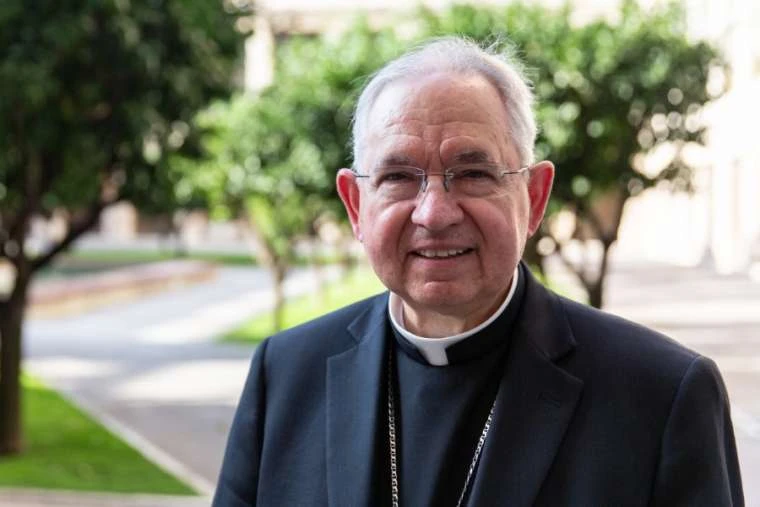
Archbishop Jose Gomez

On November 12th, Archbishop Gomez was elected president of the United States Conference of Catholic Bishops (USCCB).  He is also the first Latino and first immigrant to head the conference.  Archbishop Gomez is not a member of the Neocatechumenal Way.  He is affiliated with Opus Dei; however, he made positive statements about the NCW and other charisms.  According to Catholic News Agency:
Gomez told CNA that groups like Opus Dei, along with other Church movements like the NeoCatechumenal Way and Communion and Liberation that have gained popularity in recent decades, emphasize “the universal call to holiness making a reality in the life of the Church.”
“All of those different institutions that are promoting the vocation of the lay faithful are a blessing for the Church.”
“By the work of the Holy Spirit there have been in the universal Church many groups of people working as a movement just to bring the beauty of the Chirstian life to the presence of the lay faithful all over the world,” Gomez added, comparing Church movements to the diversity of ministries and apostolates in parishes, which he called “the center of Christian life in the United States.”
You can find the following article here (the bold is mine):
-----------------------------------------------------------------------------------------------------------

Archbishop José H. Gómez of Los Angeles at the North American College in Rome, Sept. 16, 2019. Daniel Ibáñez/CNA.- When he became a priest four decades ago, Archbishop Jose Gomez did not expect that he would one day lead the largest archdiocese in the U.S., or the country’s bishops’ conference.
“I just wanted to be a priest,” Gomez told CNA with a laugh, speaking about his election.
“Somehow God wanted me to do what I am doing, and I’m just counting on the grace of God to be able to be faithful to what God is asking me to do.”
“And also on intercession of Our Lady of Guadalupe,” he added, explaining that he has entrusted all of his ministry as a bishop to the prayers of the Blessed Virgin Mary.
Gomez, 67, was elected Nov. 12 as president of the United States Conference of Catholic Bishops. The archbishop, born in Monterrey, Mexico, and ordained a priest in Spain, is the first Latino to lead the bishops’ conference. He is also the first immigrant to head the conference.
His election is historic, but it was no surprise. Gomez became vice president of the conference, a central organizing body of almost 200 Catholic bishops with more than 300 employees, in 2016. The vice president is traditionally elected to the top job, so Gomez knew his election was likely.
But, he told CNA, the real surprise was becoming vice president three years ago.
“I was not expecting to be the president. Some people put my name forward for election as vice president [in 2016].”
“To my surprise I was elected vice president, then once you are the vice president, it is more likely that they elect you president. The whole process was a surprise to me, but I see that God is asking me to do it, and I just pray that with the grace of God I can do a good job.”
Gomez laughed, noting that he had never expected to become a Denver auxiliary bishop in in 2001, the Archbishop of San Antonio in 2004, or in 2010 head of the Los Angeles archdiocese, the largest local Church in the country.
The archbishop told CNA that his goal is to “try to live what I preach, and then, also, my ministry to the people — that’s the most important thing.”
His ministry, he said, includes serving “my brother bishops, priests, deacons, and also the lay faithful. Because really my vocation started with ministry to lay faithful.”
Gomez acknowledged that he spends a great deal of time on administrative responsibilities, and will have more of them as his term as president begins. But he said that even amid those responsibilities, and even while exercising them, he has time to build the pastoral relationships he finds so fulfilling.
“The fact that I am the Archbishop of Los Angeles gives me a beautiful opportunity to be with the people, because there are so many people active in the Church in Los Angeles. And also in the conference of bishops, really what’s its all about it serving the people, so I hope that I can have the opportunity to be with people, in events where people are, and that I can continue to be a pastor which is, I believe, my vocation.”
Gomez is the first bishop elected to lead the conference to be associated with Opus Dei, a Church group, founded in Spain and supported by Pope St. John Paul, that focuses on finding holiness in everyday life, and on the call to holiness of lay Catholics. The archbishop became affiliated with Opus Dei as a college student, and was a priest in the organization, formally called a personal prelature.
The archbishop’s vision of the Church, focused on collaboration and friendship between laity and clerics, and on the idea that everyone should be a saint, is informed by his experience in Opus Dei.
“The spirituality of Opus Dei,” he told CNA, “basically is to strive for holiness— personal sanctification — and ministry. Sharing our faith with everybody else.”
“Most of the members of Opus Dei are lay faithful living their lives and working and trying to share the faith and to be holy.”
“Everybody, starting with the pope and going through every single bishop, and priest, and deacon, we all are called to strive for holiness, with the universal call to holiness, provided to us by the Second Vatican Council, and also, as Pope Francis is insisting that we should be missionary disciples, so that means sharing our faith with everybody else,” he added.
Gomez told CNA that groups like Opus Dei, along with other Church movements like the NeoCatechumenal Way and Communion and Liberation that have gained popularity in recent decades, emphasize “the universal call to holiness making a reality in the life of the Church.”
“All of those different institutions that are promoting the vocation of the lay faithful are a blessing for the Church.”
“By the work of the Holy Spirit there have been in the universal Church many groups of people working as a movement just to bring the beauty of the Chirstian life to the presence of the lay faithful all over the world,” Gomez added, comparing Church movements to the diversity of ministries and apostolates in parishes, which he called “the center of Christian life in the United States.”
The archbishop said that in his own ministry as a bishop, he looks to the example of Pope St. John Paul II, and, that among American bishops, he has been influenced and inspired by a number of bishops.
“Obviously in the United States I had the blessing of working together with Archbishop Chaput because I was his auxiliary bishop, so he has been a wonderful example to me. But I have been influenced by many other bishops: Archbishop Joseph Fiorenza, Archbishop Patrick Flores, and then Cardinal William Levada, who just passed away, he was a good friend.”
Levada, Gomez told CNA, “asked me, when I was a young auxiliary bishop, to be a member of the doctrine committee of the USCCB. So that helped me to get to know the workings of the USCCB.”
Gomez takes the helm of the bishops’ conference in a difficult time.
The sexual scandals that emerged in June 2018, with revelations of abuse on the part of former cardinal Theodore McCarrick, have preoccupied bishops and lay Catholics.
The ecclesiastical landscape has shifted too; the pontificate of Pope Francis is different in emphasis, tone, and style from those of his predecessors. Some U.S. bishops have been accused of resistance to Francis, and bishops have responded to his leadership in different ways.
“The reality of the bishops in the United States is that we all are faithful to Pope Francis,” Gomez told CNA.
“I think we all are united. There is some perception that we are not. But the reality— what I see— is that we are united in our ministry and in our Church.”
“Every pope brings some different aspects in the life of the Church that he, by the grace of God, believes are important. And we, the bishops of the United States, are trying to be more aware of what those things are, and try to make it happen in our ministry.”
Gomez acknowledged that Pope Francis’ leadership is not similar to that of his predecessors.
“I think it takes time for people to really understand the spirituality of Pope Francis.”
“I think there are many, many aspects that are different. They are cultural and spiritual; it’s the first time in the history of the Church that there is a pope from Latin America. And some of us, who have that experience, know that it is different from the culture in Europe, or in the United States, or in Asia,” Gomez said. 
“It’s also the first time there is a Jesuit who is the pope. So every religious community, and the diocesan priesthood, have different spiritualities.”
“So I think we the bishops of the United States, and I personally, are learning how to appreciate the different aspects of the spirituality and the culture of Pope Francis.”
Gomez added that “every bishop has his own spirituality, and his own ministry in the diocese, according to the needs of the people in the diocese,” he said, noting the difference in his experiences while serving in Denver, San Antonio, and Los Angeles.
“San Antonio was basically a community of two cultures: Hispanic culture and the Anglo-Saxon culture. Now in Los Angeles we have people from all over the world. So my ministry is different.”
“One thing Pope Francis insists a lot is to respect the cultures of people, different ways of worshipping. People in Peru, or in Mexico, or people from Vietnam have different ways of worshipping and living. So the Church in the United States is learning how to address the needs of people from around the world,” Gomez added.
As he begins his term as president, Gomez told CNA he hopes to help the Church “to really understand the cultural realities of the people in the United States. I think it’s important for all of us to be more open to that.”
“With immigrants, what I talk about is not assimilation, but integration: that they be integrated into the life of the United States and the life of the Church.”
As Gomez discussed the importance of understanding the diversity of cultures in the Church, he also emphasized the source of the Church’s unity.
“Obviously I have the same truths as we all have, the teachings of Jesus Christ, in the Catholic Church.” 

Tuesday, November 12, 2019

The Spraying of Holy Water

Father Julius was criticized by the media and by the jungle when he sprayed holy water on the people from a spray bottle during All Souls' Day.  According to the jungle:
Hey, don't blame him. 

He is the product of Kiko's theology (see "Kiko and Purgatory") and Apuron's (fake) seminary.

Correction for the jungle:  Father Julius is a product of the Catholic Church and the Redemptoris Mater Seminary accredited by the Pontifical Laterian University (also known as the "Pope's University').  There were 410 comments posted on the KUAM facebook regarding the issue of Father Julius using a spray bottle.  You have heard the side of the media and the jungle.  Below are some of the comments posted on KUAM Facebook regarding the issue.  The comments are printed in red.  This is now the other side of the story and from the majority of the comments: 

Tania Stotts-Cruz Love this! 😁 How innovative and efficient this priest is. Looks like he did this will only good intentions. Blessings all around!

F Glenn Lujan See I don't know why people are all up in arms! Really there other issues we need to address! Pick and choose your battles people! You've got to have some sense of humor!

Marinalyn Hale My family and I are very strong Parishioner at the San Dimas Church in Malesso and the priest in this video is our priest Father Julius. For those who are not from Merizo and do not attend our regular church services or San Dimas functions I am proud to say that not only is Father Julius a very respectful man but he is interactive with the community, he is generous with his time, he is gracious with involving our youth during mass services as well as being a great role model and teacher for them. He has a wonderful and welcoming attitude. Bringing a new found joy in our sermons and prayer services. There was nothing intentionally disrespectful about him blessing our loved ones whom have gone before us and family member who attended the 7a.m. All Souls day mass. Typically we have an extra priest or Deacon who would assist during the blessing however this year he was alone so not only were many appreciative of his concern of time due to the morning heat but as he had done many times before he brought joy and laughter and high spirits to the people of Merizo.Your opinions are your own but as a patron of the San Dimas church I applaud him for again being an amazing priest who spreads joy and love, teaches faith and honesty and spreads the word of god with a genuine heart everyday.

Jeffrey Arnold KUAM reporter should have reported on the significant of the Day. Many of us, Catholics, visit the graves of our loved ones once a year to pray and to clean the areas. It’s our culture shared through out the world. KUAM decided to look for something negative to attack the Catholic Church. I am very disappointed!

Maureen Lujan The Church has made many changes in the way holy water is dispensed. As long as the church community is fine with the manner in which it is dispensed, I think it’s ok.

JoLisa Aguon I wouldn't mind what the priest use and how he sends that holy water to me. As long as I feel the holy water on me, I get goosebumps and feel blessed.

Carmelita Cruz Champaco What was the person’s intention when posting this video? Was it negative or positive? It surely was a positive image to me and all the patrons attending I’ve talked to that day. I don’t care how the holy water was discharged. As a person who actually FELT that holy water landing on me and on my parents’ grave, was such a blessed joy beyond explanation. Please take all negative attitude elsewhere. There’s nothing more than good intentions by our great priest, Father Julius. The spray method should be a great idea for future All Souls Day holy water blessings. It’s easier on the priest’s wrist and quadruple the number of people blessed with one spray. God bless you father.

Diana Quinata Can't believe this is newsworthy. If you don't know him personally, he's such an awesome priest. #teamfatherJulius

Scott Anderson Father Julius is awesome! 😁👍🏼 

Antoine Tajalle Archbishop Byrnes says “he’ll use the TRADITIONAL means of sprinkling holy water on future occasions “ ......notice the archbishop didn’t say that Father Julius will use the CORRECT means....maybe because the church has adopted different methods. His actions were well intended

Gladys Lara I’m not from the village of Merizo or Umatac but I’ve had the opportunity to attend several masses down there and Father Julius is AMAZING! I see him around the community during functions and he really relates to the older and most especially the younger generation.
He is well respected and loved and you can see it in a full church and his interaction with the people!
Blessings to Father Julius and to the community of Umatac & Merizo.

Lunetta Tainatongo Right after this those that attended the mass at merizo were even more blessed by the Almighty Himself from above. Knowing this priest had to be at Umatac right after I would agree right along with him. I was there myself anew found it to be of NO HARM DONE he also mention before hand that... Now I'm going around to bless you loved ones ands you also now is a good time to talk with them with what bit of time he had before heading out to another mass at Umatac. Honestly everyone should get a grip!

Jonathan Wallis I know it seems unorthodox but he needs to make sure all gets blessed by the holy oils/waters. If you guys only knew that these waters and oils only get blessed once a year. And are limited. I know I had to stand for hours to get the holy oils for every sacrament blessed for onlyOne church once a year

Larrisha Ann Cruz There will always be negative comments. I promise. It’s the human way called judgment. I’m sure his intentions are pure and not meant to offend anyone! I’ve attended a mass that Fr. Julius presided and he can speak, pray and lead his people in Chamorro! Imagine. Someone from another part of the world who comes to Guam to study and follow Jesus’ calling. A call that many of us aren’t brave enough to answer. Just saying, agree with me or not, he is still human and so are we.

Shina Marmar The church "traditions" as we know now have been changed in different ways over the centuries.

Whereas the decedents of the ones who were in the desert used to celebrate in their homes, buildings had to be built after Emperor Constantine wanted to join in the celebrations and thus so did the rest of the people who wanted to remain in his favor.

No one home could host that many.

Unleavened bread for hosts became wafers; easy to store, longer life time, and comes in great quantity. Ain't the wafer idea creative? 


Marlena Alo Oh my! Should not have been taken to another level. The purpose was for him to give the blessing and people to receive it. Being that he is the distributor of the blessing and there was no intent to hurt anyone, why take it to a level of "hating"? Leave the judgment to the Lord alone. Go to the the confession box and ask for forgiveness. And find something positive for yourself

Jenali Enaligo How is this newsworthy? He found an efficient way to get through the large amount of people and not to mention in good timing too because not too long after mass had ended it started to rain. Not everyone is gonna agree with what Father Julius did BUT he is a great priest and a great person. He's taken the time to learn chamorro and to make sure we are comfortable as possible. You people need to understand that he takes care of 2 parishes! As soon as mass ended he couldn't even eat because he had to go to the next mass. He managed to get us and our loved ones with a full blessing and that's all that matters.
Thank you Father Julius


Len Sullivan Such minor matter and people make a hige fuss about it. He probably decided to donthis cause people were complaining that doing it the old fashion way only gets a small amount of an area, but with the spray bottle he is able to get a wider area and more people. Great idea, Father. More power to you.

Cing Lan Does it really matter where the holly water comes out off?

As I said, there were 410 comments made, and the vast majority of the comments were very positive toward Father Julius.  Many of the people who were present at the cemeteries where Father Julius sprayed the holy water had nothing but positive comments.  I would not be surprised to learn if the ones who complained were the ones who were not there.  They complained like the Pharisees who were more concerned with the letter of the law and of their man-made traditions.  Father Julius did not have any ill-intentions. His intention was to give the holy water to as many people as he can.  His thoughts were on blessing as many people as he can reach. The negative publication came from the media and Junglewatch.  

Jesus warned us about the Pharisees who were more concerned with the letter of the law rather than the spirit of the law and of their man-made traditions. Let us remember the words of our Holy Father, Pope Francis.  According to the Catholic Herald:
The true defenders of doctrine are not those who uphold its letter, but spirit, Pope Francis has told the synod fathers in his closing address. 
Speaking at the end of the three-week family synod, the Pope said: “The synod experience … made us better realise that the true defenders of doctrine are not those who uphold its letter, but its spirit; not ideas but people; not formulae but the gratuitousness of God’s love and forgiveness.   

Sunday, November 10, 2019

Our Hope is Heaven, Not Purgatory

The readings in the Eucharist last night was very touching.  It spoke of the resurrection and eternal life in Heaven.  As Christians, eternal life with God in Heaven is where our hope is.  It is NOT in Purgatory.  Our desire and our soul longs for Heaven.  Our eyes looks toward Heaven.  As St. Paul stated: "I press on toward the goal to win the prize for which God has called me heavenward in Christ Jesus" (Philippians 3:14) The prize that the Apostle Paul spoke of was NEVER Purgatory. It was Heaven, the Kingdom of God.  This is where our eyes and hearts look toward.  As for the souls in Purgatory, where do you think their eyes and hearts are set on?  They are also set on Heaven as always even when they were on Earth.  

We are Christians.  As Christians, our goal is eternal life in Heaven, not Purgatory.  Although Purgatory exists, that does not make it our goal.  Kiko Arguello never denied the existence of Purgatory.  Like the Apostle Paul, Kiko wants us to focus on Heaven.....because that is the prize.....that is our goal.....that is what we strive for.  Who here strives for Purgatory?  Even the souls in Purgatory have their eyes and hope set on Heaven.  Because our eyes and hope are also set and focused on Heaven, this is why we should not weep for the dead because our brothers and sisters are NOT dead.  They are alive.  As Kiko Arguello stated (the bold is mine): 


“For the person who believes in Jesus Christ, death is like falling asleep. You go to bed and you fall asleep without knowing when. That is how you will die, like falling asleep. That is why the Church calls the dead “those who have fallen asleep in the Lord.”  You die as if you are falling asleep and you awake in the resurrection.  In an instant you pass from this world to glory, whether or not millions of years have gone by.  This is why we Christians do not weep for our dead as the pagans do, for our brothers and sisters who die are alive.” 

It was clear that Kiko Arguello was speaking about "a person who believes in Jesus Christ".  All the holy saints in Heaven believe in Jesus Christ and are alive, so why weep?  All the souls in Purgatory believe in Jesus Christ and are also alive, looking toward Heaven with hope in their hearts.  These souls are not dead, so why weep?  All our brothers and sisters in Purgatory are alive because God is a God of the living.  He is not a God of the dead.  Furthermore, Purgatory is temporary like the Earth.  The only difference is that the souls in Purgatory are already guaranteed salvation in Heaven at the end.  The pilgrims on earth, on the other hand, do not have that guarantee.  Therefore, we must continue to persevere in our faith and press on, focusing on the prize (eternal life in Heaven) otherwise we lose sight, go astray, and may end up in Hell. 

At the cross, Jesus also told the repentant thief:  “Truly I tell you, today you will be with me in paradise.” (Luke 23:43).

Paradise is a synonym for Heaven.  According to Father Hardon's Modern Catholic Dictionary: 

:
PARADISE. A synonym for Heaven. Jesus spoke of it in his promise to the good thief on the Cross (Luke 23:43). In only two other places in Scripture is it used in place of Heaven. There is a reference to “the tree of life set in God’s paradise” (Revelation 2:7). Paul wrote about a man in Christ “caught up into paradise” (II Corinthians 12:4). (Etym. Greek paradeisos, park, the Garden of Eden, paradise; from Persian pairidaēza, an enclosure.)
Even the Catechism of the Catholic Church defined "Paradise" as Heaven, not Purgatory (the bold is mine):  

CCC 1053  "We believe that the multitude of those gathered around Jesus and Mary in Paradise forms the Church of heaven, where in eternal blessedness they see God as he is and where they are also, to various degrees, associated with the holy angels in the divine governance exercised by Christ in glory, by interceding for us and helping our weakness by their fraternal concern" (Paul VI, CPG § 29).


So, Jesus told Dismas that he would be with him in Heaven TODAY.  From tradition, we know that this repentant thief is St. Dismas.  He is a holy saint, and his memorial day is March 25th.  Christ said to Dismas, "TODAY, you will be with me in Paradise."  His act of faith has saved him.  So, brothers and sisters let us continue to keep our eyes and heart on the prize, which is Heaven, not Purgatory.  

            Image result for St. Dimas    

Thursday, November 7, 2019

Marlene De Costa

Marlene De Costa is a member of the Neocatechumenal Way.  She was also catechized by Father Pius.  Father Pius was the head of the Neocatechumenal Way in Guam for many years.  He also became the Rector of the Redemptoris Mater Seminary.  Many thanks to Father Pius and the catechists, communities were born and people like Marlene De Costa put her faith into action.  The story below can be found here, helping the parish using the skills and talents given to her by God.
------------------------------------------------------------------------------------

In the last decade, Marlene De Costa has overhauled the Diocese of Honolulu’s real estate

By Anna Weaver
Hawaii Catholic Herald
On the whiteboard in Marlene De Costa’s office are two handwritten, faded slogans she’s kept up as a reminder of her mission as the Diocese of Honolulu’s real estate director: “Specialize in the impossible” and “A good plan now is better than a perfect plan later.”
Both mottos have helped her since she began reorganizing the diocese’s real estate holdings in 2010 after retiring from a career in commercial real estate.
“[Serving the church] was a way to marry the things I loved doing to whom I loved doing it for,” De Costa said.
Before she started her role a decade ago, De Costa had already begun volunteering on the diocese’s Land Management and Acquisition Committee. The committee was tasked with creating a strategic plan for the diocese’s real estate holdings as part of its “Road Map.”
After she was hired, De Costa became the committee’s “legs and arms” in overhauling diocesan real estate matters. She used to open up the group’s meetings with a prayer adapted from St. Oscar Romero, the martyred El Salvador archbishop.
One verse reads, “It helps now and then to step back and take the long view.” And De Costa feels that Catholicism helps her see that long view as she strategizes for the Diocese of Honolulu’s future.
“[The prayer] resonates with me on how I should conduct myself when I am in service of others,” De Costa said.
Social work to real estate
De Costa is a cradle Catholic born on Oahu. Her parents moved her and her younger brother, Miles, to the Big Island when she was 6 for her father’s job, and Marlene attended St. Joseph School in Hilo. The family eventually moved back to Oahu, where Marlene attended Maryknoll School from eighth grade through her high school graduation in 1966. She started college at the University of Hawaii at Manoa and then finished a dual degree in social work and sociology at Seattle University. It was in Seattle where she met her future husband, Thomas, who was also from Hawaii.
The couple went on to have two boys, Matthew, 41, and Todd, 37, both of whom attended Holy Trinity School and Saint Louis High School. Todd and his wife, Angela, gave the De Costas two grandsons, Isaiah, 5, who now goes to Holy Family School in Honolulu, and Micah, 2.5.
De Costa began her professional career as a caseworker for the state of Hawaii and worked her way up to a management position there over a 13-year period. She earned an MBA from Chaminade University of Honolulu as she transitioned from social work into business.
“The good thing about having a background in social work is that you have a ton of people skills,” she said of a strength carried over well between the two fields.
She found herself focusing on commercial real estate after taking a job with McDonald’s of Hawaii Development Company. After two years there, she moved into running a commercial property management division at Chaney Brooks for 13 years.
De Costa spent the next seven years as a partner at the Hawaii office for CB Richard Ellis Inc. (CBRE), one of the world’s largest commercial real estate firms. After selling her partnership in 2007, she “retired” in 2009 with the plan to go into consulting. But then the Diocese of Honolulu came calling.
Lisa Sakamoto, the diocese’s finance officer says De Costa, 71, is the “grandmother” figure on her end of the diocesan chancery’s third floor. De Costa and Sakamoto’s offices are next to each other and adjacent to the offices of Dara Perreira, human resources director, and Diane Lamosao, financial and systems analysis manager. All four were hired around the same time.
“She’s been our leader with her expertise, her experience,” Sakamoto said. “It’s a nice working relationship we all have.”
“They create a little community in and of itself,” De Costa said of her coworkers. “It’s fun to come to work.”
A large task
De Costa began her part-time job as diocesan real estate director in 2010 by taking inventory of all diocesan and parish-owned properties in the state of Hawaii, which took close to two years.
She and the eight other advisors on the Land Management and Acquisition Committee presented Bishop Silva with recommendations for property sales, purchases and oversight. De Costa also worked with consultants to reevaluate parish boundaries and offer the bishop recommendations on where there was demand in the diocese to expand or contract.
She’s handled 22 property purchases or sales and 38 leases, not including extensions of existing leases, along with helping parishes with issues like easements, evictions, encroachments and real property tax appeals. She’s rewritten the diocesan gift policy, sat on the diocesan finance committee’s investment subcommittee and served on the Hawaii Catholic Schools advisory board.
“I couldn’t have asked for a greater gift … having Marlene’s expertise and of course her Catholicity,” said Sakamoto. “Diocesan real estate has been paired down to a more manageable level that’s yielding returns that are to the benefit of the church.”
“More than anybody she’s provided the discipline in terms of the rental of properties for our parishes,” said Sakamoto, especially helping parishes and the diocese with legal requirements. “Marlene has accomplished everything and above what we had asked her to do when she came in, and now it’s just making sure we maintain it.”
Outside of work, De Costa says volunteering has been a consistent hobby of hers. She has held leadership roles in many real estate industry-related associations, along with being on the boards of the YWCA of Oahu, HUGS and Holy Trinity School.
De Costa was chosen as a trustee for Saint Louis School in 2018 in part because school president Glenn Medeiros had been impressed with her work on the Maryknoll School board of directors when he worked at Maryknoll.
“She’s very much in the know in regards to the Catholic church and real estate,” Medeiros said. “She’s made a big impact [on Saint Louis] in just one year.”
That includes helping advise the school on its aging buildings, many of them dating back to the mid-1920s. “I admire her, I love working with her, I hope she’s with us for a long time,” he added.
On a parish level, De Costa has stayed active over the years in her parish, Holy Trinity, Kuliouou, through the stewardship and finance committees and with the Neocatechumenal Way, which focuses on adult faith formation for Catholics. She says The Way helps her stay focused on her spiritual life.
“When you have to listen to the word of God then you have to look at yourself more closely and you can see yourself better,” she said. “It makes you realize that you aren’t as great as you think you are, that you are on a road home.”
Her journey at the diocese continues. “She can’t retire!” Sakamoto said only half-jokingly, saying there are more things for De Costa to do with local church real estate.
De Costa herself still feels like she has more work to do, properties to sell and manage. For instance, she’s working on the diocese acquiring the city mini park next to the Cathedral Basilica of Our Lady of Peace in downtown Honolulu. She’s also helping with the development of an affordable housing complex on the former Cathedral School site.
Her planned second retirement date may creep forward as she finishes tasks that she sees as essential to the diocese.
“I’m the bishop’s handmaiden,” she said. “I try and help him anyway I can.”

Monday, November 4, 2019

The Once and Future Catholic Church

Below is an article written by Father Gordon, which is worth reading.  You can find the article here.
-------------------------------------------------------------------------------------

The Book of Daniel and the Gospel of Mark warn of a great tribulation to come. Its early signs are already upon us and require invoking the Patron Saint of Justice.

A strange case has been simmering in the courts of the European Union for several years, and it came to an even stranger close at the end of October. The European Court of Human Rights (ECHR) upheld a 2011 Austrian court verdict against a seminar presenter, a woman, for “disparaging religious doctrines.” In a 2009 seminar sponsored by the conservative Freedom Party in Austria, the woman recounted an event in the life of Muhammad ibn Abd Allah whose 7th Century proclamations of the Qur’an gave birth to Islam. The event is well documented.
In 620 AD, at the age of 56, soon after the death of his first wife, Muhammad married a young girl named A’isha. At the time of their marriage, A’isha was six years old. Muhammad described her as “very attractive and of a lively mind.” Many of the revelations resulting in the Quran occurred while he was in her company.
One day, when she was left behind during one of Muhammad’s expeditions, she returned to the group accompanied by a young man. This set off a monstrous scandal that threw the girl’s marital fidelity into doubt. Muhammad then dictated what he described as a divine revelation that assured him of her innocence. This story is recounted in the Qur’an (24:11-20).
In 2009, in an Austrian seminar entitled “Basic Information about Islam,” the seminar presenter described the story of the marriage of Muhammad and A’isha’concluding, “A 56-year-old and a six-year-old?… What do we call it if not pedophilia?” In 2011, the Austrian court convicted the woman, imposing a fine for statements that constitute “an abusive attack on the Prophet of Islam.”
The woman appealed the verdict to the European Court of Human Rights. Last month, the verdict was unanimously upheld by an ECHR panel of seven judges including judges from Ireland, Germany, and France. The ECHR judges reasoned that the marriage between Muhammad and six-year-old Aisha lasted until Muhammad’s death when Aisha was 18-years-old. Thus, according to the court, “the marriage need not be motivated by pedophilia.”
The ECHR further reasoned that the convicted woman’s observations about the marriage could “stir up prejudice and threaten religious peace” and “could only be understood as having been aimed at demonstrating that Muhammad was not worthy of worship.” The ECHR arrived at this conclusion after having “carefully balanced her right to freedom of expression with the right of others to have their religious feelings protected.”
I could go into a long protracted analysis of a double standard in what constitutes “stirring up prejudice and threatening religious peace” – and how political correctness influences it – but I think you may already get the point. If you contrast the above story with the treatment the Catholic Church has been receiving in the news media and power centers of Western Culture, the duplicity is not at all subtle.
Sometimes you have to stand back a little from scandal in the Catholic Church to see a more panoramic view. The scandals feel less personal then, but also seem more ominous. A view from a little distance will leave you with a sense that there have been, and still are, some nefarious agendas behind the scenes of the Catholic abuse story.
The truth is that the world in which we live is retreating from all the institutions that once gave us meaning and purpose, and, most important of all, identity. “Losing my religion” is not just a 1991 pop culture hit by R.E.M. It is a cultural calamity.
THE STATE OF THE UNION
Without doubt, trust in the hierarchy of the Catholic Church has been strained in recent years. There is no denying it, and some of that distrust is justified by inconvenient truths that too many have tried to keep hidden. But look around you. Where DO you place your trust? Our politics are at the brink of civil war. Our news media once respected as the “Fourth Estate,” has hit rock bottom in public trust. Among polls of Americans, Congress is the second lowest source of trust among all institutions and the news media lower even than that.
Fatherhood has retreated into the forests. Families are falling apart. Gender has become confused, and a product of the will instead of the heart of one’s identity. In the Western world, the psyches of the young have become fragile. Universities pamper screaming mobs of students who block points of view that challenge them. Conservatives make them feel “unsafe.”
Colleges hire grief counselors to help 20-something year-old men and women cope with a C-level grade, or the trauma of being exposed to ideals, or of seeing a mouse in their dorm room. The resilience of young people – though still with some courageous exceptions – is under siege.
Politically, we are at each others’ throats in a game of one-upmanship and gotcha. It seemed to reach its most hurtful and horrifying peak in the public spectacle to which we were subjected in the Senate confirmation hearings for Justice Brett Kavanaugh, guilty for being accused. That was the point at which I realized that we have reached a new low, and cannot descend much further without dissolving our union in hate.
In October this year, a middle-aged man in Florida mailed pipe bombs to a long list of political figures with whom he disagrees. Then a middle-aged man in Pittsburgh, a Holocaust denier on social media, killed eleven worshippers in a Synagogue after posting a rant about Jews and President Trump. Much of the news media played down the fact that the man despised Trump. Politics, that once honorable favorite pastime of America, has become dangerous.
OUR ONCE AND FUTURE FAITH
The same is true or is fast becoming true, in our Church. Canadian Catholic blogger, Michael Brandon wrote in response to a post on These Stone Walls awhile back: “The Catholic Church has become the safest place in the world for children, and the most dangerous place in the world for Catholic priests.” I wrote of the origin for that conclusion in a controversial post that was shared 25,000 times on social media: “Five Years of Pope Francis in a Time of Heresy.”
The news media would have us all believing that the now forty-year-old sexual abuse scandal “could bring down the Catholic Church.” This is nonsense. The Church will survive this, but there is a far more pernicious threat that the news media makes it a point not to cover. I found a scary analysis of it in “The Catholic Crisis,” a fine article in Commentary (May 2018), by Sohrab Ahmari who also has a panoramic view of why Catholicism stands at a precipice and, surprise, the sexual abuse story is but a symptom of it, not the cause.
Sohrab Ahmari is a London editor for The Wall Street Journal and a senior writer at Commentary, a journal of thought and opinion established by the American Jewish Committee. He is completing a memoir on his journey to Catholicism, and, as such, a journey that forms his compelling panoramic view of the Church and its fate in the modern world. His article, “The Catholic Crisis” is a review of a new book by The New York Times’ columnist, Ross Douthat, To Change the Church: Pope Francis and the Future of Catholicism.
Both Ahmari and Douthat note that “the principle duty of a Catholic” is not to the pope, but to “the truth the papacy exists to preach, to preserve, and to defend.” Mr. Ahmari wrote:
“There is a reason to worry that lately a spirit of relativism has entered the Roman Church that threatens to undermine its unity and catholicity. That should concern Catholics and non-Catholics because the Church is the living bedrock of the West and one of the last bastions of the principal that moral truth is moral truth yesterday, today, a thousand years from now.”
In Pope Francis, both writers see a papacy that “thrives in ambiguity.” Their evidence is found among a list of perplexing notions including recent comments by Pope Francis calling into question the existence of hell. Defenders of the Pope excused the incident as a misreading of the Pope’s remarks by leftist, atheist journalist Eugenio Scalfari. However, as Ahmari points out, this particular faux pas was the fifth interview Pope Francis has granted to this journalist.
Meanwhile, Pope Francis has remained unresponsive to a request for dialogue and clarification on some controversial points in Amoris laetitia. American Cardinal Raymond Burke and other conservative cardinals posed a series of “Dubia” asking whether the prohibition on authorizing communion for those divorced and remarried in a civil, but not sacramental, union still stands. The pope, according to Ahmari, “first ignored, and then ridiculed them.”
Mr. Ahmari also reports on Ross Douthat’s “fascinating speculation” on the future of Catholicism, and it is one in which conservatives should find cause for hope. As I have written in previous posts, the Church and faith will survive this current age of doubt. In the meantime,
fidelity is our only effective response to it. But Ross Douthat offers a more sobering source of hope summarized by Ahmari:
“The liberals simply don’t have the numbers… theological liberalism is in demographic decline, and liberal orders struggle to attract vocations. Church coffers may be full, but the pews are empty. The leading lights of theological liberalism are octogenarians, and there are no successors in the wings.”
“Conservatives and traditionalists, meanwhile, have the numbers, the intellects, the energy. Orders that prize tradition and orthodoxy are thriving worldwide. In population terms, Africa is a beacon of hope for conservatives, a continent where weekly Mass attendance averages 70 percent (compared with just 20 percent in Europe) and where the Church wins nine million new believers each year.”
Quite by accident in the last few weeks, I came across a much more local summation of the state of the Church in North America, and it seems bleak. At least, it did for me until I got to the last few stunning paragraphs.
In a climate in which I thought the faithful had abandoned the notion of the Church as a mirror of justice, a faithful Catholic, a lawyer no less, concluded his stunning take on the state of the Church by profiling what the witch hunt has meant for one wrongly imprisoned priest. Don’t miss “Priests, Good and Bad” by Frank Friday published at American Thinker (October 27, 2018).
THE PATRON SAINT OF JUSTICE
Some extraordinary things can be found in Ordinary Time. It is by no human design that readings assigned long ago for the Sunday liturgy arose just weeks ago at a time of tribulation for the Catholic Church. The readings for the 33rd Sunday in Ordinary Time were anything but ordinary. Their timing seems a divinely inspired gift.
But before I proceed down this path through the labyrinthine ways of Sacred Scripture, I want to share with you a message from a very good priest and a friend, Father Stuart MacDonald. Writing from Ontario, Father Stuart is a canon lawyer and author of the TSW guest post, “Last Rights: Canon Law in a Mirror of Justice Cracked.”
Readers may recall from my posts in recent months that a new GTL tablet allows me to receive messages from those who establish a messaging account at GTL’s mainframe, (www.ConnectNetwork.com). At the time of his guest post, Father Stuart established a messaging connection and, along with a few other readers, has been helping to keep me up to date on matters affecting the Church at this critical time.
His messages have included entire missives from and about Archbishop Carlo Viganò and his challenge to Pope Francis centered on the controversy over former Cardinal Theodore McCarrick. This is a time of great tribulation for faithful Catholics, and especially so for priests who feel their loyalties torn and their allegiance under clouds of doubt. I am not shielded behind These Stone Walls from the doubt and pain experienced by so many priests right now.
A few weeks ago, Father Stuart sent a series of messages to me containing Archbishop Viganò’s published response to Cardinal Ouellet. Archbishop Viganò has challenged Pope Francis for his handling of the Cardinal McCarrick affair and other matters. I wrote about this in a series of posts I will link at the end of this one.
Just days before sitting down to type this post, wondering what on earth I could write about without taking a side on the vortex of information and misinformation, Father Stuart sent me this message:
“I have been so shaken by all this that a few weeks ago, I informed my small congregation that henceforth all weekday masses would be ad orientem because the time has come to focus on Christ and not the cult of the priest and his performance. I pray the canon in Latin sotto voce now and we pray the Prayer to St. Michael at the end of every mass. Call me foolish if you want, but it is the only way I am going to survive.”
The world might call him foolish, but I could only call him faithful. And like me, he perhaps had no idea when he wrote that message that the Mass readings for the following Sunday, the 33rd Sunday in Ordinary Time, provided a solid basis in Scripture for what he has undertaken. The Book of Daniel (12:1-3) calls upon Michael, the Great Prince, and Guardian of your people,” while the Gospel of Mark (13:24-32) warns of a time of great tribulation. For many, that time has come. I can only add to Father Stuart’s resolve the words of Saint Peter, Bishop of Rome:
“Stay sober and alert. Your adversary, the devil, prowls like a roaring lion seeking someone to devour. Resist him, steadfast in your faith, knowing that the same suffering is required of your brotherhood throughout the world.” (1 Peter 5:8-9)