Showing posts with label Encyclicals & Liturgical Signs. Show all posts

Sunday, February 1, 2026

St. Pope John Paul Ii: ECCLESIA DE EUCHARISTIA

 The following was taken from Ecclesia de Eucharistia (the bold is mine):

8. When I think of the Eucharist, and look at my life as a priest, as a Bishop and as the Successor of Peter, I naturally recall the many times and places in which I was able to celebrate it. I remember the parish church of Niegowić, where I had my first pastoral assignment, the collegiate church of Saint Florian in Krakow, Wawel Cathedral, Saint Peter's Basilica and so many basilicas and churches in Rome and throughout the world. I have been able to celebrate Holy Mass in chapels built along mountain paths, on lakeshores and seacoasts; I have celebrated it on altars built in stadiums and in city squares... This varied scenario of celebrations of the Eucharist has given me a powerful experience of its universal and, so to speak, cosmic character. Yes, cosmic! Because even when it is celebrated on the humble altar of a country church, the Eucharist is always in some way celebrated on the altar of the world. It unites heaven and earth. It embraces and permeates all creation. The Son of God became man in order to restore all creation, in one supreme act of praise, to the One who made it from nothing. He, the Eternal High Priest who by the blood of his Cross entered the eternal sanctuary, thus gives back to the Creator and Father all creation redeemed. He does so through the priestly ministry of the Church, to the glory of the Most Holy Trinity. Truly this is the mysterium fidei which is accomplished in the Eucharist: the world which came forth from the hands of God the Creator now returns to him redeemed by Christ.

During his travels, St. Pope John Paul II celebrated Mass in various, often public, locations, emphasizing the universal reach of the Eucharist. After all, the Early Christians didn't have buildings to gather in to worship. The former Pope had the mentality of the Early Christians.

Saturday, April 17, 2021

Pope Francis and the Great Reset

Most Catholics are unaware that a century ago, the Catholic Church proposed its own "Great Reset" or "New World Order" started by Pope Leo XIII and Pope Pius XI.  This Great Reset or New World Order was grounded on Catholic social teaching, based on the human person and centered on God.  The Catholic World Report wrote about this information,  According to the Catholic World Report   

A century ago the Church proposed its own version of a Great Reset, rooted in Catholic social teaching. But much of this teaching is forgotten, simply ignored, or even misrepresented.

Catholic social teaching has been called the “Church’s best kept secret”, and with good reason. The two foundational encyclicals (Pope Leo XIII’s Rerum Novarum [RV]and Pope Pius XI’s Quadragesimo Anno [QA]), other encyclicals on social topics, the Catechism of the Catholic Church (CCC), and the Compendium of the Social Doctrine of the Church provide a cohesive vision for society. In addition, we have the writings of those who developed the theology of the Church’s teaching as well as those instrumental in composing the encyclicals....

Taken together, these very clearly present the basic ideas of Catholic Social Teaching. Yet, much of this teaching is forgotten, simply ignored, or even misrepresented.  

The Pope's plan for "New World Order" is anchored on God and based on the human person while the Biden Administration and the Left-wing radicals left God out of the picture, and is not even based on the human person.  Much of Pope Francis' "New World Order" came from the encyclicals of Pope Leo XIII, Pope Pius XI, and St. Pope John Paul II.  According to the The Catholic National Register (the bold is mine):

'Great Reset' Plan Parallels Some of Pope's Initiatives - But there's a Crucial Difference

Like the plan's promoters, the Holy Father also believes the global economy needs to be reshaped coming out of the pandemic; but unlike them, his vision is anchored in God's grace.......

Cardinal Gerhard Müller, prefect emeritus of the Congregation for the Doctrine of the Faith, said he welcomes economists and politicians meeting to discuss the world economy, as the economy must benefit everyone and not a select few. But he wonders what “image of humanity” is held by WEF members and those of other similar select groups. As for the initiatives such as the Great Reset, he takes a decidedly jaundiced view. 

Without directly referring to the initiative, he told the Register Jan. 29 that two sides — “profiteering capitalism, big-tech giants of Western countries” and the “communism of the People’s Republic of China” — are today “converging and merging into a unified capital-socialism,” producing a “new colonialism” that the Pope has “often warned against.” 

The goal, Cardinal Müller believes, “is absolute control of thought, speech and action.” 

Rather than follow such initiatives, which he describes as theological-political visions linked to liberation theology, he believes the Church should apply the social doctrine of the Church “in its original and authentic formulation given by Pope Leo XIII in his encyclical Rerum Novarum and by Pope John Paul II in his encyclicals Laborem Exercens and Centesimus Annus.” The world, he said, needs “well-founded, solid, clear and effective” theories “that refer to the great values of the Western tradition” and which “really bring order to the world.” 

But perhaps the most significant danger of the Great Reset initiative is its utopian-atheistic vision, according to some critics. Schwab and Malleret, for instance, never once mention God or religion in their book, or leave any room for the transcendent.  

Therefore, this "New World Order" that the Pope speaks of is based on something that was already written a century ago by Pope Leo XIII. 

In Addition, Pope Francis also spoke about climate change. He believed the rhetoric that "97% of scientists believed that climate change was primarily caused by humans as they continuously burn fossil fuels."  The problem with this rhetoric was that it was never proclaimed by scientists or any study. It was proclaimed by politicians.  

The one who made this claim was former President Barack Obama. The second person who made the same claim was John Kerry (another politician).  And when asked to cite the study showing that 97% of scientists believed that climate change was primarily caused by humans, he backed down. This rhetoric is completely false.  Most in the political world believes that climate change was primarily caused by humans, but the scientific community is divided on the issue.  

So, when it comes to climate change, who should I listen to....the politicians who claim 97% or the scientists who are divided 50-50?  I would go by the scientist because they are the experts.  And the experts cite a number of various factors causing climate change and are still researching as to what percentage human activity have on climate change.  The 97% is completely false.  See the article here.  

When Pope Francis says that as stewards of the earth, mankind has a responsibility to take care of the earth, this is truth.  However, when he says that 97% or the majority of scientists say that climate change was primarily caused by humans, this is NOT truth.  This is why I disagree with the Pope's stand on climate change.  The Pope here is not citing truth because there is no research study showing that 97% of scientists believe climate change was primarily caused by humans.  This claim was made by politicians while the scientific community remains divided on the issue.  According to the Fraser Institute:

In 2012 the American Meteorological Society (AMS) surveyed its 7,000 members, receiving 1,862 responses. Of those, only 52% said they think global warming over the 20th century has happened and is mostly man-made (the IPCC position). The remaining 48% either think it happened but natural causes explain at least half of it, or it didn’t happen, or they don’t know. Furthermore, 53% agree that there is conflict among AMS members on the question.

So no sign of a 97% consensus. Not only do about half reject the IPCC conclusion, more than half acknowledge that their profession is split on the issue.

When the Pope speaks of politics, foreign policy, sports, science, and anything outside the realm of faith and morals, he can make a mistake.  This error does not make him a false prophet or a Left-wing radical.  Cardinal Muller made clear that the Pope does not have the same beliefs as the Left-wing radicals.    


Friday, April 19, 2019

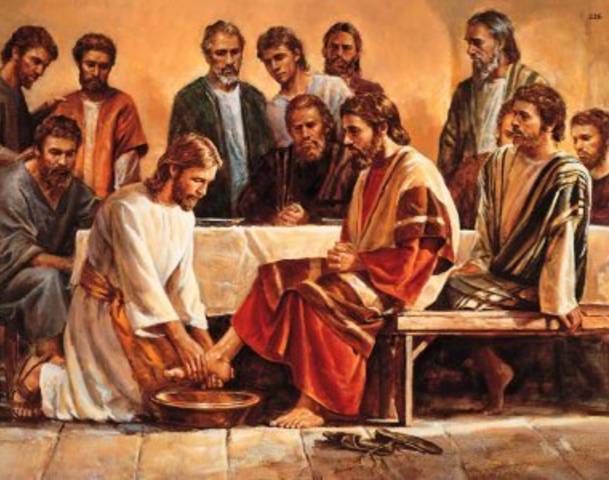
Holy Thursday: Foot Washing

Image result for foot washing rite, love, Catholic
Last night, we celebrated Holy Thursday.  We had the "washing of the feet" in one of the brother's house, but we started the celebration after the parish celebration of Holy Thursday.  As I mentioned before, some of the brothers and sisters in my community participate in the parish as Altar servers, Lectors, Eucharistic Ministers and choir members.  Last night, some of the brothers participated in the parish celebration of Holy Thursday.  

It's always nice to see the members of the NCW together with the parishioners participating in the foot washing rite in the Mass.  The participants in the foot washing, however, were all men.  In 2016, Pope Francis had reformed the ceremony of the washing of the feet during Mass on Holy Thursday by decreeing it to be open to women, too or, as he put it, "to all the members of the People of God." 

In the NCW, we had always washed the feet of both men and women even before the decree was declared in 2016.  According to an article: 
Women and men were both participating in the ancient rite long before Pope Francis arrived on the scene.
In the NCW, we would wash the person's foot and then kiss his/her foot.  The NCW teaches that the foot washing rite is an expression of service and love.  We serve others because we love them. After washing the feet of the Apostles, Christ gave a new commandment, "to love one another as I have loved you."

This foot washing rite is very beautiful especially when done with the brothers whom we often argue with.  Yes, even in the NCW communities we have arguments and judgments against each other.  After all, we are human, and we fall from time to time.  Arguments and judgments are not the miracles because anyone can argue and make judgments.  The miracle is the reconciliation and the forgiveness found in the community.  God desires forgiveness and reconciliation. The journey to holiness and salvation is a process, and the foot washing rite is a great start in experiencing love for the other.  So, brothers and sisters strengthen one another through prayer and humility. 

Friday, August 10, 2018

Pope Francis on Capital Punishment

There are some people who argue that having the death penalty is a Catholic doctrine and cannot be overturned.  See the weblink here.  The teachings of the Church have always advocated and upheld the value of human life and human dignity.  This moral teaching has not changed for over 2000 years. This moral teaching is still being taught. What has changed and can change is "tradition." Traditionally, it has been taught that the State has the divine authority to safeguard public safety even if it means to pass capital punishment. However, that trend is changing in today's society. According to Cardinal Dulles (the bold is mine):
 The respected Italian Franciscan Gino Concetti, writing in L'Osservatore Romano in 1977, made the following powerful statement:
In light of the word of God, and thus of faith, life all human life is sacred and untouchable. No matter how heinous the crimes . . . [the criminal] does not lose his fundamental right to life, for it is primordial, inviolable, and inalienable, and thus comes under the power of no one whatsoever.
If this right and its attributes are so ab solute, it is because of the image which, at creation, God impressed on human nature itself. No force, no violence, no passion can erase or destroy it. By virtue of this divine image, man is a person endowed with dignity and rights.
To warrant this radical revision one might almost say reversal of the Catholic tradition, Father Concetti and others explain that the Church from biblical times until our own day has failed to perceive the true significance of the image of God in man, which implies that even the terrestrial life of each individual person is sacred and inviolable. In past centuries, it is alleged, Jews and Christians failed to think through the consequences of this revealed doctrine. They were caught up in a barbaric culture of violence and in an absolutist theory of political power, both handed down from the ancient world. But in our day, a new recognition of the dignity and inalienable rights of the human person has dawned. Those who recognize the signs of the times will move beyond the outmoded doctrines that the State has a divinely delegated power to kill and that criminals forfeit their fundamental human rights. The teaching on capital punishment must today undergo a dramatic development corresponding to these new insights.
As a result, there has been a change to the Catechism of the Catholic Church.  According to the Catholic Education Resource Center:
In a statement published Thursday morning, the Vatican announced an emendation to the section of the Catholic Catechism that deals with the death penalty, which will now read:
Recourse to the death penalty on the part of legitimate authority, following a fair trial, was long considered an appropriate response to the gravity of certain crimes and an acceptable, albeit extreme, means of safeguarding the common good. Today, however, there is an increasing awareness that the dignity of the person is not lost even after the commission of very serious crimes. In addition, a new understanding has emerged of the significance of penal sanctions imposed by the state. Lastly, more effective systems of detention have been developed, which ensure the due protection of citizens but, at the same time, do not definitively deprive the guilty of the possibility of redemption.”
Quoting a 2017 speech given by Pope Francis during a pontifical council, the document continues: “Consequently, the Church teaches, in the light of the Gospel, that ‘the death penalty is inadmissible because it is an attack on the inviolability and dignity of the person,’ and she works with determination for its abolition worldwide.”
In a letter released Thursday, Cardinal Luis Ladaria, the Vatican’s prefect of the Congregation for the Doctrine of the Faith, characterized the change as an “authentic development of doctrine” in keeping with prior church teaching. Earlier, Ladaria wrote, more ambiguous approaches to the death penalty could be rationalized by the responsibility of governments to defend people against offenders. Ladaria confirmed in his letter that Pope Francis had specifically requested the changes.
This is not the first time that the catechism on the death penalty was changed.  According to that same article:
That said, the catechism itself is relatively recent, dating back to 1992 under John Paul II as part of a wider program to codify and clarify church teaching after the Second Vatican Council of 1962-’65. The 1992 version of the catechism noted that governments had the right to apply the death penalty under specific circumstances, but only when “bloodless means” are not “sufficient to defend human lives against an aggressor” or “to protect public order.”
In 1997, an emendation to the catechism was published under Cardinal Joseph Ratzinger (who would later become Pope Benedict XVI), clarifying that circumstances under which the death penalty might be acceptable were so rare, they were potentially nonexistent.
The final 1997 text states that the church traditionally “does not exclude recourse to the death penalty,” but with the caveat that it acknowledges the death penalty as legitimate only “if this is the only possible way of effectively defending human lives against the unjust aggressor.” However, the catechism goes on to say that in today’s society, “the cases in which the execution of the offender is an absolute necessity are very rare, if not practically nonexistent.”
The language of the latest update, therefore, builds on the 1997 document, citing, in part, the universal development of adequate prison systems as proof that the death penalty is no longer necessary in rare cases to ensure public safety.

Monday, October 10, 2016

Iuvenescit Ecclesia

The Beginning of the Year Convivience always start with the International Team.  Kiko Arguello and Father Mario gathered the Bishops and Head Catechists from the NCW to hold a convivience with them in Rome.

Father Pius was in Rome attending that convivience. He recently returned from his trip in Rome to transmit what he received to the Responsibles and Co-Responsibles.  Then the Responsibles and Co-Responsibles would transmit what they were given at the Beginning of the Year Convivience to their communities in what we call a "Transmittal Convivience."

One of the things that Father Pius shared with us at the retreat was the document "Iuvenescit Ecclesia," a document passed by the Congregation for the Doctrine of the Faith in May, 2016.  It was a letter addressed to all the Bishops of the Catholic Church.  You can read the entire letter here.  The Neocatechumenal Way is included as one of the charisms of the Church along with many others. Some people consider us a movement, but Father Pius made it very clear yesterday that the NCW is an itinerary to Christian formation.  It is similar to the RCIA program in a parish.  Its goal is to form Christians. 

This document "Iuvenescit Ecclesia" was addressed to all the Bishops of the Catholic Church.  In this letter, all Bishops and priests were encouraged to support these charisms, movements, and communities such as the NCW, the Focolare, the Charismatic Renewal, the Cursillios, etc.  The NCW is not the only one being persecuted.  Other lay movements in the Church are also feared by people because they do not understand them.  However, the Vatican insists that all these lay movements are nothing to be afraid of.  Cardinal Gerhard Muller, Prefect from the Congregation for the Doctrine of the Faith stated according to EWTN: 
The new movements, and their charisms, are good ways of responding to such challenges, he said. Parishes, religious orders, bishops, and priests should all “go together” with these new movements to meet the challenges of today.

Reflecting on the document's title, which means “The Church rejuvenates”, Cardinal Müller said the Church “is always young because we believe in the Resurrection of Jesus Christ, and therefore death cannot overcome us.” He added that the grace of the sacraments is necessary “for the renewal of our lives.”

Iuvenescit Ecclesia notes that the Holy Spirit builds up and renews the Church through both hierarchical and charismatic gifts, and focuses on the new realities which “fill the heart of the Church with joy and gratitude and are called to relate positively with all of the other gifts present in ecclesial life.”

It notes that in the New Testament, there is no “opposition between the diverse charisms … The antithesis between an institutional Church of the Judeo-Christian type and a charismatic Church of the Pauline type, affirmed by certain reductive ecclesial interpretations, in reality lacks a foundation in the texts of the New Testament.”

Sunday, May 8, 2016

The Liturgy

Throughout the centuries, the liturgies of the Catholic Church has changed.  If you do not like the way the NCW celebrates its Mass, then do not attend.  I certainly do not attend the Traditional Latin Mass, and I do not need to complain about a Mass I do not attend.  For those who are so bothered by the liturgy, you are only beating a dead horse. 

There are people who actually like the two hour Mass that we have.  In fact, you would be surprise to find that people actually stay for the entire Mass and do not leave before the blessings.  Our youth are very active in the Way, and they sit in the front, not the back. 

Not only do they participate in the Eucharist, but they are looking forward to World Youth Day, which is coming up very soon.  There are approximately 300 Guam youths going to Poland on WYD. 

Also, some are complaining that the celebration is being held on a Saturday night rather than on a Sunday.  The approved Statutes say that we can celebrate Saturday night; yet, that still becomes an issue???  If you have an issue with a Eucharist that you do not even attend, please take it up with the Vatican. 

Sunday, March 27, 2016

Regarding Kneeling

There are some people who wish to impose their liturgy on the NCW by demanding that we kneel during our celebration of the Eucharist.  According to one anonymous commenter whose comments can be found here, he/she insist that kneeling is the proper way to worship.  His/her comment are in red while mine are in black.  The comments in blue are quotes taken from Catholic documents and websites: 


It is not me that wants to impose anything on your NCW group; I would hope that the members would "want" to adore Eucharistic Jesus - "without" banning kneeling - the official position of adoration in the Roman Catholic Church. I do believe that Pope Benedict XVI and Pope Francis gave admonishment to the NCW directly and indirectly - I am just repeating their requests/correction.

Apparently, the anonymous commenter is unaware of some of the new rules that were passed after Vatican II.  According to Catholic Answers (the bold is mine):
The question of kneeling versus standing at Mass and when receiving Communion was one of the disputed questions reopened when Pope John Paul II promulgated a new, revised edition of the General Instruction on the Roman Missal (GIRM). Many liturgists today believe that kneeling is alien to modern culture and is an unsuitable posture for modern "democratic" man, even when worshiping. Standing, they say, is the "Resurrection posture." Hence many liturgists have long aimed at getting the faithful to stand, whether during the canon of the Mass, or for the reception of Communion. The idea was to establish the "custom" of standing, following which the practice could then be enshrined in the actual Church regulations governing liturgy.
Persistent liturgist influence succeeded in establishing standing as the "normal" way to receive Communion in the United States. This posture was codified in the new, revised GIRM promulgated by Pope John Paul II during the Jubilee Year 2000 (but not actually issued until March 18, 2001). Among the approved "American adaptations" to this new revised GIRM is one that specifies "the norm for reception of Holy Communion is standing" (GIRM 162:3). The text goes on immediately to say, "Communicants should not be denied Holy Communion because they kneel."
Still, the now official new rule for the reception of Communion in the United States is to receive Communion standing. The liturgists can be said to have won this particular round; their idea on the reception of Communion has now been enacted into Church law for this country.
The "norm" is no longer kneeling.  The new norm is "standing".  Nevertheless, the Catholic Church emphasized that if anyone wishes to receive the Body of Christ "kneeling", it should not deny them.  It would be wrong for a priest to demand the congregation to "kneel".  The proper way is for the priest to teach the Catholic laity that they are to stand, but if they wish to kneel....that is also okay.  It is inappropriate for a priest in the regular parish to demand that the congregation "kneel" in Holy Communion in order to protest the NEW NORM.  I hope that is not happening in Guam.  Furthermore, standing does not imply any disrespect to God.   

The website further stated (the bold is mine): 
The new revised GIRM specifies that in the United States "people should kneel beginning after the singing or recitation of the Sanctus (Holy, Holy, Holy') until after the Amen of the Eucharistic Prayer.  The faithful [also] kneel at the Ecce Agnus Dei ('Lamb of God') unless the diocesan bishop decides otherwise" (GIRM 43:3).  The fact that the bishop is given discretion in the case of the Agnus Dei means that he does not have discretion to change any of the other GIRM rules (e.g., to allow standing throughout the Mass).

The diocesan Bishop can decide whether the congregation should kneel or stand at the Ecce Agnus Dei.  In the regular parish Mass, the Archbishop allows you to kneel while in the Way, he can allow the NCW to stand.  The decision is his to make.  It was never your decision to make. 

Nevertheless, great care was taken to be in communion with the Catholic Church and the Pope.  According to Catholic News Agency,  Kiko Arguello and Pope Benedict XVI held a private meetings on May 26, 2007 regarding the celebration of the Eucharist.  If Kiko wanted to do his own thing with the Eucharist, it would not make any sense to hold a private meeting with the Pope regarding the celebration of the Eucharist. 

However, allegations of liturgical abuse were sent to the Vatican by those who oppose the Way and who wish to control the NCW.  With a letter personally written to Cardinal William Levada, Pope Benedict XVI then ordered the Congregation for the Doctrine of the Faith to examine whether the Neocatechumenal Way Massses were in keeping with the liturgical teachings and practice of the Catholic Church. In January, 2012, Pope Benedict XVI launched an investigation into the NCW.

In February, 2013, Pope Benedict XVI resigned and a new pope was chosen.  Then in 2014, Pope Francis dismissed all investigations into the Way.  The investigations, which started in 2012 was dismissed after 2 YEARS!!!!  And within those two years, what was found?  Nothing!  It was dismissed by Pope Francis and guess what????  In that SAME YEAR, Pope Francis confirmed Kiko Arguello for five more years as Consultor for the Pontifical Council for the Laity.  Yes!!!  In that very SAME YEAR, Pope Francis dismissed all investigations into the Way and Kiko Arguello was confirmed for another five more years as Consultor.  If those allegations were actually true in that Kiko has misled the LAITY, it would not make any sense at all for Pope Francis to award Kiko Arguello to take part in the Pontifical Council of the LAITY. So much for the liturgical abuse allegations against the NCW. 

The reason for Rome's silence to your letters is due to the fact that the allegations of liturgical abuse against the NCW have proven to be unfounded.  After two years of investigation, it was dismissed.  However, if you still feel that the NCW is practicing liturgical abuse, then write your letter of complaint to Rome.  You are only making the SAME allegations against the Way. You can even tell them to open up a new investigation if you want, considering that you think you know better than the Pope who dismissed two years of investigations.

And, I did look up kneeling in the Eastern Churches - there are many that do the prostrations. Perhaps, those that are doing the prostrations "want" to adore like those in Revelation?? Peace  

I highly doubt that you bothered looking into the Eastern Catholic Churches regarding kneeling.  A person whose only purpose is to impose "kneeling" into the NCW and even in the regular parish church is more concern with his/her agenda rather than the truth.  According to EWTN:
Thus a Latin Catholic who wishes to attend one of these rites should acquaint himself with the basic practices and demands of the rite and adapt himself accordingly. For example, most Eastern rites remain standing for most of the celebration and do not kneel for the consecration; a Latin should respect this tradition. 

Monday, March 14, 2016

The Real Presence Of Christ

In persona Christi
The following article came from Catholic Online (a CATHOLIC website). The article below is not saying that Christ is NOT present in the Eucharist.  He is truly present in the Eucharist - body,  blood, soul, and divinity.  But the Church also teaches that the real presence of Christ is not limited ONLY to the Eucharist alone (See the Constitution of Sacred Liturgy and Pope Paul VI's encyclical, "Mysterium Fidei").  The article below never disputed that Christ's body, blood, soul, and divinity is truly present in the Eucharist. What it brings out is the Church's teaching that Christ's real presence is not limited ONLY to the Eucharist. Catholic Online is also not a "Neo-website."

The NCW believes in Transubstantiation.  We believe that the bread and wine becomes the actual Body and Blood of Christ after the priest consecrates it.  We believe that we are eating the true flesh of Christ so that His flesh becomes one with our flesh.  We believe that the Blood of Christ flows in our veins after we consume His Blood.  We also believe that Christ is also present in the Mass, in the ministering priest, and in His Church.  For example, in the Sacrament of Reconciliation, it is Christ Himself who forgives our sins.  The priest becomes "in persona Christi"  in the Sacraments.  It is also Christ Himself who proclaims the Gospel reading in the Liturgy of the word during Mass. 

According to Catholic Online (the bold is mine):
  
Real Presence is NOT limited to the Eucharist.  There are "four modes" of Real Presence: Christ is present not only in the Liturgy of the Eucharist but also in the Liturgy of the Word, the priest who celebrates, and in the people gathered together during the Mass. In pointing to these other modes of Real Presence, I am neither trying to pit the contemplative against the communal, nor create a dichotomy where one does not exist, nor deny the supremacy of the Eucharistic presence in the way Christ presents Himself to us.  I'm merely asking that we recognize, given these various modes of Real Presence, the importance of seeing parish life, indeed the experience of the Mass itself, as involving a "people" and not a collection of monadic individuals who just happen to be sitting in the same building at the same time. 

WASHINGTON, DC (Catholic Online) - Having read through the comments to my article, How Catholics Have Failed the Culture, I've noticed one repeated theme that deserves addressing. 
 
A number of commenters wrote eloquently about the Real Presence of Christ in the Eucharist and how the contemplation of that Presence in prayer and liturgy more than compensates for the lack of fellowship in the parish community. In fact, several suggested the demands of fellowship would demean contemplation and prayer.  All these commenters imply that my expressed desire for greater "community" would be better fulfilled by the contemplation of the Eucharist

I both understand and appreciate that point of view -- it comes from the heart of the Church and makes the Catholic faith distinctive among Christians around the world.  However, it contains a misunderstanding, one that may be actually encouraging the very problem I addressed in the previous article: the paucity of most parish life in the United States, the lack of welcome, of felt connection between parish members.

The misunderstanding is about the Church's teaching on Real Presence itself -- Real Presence is NOT limited to the Eucharist.  There are "four modes" of Real Presence: Christ is present not only in the Liturgy of the Eucharist but also in the Liturgy of the Word, the priest who celebrates, and in the people gathered together during the Mass.

The Church's teaching on the four modes of Real Presence can be found in the Constitution of Sacred Liturgy (#7):

"To accomplish so great a work, Christ is always present in His Church, especially in its liturgical celebrations. He is present in the sacrifice of the Mass, not only in the person of His minister, "the same now offering, through the ministry of priests, who formerly offered Himself on the cross," but especially under the eucharistic elements. By His power He is present in the sacraments, so that when a man baptizes it is really Christ Himself who baptizes. He is present in His word, since it is He Himself who speaks when the holy Scriptures are read in the Church. He is present, lastly, when the Church prays and sings, for He promised: "Where two or three are gathered together in my name, there am I in the midst of them" (Mt 18:20).

In 1965, Paul VI's encyclical, "Mysterium Fidei," underscored what this manifold presence of Christ is to His Church.  I call your attention to the section where he talks about the "people of God":

"He is present in His Church as it shepherds and guides the people of God, since the Church's sacred power comes from Christ and since Christ, "the shepherd of shepherds" (Idem, In Ps 86, 3: PL 37, 1102), is present in the shepherds who exercise that power, according to the promise made to the apostles" (#37).

It's crucial to note that Paul VI refers to the Real Presence of Christ during the sacrifice of the Mass as a "manner more sublime" since it fills "the mind with wonder and presents the mystery of the Church for contemplation" (#38). Paul VI in a later paragraph calls it Real Presence "par excellence"!

Thus, in pointing to these other modes of Real Presence, I am neither trying to pit the contemplative against the communal, nor create a dichotomy where one does not exist, nor deny the supremacy of the Eucharistic presence in the way Christ presents Himself to us.  I'm merely asking that we recognize, given these various modes of Real Presence, the importance of seeing parish life, indeed the experience of the Mass itself, as involving a "people" and not a collection of monadic individuals who just happen to be sitting in the same building at the same time. 
 
How this recognition impacts our attitudes toward parish life, or our attempts at its revitalization, is not spelled out anywhere I know, nor need it be.  Part of the genius of the Church is its universality, its accommodation to every kind of existing person, regardless of station, language, education, and personality. 

This latter factor -- personality -- is often overlooked when discussions of liturgy and parish life are discussed.  It's common sense, at least to me, that people of differing personalities are going to respond more immediately to differing modes of Real Presence: To those who are contemplative, the Eucharist; to those who are social, the people of God; and so forth. 
 
When it comes to the Liturgy of the Word, the reading of Scripture and its exposition in preaching is often lackluster, so there is another group not being fed. "Being fed" is a phrase I have chosen deliberately because the Church, if it's truly a feminine body, should be nurturing, it should feed its people. But our Church, the historical Church and its parishes, are not very nurturing in my experience and the experience of many others. 

This lack of nurture needs to be addressed, immediately and explicitly.


http://www.catholic.org/homily/yearoffaith/story.php?id=51277


Thursday, January 14, 2016

The Three Altars

An anonymous commenter asked the following questions, which I am happy to explain:

Dear Diana, Can you explain what do you mean by "three" altars? Why is the marriage bed and dining table considered an altar? And how are these two altars related to the Eucharist in the Mass?
 
In addition to the Eucharist being a sacrifice, it is also a meal.  The Eucharist is also called "The Last Supper."  In every Catholic home, the painting or icon of "The Last Supper" is always in the dining room.  Why?  Because it recalls to our mind the last supper of Jesus and His Apostles when He instituted the Sacrament of the Eucharist. The dining table is linked to the Eucharist in the Mass.  Just as God's family gather together in the banquet of the Mass to eat His Body and drink His Blood, so does the human family gather together around the dining table in a meal.  According to the Catholic Exchange website: 
In this way, a Catholic family is much like a Catholic church. In this domestic church, as in the parish church, an atmosphere of truth and friendship is fostered, assisted by art and ritual, and ordered intrinsically to the worship and service of God. Like any parish, a family is a community devoted to each other through Christ and for Christ. Members of a church gather at a table for a meal, for Communion, just as members of a family gather at a table for a meal, for communion. The power and potency of the family meal is a sign and source of wellbeing in Christ.
The Dining Room Altar

In the NCW, we are taught to eat our meals together as a family just as God's family eats together in a parish community.  Unfortunately, many families are split during meal time.  Rather than sitting at the family table for dinner, the father would eat his dinner in the living room watching the football game on TV.  Mother would be eating her dinner at the dining room while the children eat their dinner separately in their bedrooms. 

In the NCW, families are taught to eat their meals together at the dining table without any distractions (such as cell phones, TV, etc.).  They are instructed to use real china instead of paper plates during meals.  A family that prays over their meals together and dines together stays together. Thus, this dining room table is an altar in the domestic Church of the family and linked to the Eucharistic celebration of the Mass.  

The Eucharist is also called a "nuptial sacrament."  According to the Catholic Liturgical Library: 
27. The Eucharist, as the sacrament of charity, has a particular relationship with the love of man and woman united in marriage. A deeper understanding of this relationship is needed at the present time. (83) Pope John Paul II frequently spoke of the nuptial character of the Eucharist and its special relationship with the sacrament of Matrimony: "The Eucharist is the sacrament of our redemption. It is the sacrament of the Bridegroom and of the Bride."......... The Eucharist inexhaustibly strengthens the indissoluble unity and love of every Christian marriage. By the power of the sacrament, the marriage bond is intrinsically linked to the eucharistic unity of Christ the Bridegroom and his Bride, the Church (cf. Eph 5:31-32).

Catholic Liturgical Library

St. John Paul II taught that the Eucharist is a sacrament between the Bridegroom (Christ) and of the Bride (the Church).  At the Eucharist of the Mass, when we eat His Body and drink His Blood, we become one with Christ, physically and spiritually.  

The union between man and woman in the marriage bed brings life (in this case a human baby).  But the union between Christ (the bridegroom) and the Church (the bride) brings eternal life (John 6:54).  Thus, the Eucharist in the Mass is called a "nuptial sacrament" because it brings into union Christ and His Church.  In other words, we become one with Christ when we eat His Body and drink His Blood at the altar.

In the human family, which is the domestic Church, the marriage bed is the third altar.  In many Catholic homes, a crucifix or cross is usually hung over the bed. This third altar recalls the marriage between Christ and His Church just as the second altar recalls the Last Supper of Christ and the Apostles. 


Tuesday, October 27, 2015

Mass Facing The People

The following was made by an anonymous commenter in my last entry post: 

Tim is absolutely correct about those list of issues. None of them were endorsed by Vatican II, but most people think they were.

Parishes have been conditioned to accept a "banal" liturgy (as Pope Benedict put it). The NCW Eucharist is just the exaggeration (to the point of heresy) of these errors.
 
The anonymous commenter was referring to Tim Rohr's criticism of the Novus Ordo Mass.  According to Tim Rohr: 
 
For those who want to know more truth, here's a list of other documents to ask your pastor for:
  • Mass facing the people.
  • Communion in the hand.
  • Saturday night Mass.
  • Communion standing instead of kneeling.
  • Regular use of Eucharistic Ministers.
  • Removal of the high altar in favor of a "table".
  • Pop music in the liturgy.
  • Full use of the vernacular in the liturgy. 
  • "Liturgical dance"(always forbidden)
There are actually documents for some of these things. BUT NONE OF THEM ARE IN VATICAN II. And in fact, when you actually read them, you will be amazed at how these things came about. As an example read Paul VI lament over permitting communion in the hand. He was horrified by the potential for abuse. 
 
 
This is my response: 
 
As one can see, Tim Rohr is also against the regular parish Mass.  While it is true that many of those things mentioned are not found in the 16 documents of Vatican II, some of them were NOT invented AFTER Vatican II.  Let us look at the first item the jungle mentioned: Mass facing the people. 
 
According to the weblink I provided below (bold is mine): 
Though the priest celebrating Mass facing the people was not mentioned in the Council’s Constitution on the Liturgy (SC), permission was included in the 1964 Instruction Inter oecumenici, in a section on “Designing Churches and Altars to Facilitate the Participation of the People”:............... 
Setting up a new, temporary altar in order to be able to celebrate Mass facing the people is never mentioned. 
Many Catholics think that Mass facing the people was an innovation of Vatican II. However, liturgists had been arguing for decades that it was permitted by the rubrics of the older Missal. 
For example, in 1937 Orate Fratres published a question about an earlier article that mentioned a Mass said by a priest facing the congregation, and asked about the justification for this practice. The response said that it was the current custom in St. Peter’s Basilica and other Roman churches for the priest to face the people because of the location of the altar, and that there were specific rubrics for the Mass instructing the priest what to do in such cases. It concluded: 
Not only, therefore, does no Church law or rubric forbid the construction of altars at which the celebrant faces the people as of old, but the present rubrics, as quoted above, still make provision for Mass celebrated at such an altar. (Orate Fratres, April 18, 1937, p. 280.) 
The Day The Mass Changed Part I

The Day The Mass Changed Part II
 
As you can see, before Vatican II, it was the current custom in St. Peter's Basilica and other Roman churches to face the congregation because of the location of the altar, and there were already specific rubrics for this particular Mass.  The instruction Inter oecumenici, which mentions a Mass facing the people was written in 1964 and also mentioned in a Vatican document Liturgiam authenticam, (the bold is mine):
 
 On 4 December 1963 the Fathers of the Second Vatican Council approved the Constitution on the Sacred Liturgy, Sacrosanctum Concilium.In order to facilitate the implementation of the liturgical renewal desired by the Council Fathers, the Holy See has subsequently published five documents of special importance, each successively numbered as an "Instruction for the Right Application of the Constitution on the Sacred Liturgy of the Second Vatican Council".  

The first of these, Inter Oecumenici, was issued by the Sacred Congregation of Rites and the "Consilium" for the Implementation of the Liturgy Constitution on 26 September 1964, and contained initial general principles for the orderly carrying out of the liturgical renewal.
http://www.vatican.va/roman_curia/congregations/ccdds/documents/rc_con_ccdds_doc_20010507_comunicato-stampa_en.html

According to Inter Oecumenici (bold is mine): 
91. The main altar should preferably be freestanding, to permit walking around it and celebration facing the people. Its location in the place of worship should be truly central so that the attention of the whole congregation naturally focuses there.
Inter Oecumenici 

In conclusion, the Mass facing the people was a practice already taking place in some Roman churches and was spoken about in Vatican II despite that it is not in one of the sixteen documents.  It did not have to be in any of those 16 documents because it was implemented as one of the five "instructions for the Right Application of the Constitution on the Second Liturgy of the Second Vatican Council (See weblink below):

http://www.vatican.va/roman_curia/congregations/ccdds/documents/rc_con_ccdds_doc_20010507_comunicato-stampa_en.html

It is clear that the jungle opposes the regular parish Mass by planting seeds of doubt into the Catholic faithful in order to promote the Latin rite Mass. Rohr feels that only the Latin rite Mass shows more reverence for God than any other Catholic Mass.