Monday, February 25, 2019

Discovering the Way with St. John Paul II

Father Neil Xavier O'Donoghue was in Guam several times, and he made the news.  You can find the news report in the Irish Catholic:

------------------------------------------------------------------------------------------------------------

Discovering the way with St John Paul IIĆ¢€™s help
Dr Neil Xavier O'Donoghue meeting Pope Francis.
Chai Brady speaks to a renowned Catholic academic about his life and Faith
 “Do not be afraid to be holy” was then Pope John Paul II’s message to pilgrims during World Youth Day in 1989, and that struck a chord with a young man soon to enter seminary.
Dr Neil Xavier O’Donoghue, now a lecturer of Systematic Theology in St Patrick’s College in Maynooth, was “impressed” by what St John Paul II said.
“That was his refrain there, and to see that Christianity was an option to me, I see that a vocation is a vocation to Christianity not to the priesthood per say. The main vocation is to Holiness, within that you have to discern what it is, and I discerned that it was a vocation to the priesthood,” he said.
However, this wasn’t the only thing that helped him on his Faith journey.
Serious
Growing up in Ballincollig, Co. Cork, the eldest of two brothers and a sister, Dr Neil became more serious about his Faith after his teenage years.
“I suppose it was at the World Youth Day in Santiago Del Compostela, which was just after my Leaving Cert before starting in UCC. During that year I was discerning and I saw the vocation more clearly at the end of that year,” he said.
He joined the Neocatechumenal Way, a charism in the Church dedicated to Christian formation. After that pilgrimage in Spain with the group’s youth community and the then Pope’s message, he had a vocational meeting.
His US adventure began when he was chosen at random to go to New Jersey. “I was 18 at the time, it was an adventure it was no problem. At the time I didn’t know which side of the US New Jersey was on, but I was up for it,” he said.
Dr Neil spent 10 years as a seminarian in the Redemptoris Mater Seminary in Newark. Five of those years were spent as a missionary in Atlanta, Miami and Washington DC.
Seminarians
It was in 2013 that Cardinal Brady asked his bishop in the US, Archbishop John Myers at the time, to borrow him to help establish the new Redemptoris Mater Seminary in Dundalk and “get it off the ground”. He had already taught seminarians in the US for 11 years and went on to spend five years teaching seminarians in Dundalk.
Archbishop Myers agreed and it was back home for Dr Neil who served there as Vice Rector of the seminary of the Archdiocese of Armagh and as a curate in a number of parishes in Dundalk and south Armagh.
Discussing the differences between working as a priest in Ireland and the US he said that ultimately there was very few.
“People are more or less the same on one level, on another level I think the Church is a bit different in the States because it is bigger so you have more room for variety whereas here you have a one size fits all reality. In the States different parishes have a difference emphasis, they have that advantage over us I suppose,” he said.
Dr Neil then decided to move into academics after a discussion with his archbishop, Cardinal Joseph Tobin CSsR of Newark.
He said: “I’m settling into the job here I’ve written a lot about the Church in early Ireland, about the way the Eucharist was celebrated. My doctorate was in the Eucharist in pre-Norman Ireland and so I’ve done some work on that and on liturgical renewal in general.”
Teaching systematic theology, he says the ultimate question within students is whether the Good News is real.
“That’s the ultimate question, is all this real? That is the question that each students has to answer for themselves above and beyond the actual mechanics of getting a degree in theology,” he said.
Dr Neil also writes a monthly column for the Messenger of St Anthony where he focuses on the theology of the Pope.
Speaking about the topic he found most interesting related to his writings on the Pope he said: “I suppose it would be his emphasis on forgiveness which would be the most important one with Pope Francis, I suppose the power of Confession is a big deal with him.
He also does some blogging on praytellblog.com, which is sponsored by the Benedictine Abbey of Collegeville and is the author of several books.

Wednesday, February 20, 2019

Congratulations to Jose Santos

Once again, a former RMS seminarian from Guam have been ordained into the priesthood. Father Jose Santos who worked in the Asan parish for a long time has been ordained a priest in Mexico.  Some of the brothers in the Asan community were present during his ordination.  Father Jose could have been ordained a priest in Guam for Guam, but this turns out to be another loss for Guam.  Congratulations to Father Jose Santos.  


Sunday, February 17, 2019

The Pennsylvania Grand Jury Report

The following article was written by Father Peter M.J. Stravinskas in These Stone Walls, which you can find here.

-----------------------------------------------------------------------------


The Pennsylvania grand jury report is misleading and had an agenda. One observer noted, “This report should not have been on a news channel, but on the History Channel.”
Some readers found my article, “PA Attorney General Josh Shapiro in ‘The Reckoning’” to be explosive. If true, it deals with a subject that needs to be exploded instead of exploited. The truth is that you have not been told the truth in that now infamous Pennsylvania grand jury report. At the end of my article I suggested some further reading. I also promised that this week on These Stone Walls a prestigious guest will offer the most compelling challenge of all to the distortions you and your Church have been subjected to.
It is a great honor this week to present this analysis by Father Peter M.J. Stravinskas, one of America’s foremost theologians and Catholic editors. Father Stravinskas presents a riveting and highly revealing analysis of the Pennsylvania report conducted by the Philadelphia law firm of Roca Rothberger Christie, LLP. His summary is the most concise and compelling of all the commentary I have read in these troubled days of persecution.
Father Peter M.J. Stravinskas is the founder of The Catholic Answer and is currently Publisher and Editor of the superb bimonthly journal, The Catholic Response. He earned a B.A. in Classical Languages, Masters degrees in both School Administration and Biblical Theology, a Doctor of Philosophy in School Administration from Fordham University, and both a Licentiate and Doctor of Sacred Theology from the Marianum in Rome and the Marian Institute of the University of Dayton.
I am so pleased to present this guest post by Father Stravinskas. His conclusion is that we must not be silent in the face of persecution. Please share this post with others.


DUC IN ALTUM: PUT OUT INTO THE DEEP
On August 14, the Attorney General of Pennsylvania, Josh Shapiro, released the findings of a grand jury investigation into cases of alleged sexual abuse of minors by Catholic clergy in six dioceses of the Commonwealth (the Archdiocese of Philadelphia was not included since it had undergone a similar review earlier). It was the report “heard ‘round the world.” Most people do not realize that a grand jury report is just that – a report, which provides details of allegations and accusations, which may or may not be true, which may or may not be prosecutable. In addition to the sensationalistic and prurient language of the report, it was released by Shapiro in such a way as to suggest that these accusations were all verifiable crimes and that they were current events. As one commentator put it, this report should not have been on a news channel but on the history channel.
At the time of the report’s release, in various articles and in interviews, I asked why the dioceses of Pennsylvania had not gotten out ahead of its formal presentation (since they knew it was coming and likewise knew that it would lack balance and accuracy). Somewhat belatedly, but thankfully, the Archdiocese of Philadelphia contracted the services of the law firm Lewis Roca Rothgerber Christie LLP to provide a professional analysis of the report. Below you will find my redaction of that analysis (shortened for space considerations), but providing its principal findings. After reading that, I would invite you to move down to some concerns and suggestions I offer for the Church in the United States (and beyond) to consider about how to proceed with further reform (yes, much reform has already occurred – although you would never know that from the way the issue is handled by the secular media).
Statistical Analysis of Information Contained in the
August 14, 2018, Pennsylvania Grand Jury Report
In order to properly understand the import of the Grand Jury Report (the “Report”) and what the Report says about the Catholic Church in Pennsylvania, it is necessary to understand its allegations in the proper factual context. To help supply this context, this document provides a statistical analysis of the Report and provides relevant information about other studies of child sexual abuse.
At the outset, it is important to note that the Report, while lengthy, is frequently vague and lacking in detail. For purposes of this statistical analysis, this document focuses on factual information related to 680 separate allegations of abuse over an 84-year period (1934 to the present). The details surrounding the remaining victims identified in the Report are so deficient (including critical facts like dates of the alleged abuse) that they could not be included in this analysis. In addition, in light of due process concerns acknowledged by the Pennsylvania Supreme Court, the Report was released in redacted form.
The following facts are significant:
  • The Report has not identified any priests with substantiated claims of sexual abuse of minors who are still in active ministry. While the status of several priests named in the Report remains unknown, based on follow-up reports from various dioceses, we have only been able to identify three priests accused of sexual abuse in the report who remain in ministry. These three priests are from the Diocese of Pittsburgh, and they are listed by the Diocese as people who have been accused of sexual abuse, but the allegations were not substantiated.
  • Of the 680 alleged victims whose claims were tied to specific years, only 23 claim they were abused after the USCCB adopted the Charter for the Protection Children and Young People in 2002 (the “Charter”).
  • The average year each alleged incident of abuse in the Report ended was 1979. Stated differently, the average incident of abuse alleged in the Report is now 39 years old.
  • Much of the information in the Report has been publicly known for years.
  • Of the 301 priests identified in the report as having allegedly sexually abused a minor, 140 are now deceased.
  • Many of the alleged incidents of abuse occurred many decades ago. For instance, the Report references a victim alleging he was abused in the 1930s. The victim first reported the alleged abuse in 2008 when the victim was 80 years old. The accused priest was born in 1892 (the year Grover Cleveland was elected President) and was ordained in 1922. The priest was long deceased when the allegations against him were first reported.
  • It is important to note that the Report includes all allegations of abuse the government found in the course of its two-year investigation, including many allegations that the Report recognized as not credible. While the media has generally claimed that all of the allegations in the Report were proven true, other reports of child abuse or child sexual abuse regularly report that only a subset of allegations are found to be substantiated:
    • The 2004 John Jay report, which covered a similar time frame as the Report (1950-2002), stated that out of 10,667 alleged incidents of sexual abuse of youths, only 4,570 (less than half) were deemed substantiated.
    • The Pennsylvania Department of Human Services only substantiated 10% of the 44,000 statewide reports of child abuse received in 2016. Of the 2,602 reports of child abuse in child care settings, only 7% were substantiated.
    • In 2017, state authorities substantiated only 18 of the 280 (6.4%) reports of abuse filed against Philadelphia school employees.
    • While the Attorney General acknowledged that child sexual abuse is a broad societal problem (expressly including schools, physicians’ offices, and public officials), and claiming an interest in eradicating child sexual abuse throughout society, Shapiro did not ask all victims of abuse to come forward. Instead, he only encouraged those who had been sexually abused by a Catholic priest to contact the “Clergy Abuse Hotline” his office has established.
    • This myopic focus on abuse within the Catholic Church stands in the face of the available data, which shows overwhelmingly that the sexual abuse of minors is a much bigger problem outside the Church. This is true within Pennsylvania and nationally.
PENNSYLVANIA COMPARISONS:
  • Since 2002, more than 600 school teachers in non-Catholic schools in Pennsylvania have been disciplined in connection with abuse or otherwise inappropriate behavior with children. This includes more than 50 school teachers in 2018 alone.
  • In 2016, the year the Grand Jury began its investigation, the Pennsylvania Department of Human Services identified 3,078 substantiated allegations of sexual abuse during the calendar year. This is more than three times the number of total allegations against the Catholic Church (substantiated and unsubstantiated) identified by the Grand Jury over an eighty-year time span.
  • The same year, Pennsylvania’s Sexual Offenders Assessment Board received 1,195 founded or indicated reports on 940 perpetrators, an 11.5% increase over 2015.
NATIONAL COMPARISONS:
  • What is true in Pennsylvania is also true on a national level. Evidence shows that sexual abuse of minors is a huge epidemic that touches every major institution in society. Further, by all accounts, few institutions have done as much as the Catholic Church to learn from past failures and take steps to prevent abuse going forward.
  • Nationally, 24.7% of women and 16% of men experienced sexual abuse during their childhood.
  • 33% of those who sexually abuse minors are the victim’s parents; 58% are an acquaintance of the victim; 4% are strangers.
  • Over twenty years, at least 368 gymnasts accused their USA Gymnastics coaches of sexual assault. Two former USA Gymnastics officials admitted under oath that the organization “routinely dismissed sexual abuse allegations as hearsay unless they came directly from a victim or victim’s parent.” USA Gymnastics “acknowledged in court records that it seldom, if ever, forwarded allegations of child abuse to police or child protective services without being asked.”
  • Between 1971 and 1990, 1,151 Boy Scouts reported being sexually abused by their leaders. Over the same time-span, 416 Scout leaders were either arrested or banned from Scouting for sexual abuse of Scouts. Experts believe that the real number of abusers and victims was probably several times higher.
  • Insurance companies receive around 260 reports per year of sexual abuse of a minor in U.S. Protestant churches. This annual number is more than the total accusations against Catholic clergy since 2005.
  • Nearly one in ten public school students suffers sexual harassment, rape, or sexual abuse at the hands of a public school teacher.
  • 290,000 students experienced some sort of physical sexual abuse by a public school employee from 1991 to 2000. By contrast, the first John Jay study found 10,677 allegations of abuse against priests and deacons over a much longer time-frame, 1950 to 2002. Based on these numbers, the study’s author said that “the physical sexual abuse of students in schools is likely more than 100 times the abuse by priests.”
  • By way of contrast, in 2017 the USCCB’s independent auditor found only 24 allegations that current minors were sexually abused, only six of which were substantiated by the close of the audit cycle.
Having an objective review of that most damaging grand jury report, we should be able to come to some conclusions and a plan of action.
While we must condemn any sexual abuse of vulnerable people by clergy (or anyone else), a few points need to be made. First, since 2002, it is fair to say that the safest place for a child to be is in any Catholic institution – and the statistics bear this out. In this regard, see the excellent article published on December 2nd by The Media Report which notes, among other statistics, that in less than three months, the Chicago Public Schools office has received over 600 allegations of sexual abuse. Now, in fairness, an allegation is just that. However, even if we take half that number, we are left with a monthly average of 100 abuse allegations in just a single public school system (see “Sex Abuse in Chicago Schools”).
Indeed, the Church could offer valuable counsel to all kinds of organizations on how to protect minors from sexual predators. Second, it is patently unfair to accuse Church officials of “coverup” due to confidentiality agreements. In point of fact, when an out-of-court settlement is reached, a confidentiality agreement is standard procedure. Readers of TCR will recall that I have consistently opposed out-of-court settlements for a variety of reasons, however, if that route is taken by a victim’s legal team, then one should not balk at it years later.
Presently, attention is focused on episcopal accountability. In 2002, when the United States Conference of Catholic Bishops promulgated the so-called “Dallas Charter,” a notable absence
from the Charter’s sanctions was the bishop. That lacuna is now being addressed, both in terms of episcopal sinful and criminal activity and episcopal nonfeasance (that is, failure to deal with
abuse problems according to the norms of both civil and canon law).
Suggestions (and demands!) have come from all quarters. Some of these have been very thoughtful and helpful. Some have been well-intentioned but misguided. Some who have advanced remedies have a distinctly anti-clerical and even anti-Catholic bias; they are not reformers but revolutionaries, out for red meat. We need to remember that revolutions never end well. Anger and a hidden agenda spell doom for any possible good that could emerge.
“Off with all their heads!” is neither human nor Christian. That mentality has caused not a few innocent priests to be unfairly tried in the court of public opinion since 2002; regrettably, very few bishops have come to their defense out of fear of bad press. Now, some of those same people are coming after the bishops, predictably. One of the “reforms” put forward is that oversight of accusations of clerical abuse (whether by priests or bishops) be handed over to civil authorities. Is this something we really want? Let’s consider the prospects for justice.
– As you should have seen from the very detailed analysis of the Pennsylvania grand jury report above, the goal was not justice; slander, scandal and defamation were. Interestingly, that same Attorney General has now shown his hand completely by filing a challenge to President Trump’s final religious exemption rules, which guarantee freedom of conscience. Shapiro also continues his legal harassment of the Little Sisters of the Poor.
– In every jurisdiction where the statute of limitations has been rolled back, the only entity to come under the gun has been the Catholic Church. Jurisprudence has valued the statute of limitations for centuries for very good reasons. If, however, it is revoked or set aside for a period of time, why is that window of opportunity for litigation not extended to all potential institutions harboring abusers, starting with the public schools?
– The unbelievably biased procedures against Cardinal George Pell in Australia, violative of all principles of fairness and transparency, give new meaning to “kangaroo court.” Such judicial behavior has not been limited to “the Land down Under”; we have had numerous examples of it here in the United States. As Arthur Schlesinger asserted, “Anti-Catholicism is the deepest-held bias in the history of the American people.”
If society-at-large and legislative bodies, along with judiciaries, were truly concerned with the welfare of minors, their laser would not be exclusively focused on the Catholic Church. The real goal, of course, is to discredit the Church’s moral standing since hers is nearly the only voice raised in the culture wars – speaking out in opposition to abortion, same-sex unions, euthanasia, and further drifts into secularization.
A well-regarded motto urges: “Ecclesia semper reformanda” (The Church is always in need of reform). Reform, not revolution. Luther’s initial challenges were for reform; he and his movement descended into the realm of revolution, throwing out the baby with the bath water. Genuine reform must be grounded in a true love for the Church and in rational proposals that take all dimensions of a problem into account. Lay review boards for clerical abuse have functioned very well for the past seventeen years; a variation on that theme for episcopal accountability should do as well. St. Thomas Ć  Becket, St. John Fisher, Cardinal Mindszenty and Cardinal Stepinac didn’t do very well at the hands of civil authorities. We need to learn from history, lest we repeat its mistakes.
Most of you good readers are not blogging your discontent; you are too busy leading a Gospel-inspired life. When the Church is unfairly targeted (unfairly, not fairly), you need to raise your voice in her defense. You should also give strong support to good priests and bishops (who are in the majority). Last but not least, you must pray for the purification of the Church in her head and members – a painful but necessary process that must take place in every age. If you do these things, you will duc in altum.
Father Peter M. J. Stravinskas
Editor and Publisher

Monday, February 11, 2019

From Cardinal Sean's Blog


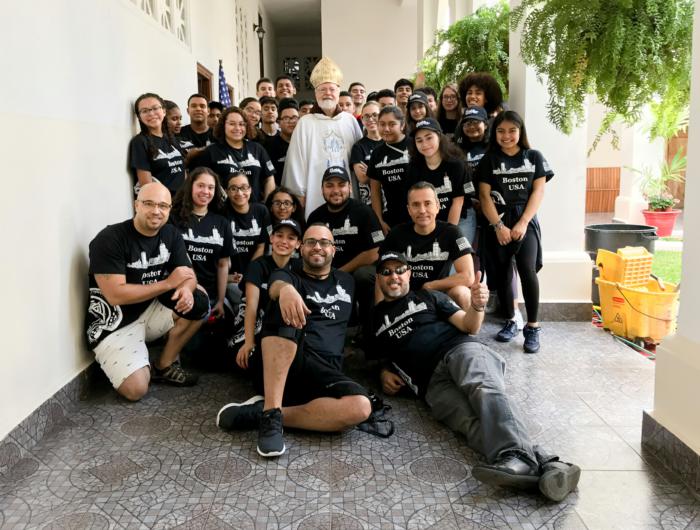
Cardinal O'Malley celebrated Mass with pilgrims from Boston before the vigil with the Holy Father in Panama City. Pilot photo/CardinalSeansBlog.org


From Cardinal Sean's Blog

As I left off last week, the Holy Father was just arriving in Panama to attend World Youth Day.

Of course, there were a number of events connected to his welcoming and arrival, and the Holy Father's talks, particularly on Friday, were beautiful.

There were about 30 American bishops with us in Panama and, as I mentioned last week, the U.S. had the largest delegation of any single nation at World Youth Day, except, of course, for Panama.

The theme was "Be It Done to Me According to Thy Word," and they even had rubber wrist bracelets with that phrase on them.

Mass with pilgrims from Boston

On Saturday morning, before the vigil with the Holy Father, I gathered with all the pilgrims from Boston attending World Youth Day at the Church of Our Lady of Carmen, a beautiful Carmelite church in the center of Panama City.

In addition to the group traveling with the archdiocesan pilgrimage, there were parish groups from Revere, Lowell, Marlborough, East Boston, and the cathedral, who are part of the Neocatechumenal Way, the LifeTeen Group from Hanover and Norwell, and a group from the Brazilian community at St. Tarcisius Parish in Framingham.

There were about 200 pilgrims from Boston with us at the Mass -- more than I had been expecting.

Meeting with Pope Francis

On Saturday afternoon, we gathered with the Holy Father at Metropark. We were blessed with the weather because, although it was hot, we had no rain.
The vigil on Saturday evening was impressive. There were a number of testimonies given by individual young people about their faith. There was also a testimony of a family, who spoke about their daughter who has Down syndrome.

There were several musical numbers and then the Holy Father gave a talk, which was followed by adoration of the Blessed Sacrament.

It was inspiring to see hundreds of thousands of young people in complete silence during the adoration.

Then, throughout the night, they had concerts and prayers.

Our pilgrims from Boston stayed overnight on the site, though we bishops headed back into the city until about 3:00 a.m., when we headed out again to attend the Sunday morning Mass.

There was a crowd of about 700,000 people for the Mass. The music and the participation were, as always, very moving.

At the Mass, they had relics of Archbishop Oscar Romero, who was one of the patrons of this World Youth Day.

At the Mass, I met the pastor of Easter Island, Father Bernardo, who sought me out. He himself is a member of the native peoples of Easter Island, the Rapanui, and told me he is the only Rapanui priest in his archdiocese.

He introduced me to one of his Rapanui parishioners who was with him, as well.

They gave me a necklace and a flag because they knew that Easter Island was my first assignment and they are still waiting for me to come and be the assistant pastor there.

As we concluded, the Holy Father made the announcement that the next World Youth Day will be held in Lisbon, Portugal.

There were a number of Portuguese there, including the patriarch of Lisbon and the head of the Portuguese bishops' conference.

I spoke to the patriarch, and he told me that there is great excitement in Portugal over hosting World Youth Day in 2022. He told me that one of the ideas he has is to reach out to the Portuguese speaking countries in Africa and, hopefully, bring many young people from that part of the world. They also have a close relationship with Cape Verde and Brazil.

The presence of Fatima also makes Portugal an attractive location for World Youth Day.

Scottish Pilgrims in Panama

More stories from the World Youth Day in Panama are coming in.  The next world youth day was also announced in Panama....Portugal.  The following article can be found here.
-------------------------------------------------------------------------------------------------------

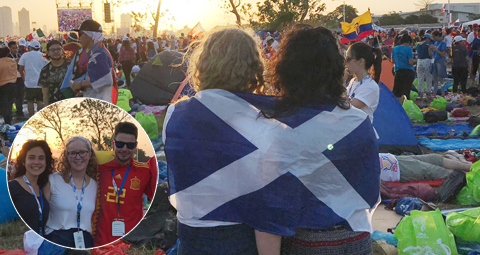
The Glasgow pilgrims who beat the odds to see the Pope in Panama

1-WYD-PILGRIMSTrio from Scotland travelled 7,000 miles via Spain and Costa Rica to reach World Youth Day
A trio of young pilgrims from Scotland who beat the odds to see Pope Francis in Panama have said World Youth Day made them feel less alone and helped them ‘recharge’ their Faith, as they returned to Glasgow.
No Scottish diocesan or national pilgrimage groups were organised this year to World Youth Day, which brings together young Catholics from across the globe every three years, and it was thought that Scotland was unrepresented at the gathering.
However, the trio from St Thomas in Riddrie, Glasgow, would not be beaten in their goal to attend and financed their own journey by selling almost 4,000 candles in churches and reaching out to a group who were travelling from Portugal.
Through December and January, they raised £4,000, covering more than half of the £2,000 cost each of their 7,000-mile journey from Glasgow to Madrid, Costa Rica and over the border into Panama.

Neocatechumenal
Hundreds of thousands of people gathered in Panama City from January 22-27. Among them were Madalena Fonseca, 21, Louise Swan, 21, and David Sanchez, 19. All three are part of the Neocatechumenal Way, a Catholic movement with around 100 members in Scotland.
Madalena came to Scotland from Portugal 10 years ago, David arrived from Spain four years ago after his father was asked to evangelise here by the movement, and Louise was born into the Way after her father was introduced to it by the woman he would later marry.
After putting out a call to friends in the movement, Madalena—who has been to World Youth Days in Madrid, Rio and Krakow along with Louise—managed to secure a space on the Portuguese pilgrimage.
Serendipitously, Portugal would later be announced as the venue for the 2022 World Youth Day, meaning the three pilgrims from Scotland were given a prime spot on the stage with Pope Francis during Mass.
Madalena studies optometry at ­Glasgow Caledonian University, David sports and coaching at the City of Glasgow College and Louise is enrolled in French and Spanish at Glasgow University.
Despite busy university schedules and exams, they took time out because ‘World Youth Day was more ­important,’ they said.

Faith recharged
David said WYD helps young ­people ‘recharge their Faith.’
“I say it’s like a battery of a phone. In Poland [for World youth Day 2016] it was 100 per cent, then after three years I was running out of battery and I needed to recharge it.”
He said the vigil Mass in Panama was an incredible moment. “I spoke to everybody that night, from all over the world,” he said. “From Canada, America, Columbia.
“When I went to [World Youth Day] my Faith wasn’t the best, but I could feel Him there, and that filled me up and I can now evangelise again.
“When the Pope was talking about Mary saying ‘yes’ to God, it reminded me of my situation when I had to come [to Scotland]. I felt like the Pope was inviting me to evangelise—and when I get back to college I’m thinking about telling them all what happened.”
Madalena said WYD was a ‘powerful’ experience.
“[The Pope] said some times young people can feel invisible and for me in my life I feel that a lot. You can feel very isolated here in your little life and nobody else believes and then you go to WYD and see all these people who believe the same as you. It’s incredible.”
She added that she hopes to spread what she learned at WYD back in Scotland.
“In my head I say, ‘yes, I’ll do the work of God,’ but when it comes time to act, it’s hard. It’s scary when you come back because you feel like you are in a bubble there, that everything is perfect, and then you come back home to reality. So it can be very hard to give witness to my Faith. But this pilgrimage was a very strong invitation to not be scared because God will be with us. I received so much at WYD that I’d feel very selfish if I keep it all to myself.”
Louise, who also attends St Joseph’s in Clarkston, took a Saltire with her on the trip, and proudly wore it at the various papal events—although she says many of the international pilgrims did not, unfortunately, recognise it.
She said that her Faith gives meaning to her life, and that joining the thousands of young people from across the world gave her hope.
“In Scotland it’s quite easy to feel alone, especially as a young person. Even in a church it can be quite empty. Most of my friends are not Catholic or if they were they don’t go to Mass and no longer believe in God. It’s very hard to be seen as different, and almost put yourself at risk to be mocked or not have any friends—which I know wouldn’t happen, but it is a fear.
“So it’s good to see other young people in the same situation with the same problems as you. It made me feel less isolated. Maybe that’s a problem—that we don’t interact with the youth enough in Scotland in the Church.”
The Neocatechumenal Way was formed in Madrid in 1964 by Kiko Argüello and Carmen HernÔndez. In Scotland, they provide catechesis, with groups meeting during the week and for Mass on Saturdays.
Madalena said the Way helps her find answers to life and deepen her Faith. “You participate—you’re invited to share what you’ve learned,” she said describing the movement. “You’re not just there sitting down and filling a chair—you are there because you are giving your life.”
And she encouraged other young people to follow the trio’s lead and attend the next World Youth Day. “It’s not impossible—we took 30 people with us to Brazil, again by selling candles, and its funny how people remember us,” she said. “It is possible if you really do desire to go. Go to World Youth Day—it gives you the strength to carry on.”

Monday, January 28, 2019

NCW Pilgrims In WYD

The NCW in Brisbane Australia consisted of Native-born pilgrims who came from Central and South America.  Coming to the World Youth Day in Panama brought some feelings of loss and redemption for these pilgrims.  The following article can be found here
-----------------------------------------------------------------------------

Old feelings of loss and redemption for native-born pilgrims returning to Americas for WYD

AS young Catholics from across Australia arrive in Central America en route to World Youth Day in Panama, some have spoken of an emotional homecoming – their families fled strife-torn Central America decades ago, and this is their first chance to return.
Other pilgrims have spoken of their hopes for coming face-to-face with Pope Francis and having a faith encounter amidst pilgrims from across the world.
For Sandra Pena, a 31-year-old Brisbane Catholic and a member of the city’s Neocatechumenal Way community, making her sixth WYD pilgrimage, this trip was “a dramatic moment” in her life.
Her family fled strife-torn El Salvador when she was four years old.
“My roots are in Central America and I have never been here before,” Ms Pena, who speaks fluent Spanish and is an experienced medical receptionist, said.
Several of her fellow young pilgrims are from families who fled El Salvador and have made a new life in Australia.
“I’m really looking forward to having an encounter with Christ because in this year I really feel like I’ve gone away from God, kind of lost my way,” Daniel Urbina, also making a pilgrimage with Brisbane’s Neocatechumenal community, said.
“I am hoping that God will speak to me and help me to find my direction by coming here.”
The World Youth Day gathering in Panama City, which opened on Tuesday and continues until today (January 27), will be the first time the event, first instituted by St John Paul II in 1985, will be held in Central America and likely the only opportunity for many of the region’s young adults and teenagers to catch a glimpse of Pope Francis, who arrived in Panama on Wednesday (January 23).
Ahead of arriving in Panama City, Mr Urbina, is travelling with Australia’s Neocatechumenal communities, first through Mexico and Costa Rica.
In Mexico the young pilgrims billeted with Catholic families in the city of Puebla, and visited the hilltop Our Lady of Miracles Church built over the top of an Aztec pyramid, and the archaeological wonder of Teotihuacan, the pyramids of the Sun and the Moon, and the Basilica of Our Lady of Guadalupe.
Many of the young Catholics have attended past World Youth Days and have found it a life-changing experience.
“In Poland (WYD 2016) I really found the mercy of God and that Christ loved me,” Mr Urbina said.
“It was a great experience and I hope to have another experience like that.
“What really stuck out to me in Poland was the communion that we had with young people there.
“We got to meet a lot of people from other countries, and to see the joy people had, welcoming us to share the faith with other young people.
“It was really beautiful … in Australia, many times I feel alone following my faith – but there I saw a whole generation of young people who want to follow Christ.
“To me that was a really great experience to have.”
Australian pilgrims have experienced a few discomforts – ranging from lack of sleep, trials with bus schedules and diarrhoea – but they have also learnt of the far greater challenges faced by young Central Americans wanting to make their way to Panama City.
Nicaragua has been dealing with political and economic upheaval, some of it involving violent clashes with government forces that have plagued the Central American nation since last year.
“Some of the young Nicaraguans heading to (World Youth Day) have made extraordinary economic sacrifices, selling things, begging institutions for help, because it’s a unique opportunity,” 25-year-old Nicaraguan journalist Israel Gonzalez Espinoza told Catholic News Service.
Past World Youth Day gatherings have taken place in Spain, Poland, Brazil, the Philippines, the United States and other countries that have been cost-prohibitive to Central American youth, many who are now excited about their physical proximity to the upcoming celebration.
Nicaragua’s deteriorating economic and political situation, was expected to impact on pilgrims from Central American nations such as El Salvador, Guatemala, Mexico, Honduras, travelling by land through Nicaragua.
Mr Gonzalez said he had heard that Panama had been in talks with officials in the country to expedite a safe passage of pilgrims travelling through and returning through Nicaragua before and after World Youth Day.
Ms Pena said her only disappointment leading up to this WYD was that she wanted to share it with more young Catholics from Central America.
Despite the tensions, another Brisbane pilgrim Gustavo Mendez, whose parents also left El Salvador for Australia, was keen to experience the mass gathering of young Catholics in Panama City.
He also attended WYD in Poland and found it a life-changing experience.
“I encountered Christ – not only in the words (spoken by Pope Francis), but in the people,” Mr Mendez said.
“Seeing the three million people united in Poland – that’s where I felt the presence of Christ, because I saw together we could be the image of Christ.
“And that left a grand impression in me.
“I wanted to see in this pilgrimage in Panama that I could have the exact same encounter – not only seeing Christ in the sacraments and confession but also meeting Christ in the people, and more importantly meeting Christ in my own life.”

Thursday, January 24, 2019

The Credibility of Bishops on Credibly Accused Priests

The following article was written by Father Gordon MacRae.  As usual, he writes a very strong article on the crisis facing our Catholic Church today.  It's ironic that since 2002, none of the bishops paid much attention to due process of the law as they remove priests from their diocese and refuse to support them.  Now, that bishops are being accused left and right, suddenly, they focus on "due process."  Please continue to pray for our Church, the clergy, and for our Archbishop Anthony Apuron and our Coadjuator Archbishop Michael Jude Byrnes.  The following article can be found here

------------------------------------------------------------------------------------


Sixteen years after the Dallas Charter set a ‘credible’ standard to suspend hundreds of accused priests, bishops are only now trying to define what ‘credible’ means.
“‘Credibly accused’ is being worked out in terms of our lawyers even now as we speak.” Cardinal Daniel DiNardo, President, U. S. Conference of Catholic Bishops.
I chose the image atop this post because it presents such a startling contrast. The untitled and uncredited image was sent and I was so moved by it I asked to have it posted on Christmas Eve on LinkedIn, an entirely secular social network. If a picture speaks a thousand words, this one speaks volumes. Within days, it garnered 3,000 views and a multitude of comments. Readers found it to be remarkably inspiring.
I wanted to include it here because it reflects the reality in which I live. It also reflects the true mission of priesthood, “a heroic vocation” as described by Matthew Hennessey, an editorial features editor at The Wall Street Journal, who wrote in 2017 that, despite all the bad press…
“One thing hasn’t changed. Young men still want lives, of heroic virtue and the priesthood offers that in abundance.” (“The Priesthood is a Heroic Vocation,” August 17, 2017)
Both the photo above and Matthew Hennessey’s WSJ op-ed stand in stark contrast to how most in the news media – often predators in their own right – are portraying Catholic priests. A typical example was analyzed in these pages in a post about the one-sided hysteria masked as journalism that has dogged Catholic leaders in the sexual abuse moral panic of the last two decades. That post is “USA Today’s Tim Roemer on How to Save the Catholic Church.”
I owe some thanks to USA Today and former Democratic Congressman Tim Roemer for at least being transparent in their real agenda for Catholics in America. Their moral outrage has goals: abandon civil rights for priests, allow priests to marry, ordain women, and appoint lay leaders to replace bishops in supervising clergy and screening seminarians. In other words, make bishops obsolete.
But nothing Tim Roemer has said or written alarms me as much as the quote atop this post from Cardinal Daniel DiNardo, President of the U.S. Conference of Catholic Bishops. The Gospel could be the measure of how the bishops respond to the crisis. Church law could provide a framework for formulating policy. Bypassing all of that for the U.S. bishops, “Credibly accused is being worked out in terms of our lawyers even now as we speak.”
“Even now as we speak.” Sixteen years after adopting “credible” as the standard by which accused priests – “from however long ago” – are measured and discarded, the bishops are only now discerning what “credible” should mean, and only because there is a movement afoot to apply the same standard to bishops. A little history is in order.
In 2002, the bishops meeting in Dallas under the harsh glare of the news media adopted a policy in a time of crisis. Having invited David Clohessy, Barbara Blane and others from SNAP (the Survivors Network of those Abused by Priests) to address the conference, the bishops adopted the “Charter for the Protection of Children and Young People.”
Known simply as the “Dallas Charter,” its main promoter was Cardinal Theodore McCarrick Cardinal Avery Dulles lobbied against it, and published a stinging rebuke in “The Rights of Accused Priests.” The bishops, however, sided with Cardinal McCarrick.
ZERO TOLERANCE IS NOT A GIFT OF THE HOLY SPIRIT

In 2000, the U S bishops published a pastoral document entitled “Responsibility and Rehabilitation.” It criticized the American criminal justice system for adopting one-size-fits-all concepts of justice and mantra-based policies such as “zero tolerance” and “three strikes and you’re out” that enhanced penalties while discounting paths to rehabilitation. The bishops urged that justice should be restorative, and not only punitive.
Just two years later, those same bishops signed the Dallas Charter inflicting upon their own priests what they condemned in the criminal justice system. The bishops’s draconian new policy for priests negated restorative justice. “One strike and you’re out – forever!” Among those paying attention, even hardcore law and order types scratched their heads at the abolition of due process by which this would be implemented.
An accusation – whether from this year or fifty years ago – need not be proven or even true. It need only be ‘credible.” The accepted interpretation of “credible” was that it could have happened. In other words, the priest and the accuser were both present in the same general locale 30, 40, or 50 years ago. This new zero-tolerance policy held that any priest so accused, from however long ago, is to be removed and barred from any ministry unless and until proven to be innocent.
The cases, many of which skipped the preliminary investigations required by canon law, were then submitted to the Congregation for the Doctrine of the Faith at the Vatican for finality. The CDF had every reason to conclude that canon law was being followed and legitimate investigations were carried out. Writing in First Things (Aug.-Sept. 2002) Father Richard John Neuhaus described the scene in which the “Dallas Charter” was created:
“Almost 300 bishops sat in mandatory docility as they were sternly reproached by knowing psychologists, angry spokespersons for millions of presumably angrier laypeople, and above all, by those whom the bishops learned to call, with almost cringing deference, the ‘victim/survivors’… Tears earned a gold star and welling eyes an honorable mention from the media… Like schoolboys, the bishops anxiously awaited the evening news to find out their grades.” (“Scandal Time III”)
The resultant process was described in these pages in a courageous post by priest and canon lawyer, Father Stuart MacDonald, JCL, “Last Rights: Canon Law in a Mirror of Justice Cracked.” It was a timely and soul-searching post for the whole Church about the rights of accused priests and the real-world failure of the hierarchy to secure and respect those rights.
Since the Dallas Charter was enacted by the bishops in 2002, that “real-world failure” has resulted in scenes far more reminiscent of the American McCarthy era than the American Catholic church. In the months to follow that Dallas meeting, thousands of files were scoured and hundreds of priests were rounded up. Priests merely accused, many of whom had ministered without incident for years or decades, were summarily expelled from Church ministry and property. Again, Father Neuhaus:
“The bishops have succeeded in scandalizing the faithful new by adopting a thoroughly unbiblical, untraditional, unCatholic approach to sin and grace… They ended up adopting a policy that was sans repentance, sans conversion, sans forbearance, sans prudential judgment, sans forgiveness, sans almost everything one might have hoped for from the bishops of the Church of Jesus Christ.” (The Rev. Richard John Neuhaus, “Scandal Time III,” 2002)
WHEN THE CHURCH DEFAMES HER PRIESTS

Back in July of 2011 I wrote with exasperation about the result of all this by profiling the case of Boston priest, Father F. Dominic Menna. “Father Dom” ministered as a senior priest well into his late seventies in a parish where he was beloved and respected. Then the 2002 moral panic came. An easy target, Father Menna found himself among dozens to face a vague claim from the distant past, an incident alleged to have occurred over forty years earlier.
It was unsubstantiated and could never be substantiated. By what magic could a 40-year-old claim of fondling be substantiated? But it “could” have happened, and that rendered it “credible.” Father Dom was dragged before the Archdiocesan Sanhedrin, stripped of his faculties as a priest, and put out into the street. The next day, The Boston Globe ran his name and photo and identified the vague details of his “offense” forgetting to mention that it was both unproven and up to a half-century old.
Of course the purpose of all that is to invite new accusers to cash in. This claim came through the usual contingency lawyers who became quick millionaires by holding press conferences to shame bishops into quick settlements. I wrote about the sad Father Dom story in 2011 in, “If Night Befalls Your Father, You Don’t Discard Him. You Just Don’t!
Ah, but we do discard them! Or at least most of us keep silent while someone else does. This is the “zero tolerance” that our bishops have embraced and that even Pope Francis now touts as a centerpiece of the Church’s response. So why am I protesting all this anew? In a December 19 issue of CRUX, Correspondent Christopher White published “Two Decades into Crisis, No Consensus on What ‘Credibly Accused’ Means.”
After sixteen years of compiling scarlet letter lists of the accused – some living, but most dead, some guilty but many not – the question has arisen anew about whether names of accused priests – merely accused, mind you – should be published by their bishops. The demand to do so comes from lawyers, the news media, and SNAP, but as Father Richard John Neuhaus warned in 2002, the “victim advocates are not satisfied and, sadly, may never be satisfied.”
It is not enough that the bishops release these lists of names. The newest wave of SNAP leaders (the previous wave disappeared after being implicated in an alleged lawyer kickback scheme) want the bishops to also include in these lists descriptions of the alleged abuse so that others who want to contact the same contingency lawyers can concoct consistent stories. If you balk at the plausibility of such a concern, it is only because you have not yet read the evidence for it in “A Weapon of Mass Destruction: Catholic Priests Falsely Accused.”
But there are other concerns, the most important of which is fundamental civil liberty and due process. After fallout from the now infamous Pennsylvania grand jury report on accused priests, bishops in multiple states have conceded on the issue of publishing the names of the “credibly” accused, living or dead, guilty or not. This has been going on for years, but now, the sound of screeching voices has risen to a scarlet letter crescendo.
TAKING RIGHTS FROM SOME DESCENDS A SLIPPERY SLOPE
Cardinal Daniel DiNardo told CRUX that among the next steps in the bishops’ collective response to the crisis would be “studying national guidelines for the publication of lists of names of those clerics facing substantiated claims of abuse.”
It did not go without notice among the lawyers, the news media, and SNAP that the parameter has suddenly been altered. After two decades with “credible” as the standard for dismissing priests and releasing their names, “substantiated” is now the operative word and it is a far different standard. Why it took the bishops nearly two decades to ask themselves what “credible” means – not to mention whether it ever reflected justice or the Gospel – is unclear. A lot is unclear.
But some clarity on this came forth from another source “When the Church Defames Her Priests” was published in Homiletic & Pastoral Review in 2017 by Opus Bono founder and president, Joe Maher, and David A. Shaneyfelt, an attorney in private practice in California and an Opus Bonoadviser.
The article addresses the destructive and ill-advised practice adopted to date by some two dozen dioceses in the United States to create and publish lists of priests who have been merely accused. The Opus Bono authors wrote:
“We take special issue with those dioceses who think that publishing a list of names of clerics who have been ‘credibly’ accused of sexual misconduct is warranted. We disagree for many reasons – canonical, theological, pastoral, and legal. It is this latter reason we wish to address here.”
The article goes on to present a transparent but chilling explanation of what “credible” means in this context, and a compelling case for protecting the due process rights of priests who are merely accused. After reading, I could not help but agree with its urgency. The article captured the flagrant injustice in this practice:
“How ironic that a bishop, who aims to demonstrate his concern for one victim of abuse, will thereby create another victim of abuse – and end up paying large amounts of damages to each in the process. How doubly ironic that a bishop who initiates such a policy may someday find himself on the list.”
Lest any bishop thought that suggestion implausible, it has now come to pass. In “Giving Due Process Its Due,” an excellent article at The Catholic Thing, Stephen P. White (no relation to CRUX writer, Christopher White) wrote that at the November meeting of bishops, Bishop Donald Trautman (Emeritus of Erie, PA), spoke against plans to have a similar reporting system for allegations against bishops.
In response to the idea that allegations against bishops be reported to the Nuncio, and thus to Rome, Bishop Trautman objected: “I think this proposal is very dangerous and unjust. It calls for the reporting to the Apostolic Nunciature accusations not investigated, not substantiated, not proven. That’s unjust.”
I agree with Bishop Trautman, however, as Stephen White reported, it raised a few eyebrows among bishops for it is precisely what US bishops have been doing to hundreds of priests since the Dallas Charter was enacted in 2002.
The growing demand – to which the bishops of some seventy U.S. dioceses have already capitulated – is to bypass the legal system standard of a criminal conviction as the impetus for requiring registration of sexual offenders. Some bishops have created their own private version of “Megan’s Law,” but without the law’s built-in respect for basic civil rights. In American courts, only those convicted in a court of law can end up on such a published list.
Dozens of U.S. bishops and dioceses have already published these lists with no legal entity requiring them, and with little recourse on the part of the priests, many of whom are innocent. These lists replace justice with capitulation to a lynch mob.
The November-December issue of Annals Australasia: Journal of Catholic Culture reprinted the following excerpt, an eye-opener from Peter Hitchins in the (UK) Daily Mail, 17 December 2017, entitled “We have forgotten what justice means”:
“Accusations of long-ago sexual crime have become a sort of industry in this country. People are so horrified by them that they almost always believe them. Because the crime is so foul, we stop thinking…. Police and prosecutors use our horror to get easy convictions when they must know that their cases are weak. The less actual evidence that they have, the more they stress the disgusting nature of the alleged crime. And they forget to remind us that it is alleged, not proved.
“Equally shamefully, judges do not stop these trials, and juries leave their brains at the door. They convict not because they are sure the case has been proved beyond reasonable doubt, but because they are angry and revolted. I am miserably sure there are disturbing numbers of people in prisons now, prosecuted on such charges, who are innocent of the accusations against them. It is our fault, because we have forgotten what justice is supposed to be like, and that, if we do not guard it in our hearts, it will perish in our country.”
If Pennsylvania Attorney General Joshua Shapiro’s one-sided, untested grand jury report is to be the standard by which we execute justice and formulate policy – without evidence, without trials, without a defense – then justice has already perished in our country. If our bishops publish lists of names of priests merely accused, but without substantiation, their credibility will perish with it.
Note from Father Gordon MacRae: Please share this important post and visit these related posts from These Stone Walls: