Showing posts with label Evangelization. Show all posts

Tuesday, September 2, 2025

Looking Forward

 A few weeks ago, our youth returned home from Rome and Austria. They shared their experiences of the Pilgrimage, and they are always looking forward. 

2027 is two years away, but the years go by so fast. My family is already looking forward to the next World Youth Day, which will be in South Korea. We have already started saving up for the trip. So, we are looking forward to WYD. It's fortunate for us because we are close to South Korea. The last WYD was in Portugal, which was very far for us. 

In the meantime, the NCW continues to evangelize both in Guam and other Pacific Islands. We hope to produce more vocations especially the priesthood. We already have a few who are studying for the priesthood. These sons of Guam may not be priests in Guam, but they are for the universal Church. We continue to pray for them. 

Thursday, July 18, 2024

In Response to an Anonymous Poster

 This post is in response to an anonymous poster who wrote in my blog. According to his/her comment, which can be found here:

Everything you mentioned are things anyone can do even if they’re not walking in the Way. So, what makes you unique?

That is true. Anyone can bring flowers to the altar. Anyone can set up to make the place of the celebration beautiful. But how many of us can stop making judgments or take criticisms? The Neocatechumenal Way is an itinerary of Catholic formation at the service of the bishop as one of the diocesan ways of implementing Christian initiation and ongoing education in the faith. It is one of the many organizations in the Catholic Church that brings our conversion. 

Conversion takes place in a community. In the Way, it is no secret that we decorate the altar with flowers, but one would be surprised to find that the brothers can judge others over flowers. We cannot please everyone. Some people will say that the flowers on the altar is very little and more flowers are needed. Others will say that we put too many flowers on the altar that it looks like a jungle.  We can never please anyone. Nevertheless, comments like these can hurt the person who spent much time and effort arranging the flowers. One person I know took the judgment personally that she retaliated. This is a human reaction. Later, she returned to apologize for the outburst. Another person I know took the criticism with humility. She thanked the person for the judgement. Most people do not react that way. We can only say that she found the Holy Spirit to take the judgment with humility. As for the person making the judgment, I am certain that the humble gratitude shown may have made her think twice about her judging attitude the next time around. 

The Neocatechumenal Way is one of the many organizations in the Catholic Church to help people have a closer relationship with Christ and to convert. God said, "Be holy for I am holy" (1 Peter 1:16). Holiness is possible only with God. The holy saints in Heaven were once sinners like us. Therefore, it is possible that sinners like us can one day become holy saints like them. The Way is not for everyone. But God has created many organizations within His Church to help His people convert and be closer to Christ. 

Furthermore, our duty as baptized Catholics is to share the gospels to everyone so they can also come to know Jesus Christ. We have seen the miracles in our history, and we share our testimonies during evangelization. 


Tuesday, March 7, 2023

Welcome to Guam, Giuseppe Gennarini

 The NCW communities in Guam welcomed Giuseppe Gennarini and the Iterenant Catechist team of the United States. Truly, this is a historic moment for the Neocatechumenal Way in Guam.  Some of the brothers in Saipan also flew to Guam for this historic event. A few of the priests in Newark and New York were also present.  In the meeting with Gennarini, it was  announced that some of the brothers in Guam will evangelize in Chuuk, Yap, Palau, American Samoa, anf Kiribati. We will evangelize throughout the Pacific. 


Tuesday, April 5, 2022

Witnesses to God's Miracles

 A mission family from Ukraine has returned to Spain and recounted their journey back home.  The mission family had 10 children.  It is not surprising to find that members of the Way have large families for we are open to life.  In fact, some of the couples in the Way have also adopted children into their family.  Two of the mission families are seminarians and have decided to stay in Ukraine.  It is also not surprising to find that some of the youth in the Way have been inspired into the priesthood.  When families walk together in the Church, the children often become closer to God and His Church.  At any rate, their story was recounted in Catholic News Agency:

---------------------------------------------------------------------------------

Missionary family returns to Spain from Ukraine: 'We witnessed God's miracles'


César Campomar and María Auxiliadora Hernando and their ten children have lived in Ukraine since 1997 where they went to evangelize as members of the Neocatechumenal Way.  The family had to flee Ukraine because of the war and arrived in Burgos from Kyiv last Thursday.

Before serving in Ukraine, they lived as missionaries in Belarus for six years but they were given "an ultimatum because they knew we were from the Church" and so they were given a new assignment in Ukraine.

The family decided to leave Ukraine shortly after Russia’s invasion.

César, María Auxiliadora, and seven of their ten children, along with their respective wives and children, headed for the border to try to make it back to Spain. Two of their children who are seminarians decided to remain, and another lives in Murcia, Spain.

All together there were 25 people: 13 adults and 12 children. Two of them returned by plane, and the rest left in three vans. It took them a week to get to Burgos.The family crossed the border with Hungary because "it was easier than doing it through Poland," and stopped in Trieste and Nice along the way. 

The Campomar Hernando family told the Archdiocese of Burgos that they "witnessed God’s miracles for us” during the trip of over 2,250 miles.

They were held up at the border crossing for 13 hours and could get only about five gallons of fuel at each gas station. In addition, some of their vehicles broke down, but  "thanks to the generosity of the people" they met, the problems were taken care of.

"Some of the babies only had birth certificates,” but they lacked official documentation. However, “they were treated well" by authorities, said César.

Maria Auxiliadora said that given the terrible situation in Ukraine they want to discover “the hand of God in all this … May he help us discover his will.”

Monday, June 14, 2021

The Mustard Seed

 Mark 4:30-32  Again he said, "What shall we say the kingdom of God is like, or what parable shall we use to describe it?  It is like a mustard seed, which is the smallest of all seeds on earth.  Yet, when planted, it grows and becomes the largest of all garden plants, with such big branches that the birds can perch in its shade."

Some of our youth in the Way are currently off-island on a pilgrimage.  When they return to Guam, they will tell their experiences to the brothers in their communities.  It is always good to listen to their experiences.  These pilgrimages have also fostered vocations for some of our young men and women.  It is where they hear God calling them to the priesthood, the convent, or to itinerancy. Some of the young men in the pilgrimage may answer God's calling to the priesthood.  And when these sons of Guam answer the calling, they will be sent by their communities to a seminary in the U.S. mainland or another country where they will continue their studies to the priesthood.  They will serve the universal Church in either the U.S. mainland or the country they were sent.  The NCW started as a small mustard seed whose faith continues to grow among its members.  It continues to promote and foster vocations even when the Guam Redemptoris Mater Seminary was sold.  It continues to be fruitful in promoting vocations and in the new evangelization.    

Kudos to the young men and women who are participating in the pilgrimage off-island.  Imagine how eager these youth were to participate in a pilgrimage rather than attend a rock concert.  They will continue to evangelize in their pilgrimages off-island so that the vocations and the Catholic Church in the U.S. mainland and other countries will increase.   

Saturday, October 31, 2020

Spanish Mission Family in Tanzania

 The following is an article about a mission family from Spain who moved to evangelize in Tanzania.  It's always inspiring to hear stories from the mission families and itinerants.  You can find the following article here.

----------------------------------------------------------------------------------

A Spanish missionary family’s love story with Tanzania


When God called them, they answered, and followed His prompting to serve.

Maria and Juan Pablo are a Spanish couple and members of the Neocatechumenal Way. For several years, they’ve been missionaries in Africa, specifically in Arusha, Tanzania. Today, the city has 416,000 inhabitants.

Maria explains how she recognized the call to go to another country to spread the Gospel:

“I felt,” she remembers, “that the Lord was calling me to keep nothing for myself, to give Him that little corner of my life that I had held on to, where I was afraid the Lord would enter. I felt in a strong way that God was calling me to surrender myself totally to him.”

Fear, then courage

Maria admits that initially she was afraid, and decided not to talk about it with her husband, Juan Pablo. Months passed before she decided to share her feelings on the subject with him.

That conversation started a process of discernment that the two of them shared. After a few months, during a Neocatechumenal meeting, Juan Pablo and Maria stood up to offer themselves as missionaries to go to whatever part of the world needed them. Thus began the wonderful love story of this Spanish couple with Tanzania.

Life in Tanzania

In the mornings, Maria and Juan Pablo’s children go to the school run by the Augustinian Missionary Sisters. They’ve already learned Swahili, adapted to the country’s educational methods, and made local friends. At their home, a local woman works as a nanny for the children so that the couple can go work at the parish in the afternoons.

On the occasion of the Extraordinary Missionary Month of October and World Mission Sunday (which was celebrated on October 18 this year), Juan Pablo has wanted to sent a clear message: “I would like to tell everyone how important it is that the Church be missionary.”


“The Holy Spirit always calls us out of our comfort zone to proclaim the Gospel,” he says. In order for the Church’s missionary work to be possible, he asks everyone to help, each to the extent that he or she can, “according to their own circumstances.” He emphasizes that “the important thing is to be united in prayer.”

Donations that bear material and spiritual fruit

Just this year, the Catholic Church has sent $56,000 to Arusha, where Juan Pablo and Maria live, so that the diocese can function and to provide support for local catechists, who go where the missionaries cannot reach. In addition, the funds help promote the diocese’s communications.

Juan Pablo and Maria do not charge for the work they do. The funds come from the donations made by millions of people from all over the world during the World Mission Sunday campaign, and are managed by the Pontifical Missionary Societies (PMS). In this way, over the last 16 years a total of $1,826,502 dollars have been sent to Tanzania, an average of more than $114,000 a year.

These funds have made it possible for the Catholic Church’s work in the country to grow. The number of parishes has gone from 17 to 39, and the number of schools has grown from 1 to 281. What’s more important is that the number of baptisms has gone from 1,926 to 46,500. Schools, parishes and baptisms are growing, and that’s good news for the whole Church.


Wednesday, September 4, 2019

NCW Is Leading Catholics Toward Full Grace of Baptism

The Neocatechumenal Way is an itinerary to Christian formation.  In other words, it is a detailed path of conversion by discovering the richness of one's baptism. Christ said that it is by their fruits that one would know His disciples.  And the NCW has many fruits as I have pointed out numerous times in my blog.  The following article can be found here. 
---------------------------------------------------------------------------------

The Neocatechumenal Way is leading Catholics towards the full grace of their baptism

Double celebration: Young Catholics Benedetta Giannini, from Brisbane, and Ambrose Skruzny, from Melbourne, celebrate both World Youth Day and Australia Day while in Panama City.
MOST of us were baptised as infants and never had a chance to learn about the faith we inherited, which is precisely why the Neocatechumenal Way is heaven-bent on catechesis. 
Brisbane archdiocese has many Neocatechumenal Way communities, including at Loganholme, Wynnum and Newmarket.
Sydney Neocatechumenal Way priest Fr Tony Trafford said their mission came straight from the pages of the Catholic Catechism article 1231.
 “Where infant Baptism has become the form in which this sacrament is usually celebrated, it has become a single act encapsulating the preparatory stages of Christian initiation in a very abridged way,” the catechism reads.
“By its very nature infant Baptism requires a post-baptismal catechumenate. 
“Not only is there a need for instruction after Baptism, but also for the necessary flowering of baptismal grace in personal growth.”
Fr Trafford said the catechism clearly tells us baptised infants must be given post-baptismal catechumenate in order to “bring the grace of the sacrament to fruition in the life of the person”.
That is where the Neocatechumenal Way steps in.
The Way invites people every year to undertake catechesis as well as reaching out into new communities with the permission of the parish priest and bishop. And catechesis is for life.
Members of the Way learn and discover their faith every week at catechesis sessions, the staple of the community’s ministry.
Evangelisation is an inescapable consequence of this mission.
“As a (Neocatechumenal Way) community begins to grow, it’s clear they’ve received something that’s changed their lives,” Fr Trafford said. 
“And when you see something that’s changed your life, you want to tell other people about it because it could change their lives too.”
The evangelisation to follow was as old as the journey from Antioch to Corinth.
“If you look at the Acts of the Apostles, and the Epistles and the New Testament, you see how (St) Paul and the others went from one city to another bringing the faith they’d received by announcing the Gospel,” Fr Trafford said. 
“And what they saw, when they announced the Gospel, that itself produced fruit without having to set out creating structures or anything else.
“The fact of announcing the kerygma awakens in the heart of the person who receives it.
“The Church grew like that – and we work a bit in the same way.”
At Eastertide, members of the community also go out to do missions of the square in public.
Fr Trafford said they set up a cross and a lectern outside a shopping centre and started preaching the message of the Gospel.
“I’m sure the treasure we received is so great it’s not just for us,” he said. 
“If God chooses us to be Christians, it’s not because of anything we’ve done, it’s because he has a mission for a Christian to be a sign and a witness to the world. 
“That Christ is crucified and risen. And this is a sign of God’s love for mankind, for the sinner. 
“We don’t keep quiet. We try to announce Him to the world.”
Young people especially were drawn to the Way in droves.
Fr Trafford said young people recognised what was authentic and saw in their community an honesty and a sincerity. 
He said the Neocatechumenal Way took about 250 young people to Panama for World Youth Day this year, and 450 to Krakow.
A unique liturgy was part of the appeal of the Way. The Neocatechumenal Way celebrates Mass with some changes to a typical Mass.
“We always celebrate (Mass) in the form of an assembly, around the altar, because the call of the Church is to love and to be one, and so we can’t be anonymous,” Fr Trafford said. 
“It’s important to see one another, and listen to the Word of God together, seeing one another, hearing Christ being proclaimed in our midst.”
Other special Mass permissions included introductions to all the readings to help people listen closely or to simply approach a tired old reading in a new way.
Fr Trafford said the introduction was “not some theological treatise, it’s about me now, in front of this Word, which is Christ being proclaimed to me”.
He said these alterations helped young people become involved too.
Not only was the liturgy strongly articulated, vocations were too.
Fr Trafford said when the Church was life-giving then all the charisms appeared.
Marriage, priesthood and religious life were all highly encouraged in the communities. 
This year the Way has had four ordinations, two from its Sydney seminary and two from its Perth seminary.
The Way opened 120 seminaries across the world in the past 25 years.
“The fruits are there,” Fr Trafford said, “God is faithful – He rescues.”
Fr Trafford had a simple message to Australians – “God loves us as we are and his love is shown to us in Jesus Christ”.

Friday, August 9, 2019

RMS in Macau Gains Worldwide Attention

Recently, I posted about the RMS that will be established in Macau.  Apparently, it has gained such worldwide attention that it has been in numerous news media.  I remember Kiko Arguello once saying that he wanted to bring about 12,000 priests from China into the Catholic Church.  With an RMS established in Macau, that could actually happened.  After all, there are currently more men in China than women due to China's campaign of killing female babies in the past. 

As many already know, there are a few junglefolks against having an RMS in Macau. These are basically the same people who opposed Guam RMS.  However, do not be discouraged, brothers.  The NCW have the support of four popes including Pope Francis.  According to a letter by Pope Francis sent to the Neocatechumenal Way dated March 5, 2015:
And today I confirm your call, I support your mission and I bless your charism. 
Any bishop who opposes the Neocatechumenal Way and the Redemptoris Mater Seminary should bear this in mind: If one is truly in communion with Pope Francis, then one should support what the Pope endorses rather than oppose it.  The same goes for the laity.  Pope Francis has already expressed his support and given his blessings to the Neocatechumenal Way.  Those who do not support what the Pope has blessed and endorsed have placed themselves outside God and His Church.  The following article can be found here.
----------------------------------------------------------------------------------

Macau to host new seminary for Asian evangelization


HONG KONG - A new seminary to train priests for all of Asia will open in the Chinese territory of Macau in September.
The Congregation for the Evangelization of Peoples has entrusted management of the Redemptoris Mater College for Evangelization in Asia to the Neocatechumenal Way, ucanews.com reported.
The seminary was established by a decree signed June 29 by Cardinal Fernando Filoni, congregation prefect, after an audience with Pope Francis.
Filoni told Agenzia Fides, information service of the Pontifical Mission Societies, the college is “the fruit of apostolic creativity that looks to evangelization in that continent and expresses a will of decentralization of the congregation.”
The Neocatechumenal Way has long-standing experience of forming priests for the mission in Asia, he said.
The new college’s “specific nature is to take care of the formation for missionary priests who will have the evangelization in the territories of Asia at heart,” he continued.
The choice of Macau, a former Portuguese colony returned to China in December 1999, is linked to its history as a gateway for Jesuit missionaries such as Matteo Ricci, Francis Xavier and Alessandro Valignano who passed through it before going to China or Japan.
The seminary is being opened in response to St. John Paul II’s 1990 encyclical Redemptoris Mission (“Mission of the Redeemer”), which identifies the Asian continent as a territory where “the Church’s mission ad gentes (to the nations) ought to be chiefly directed.”
It is also a response to the call of Pope Francis, who in his apostolic exhortation Evangelii Gaudium (“The Joy of the Gospel”) invited the church to “go forth” to always proclaim the Gospel.
Filoni said Macau “has historically represented the door or a bridge for the mission of the Church in the East and as a promoting center for evangelization in the Far East.”
Bishop Stephen Lee Bun-sang of Macau accepted the congregation’s request to host the new college. However, appointments and authority over it will remain the direct prerogative of the congregation.
The Neocatechumenal Way was founded in Madrid, Spain, in 1964. It is estimated there are more than 100 Redemptoris Mater seminaries, 40,000 communities and 1 million members worldwide.

Monday, August 5, 2019

Bishop Keenan's Interview

There are many bishops and cardinals who speak well of the Neocatechumenal Way.  They had many good things to say about the Way, which has borne many good fruits for the universal Church.  Bishop John Keenan is one of those many bishops who spoke well of the Way.  In his interview, he stated:
I would always refer to the newer movements and our university chaplaincies in particular: Faith, Evangelium, the pro-life movement, Neocatechumenal Way and Communion and Liberation, to name but would also add, however, that this is also true of older movements like the Legion of Mary and the SVP, particulary when they are active with enthusiastic younger members.  What they do is offer a serious way of your faith.  If you want to live your faith more intensely, with more commitment then this is a good way to go.......... 
........the key to many of these movements is the proposal of a serious prayer life, and seriously teaching the Catholic faith and why we believe it.  Those who come then conclude: now I see how it all fits together.  Now I see the faith as a unity, and I see the extent of the faith.  A test of renewal and strength then is to be asked by the world what it is to be Catholic and to be able to confidently answer.  This confident faith, supported by authentic Catholic friendships, is what these movements can offer. 
 Bishop's Keenan's full interview is found here.  Although the interview is too long to publish on this blog, it is worth a read.  

There are some Catholics in Guam who prefer to focus only on the homeless and the poor.  However, the homeless and the poor are NOT the ones set out to change society and destroy the Catholic Church.  It had always been the pro-choice movement, feminist movement, and LGBT movement that sought to change the norms of society and destroy the Catholic Church because they sought POWER.  The homeless and the poor never sought power because they are simply too busy struggling to survive as always.  As Bishop Keenan stated in his interview: 
It is a new manifestation of what Orwell said: "All animals are equal, but some are more equal than others."  This is where we are now.  All rights are "equal", be they religious rights or LGBT rights...but some are more equal.  Orwell used that as a parody of communism, and eventually he identified this as a fatal flaw which would bring about its downfall.  It was predicated on a contradiction, as is postmodern society.  He said that of the Eastern Bloc, but it now equally applies to the politics of the West.  You cannot have equality for all and say that some are more equal.  Ultimately it ceases to be about truth, but about power.  It is built on sand, not nature, or reason.  It is built on the will to power. 
Many of us are aware of the story The Emperor With No Clothes.  We must be a Church who exposes the emperor with the solid truth....that he actually had nothing on.   

Image result for bishop john keenan

Tuesday, July 30, 2019

Redemptoris Mater College in Macao

The following is worth reading. A new Redemptoris Mater college was established in Macao.  The fact that RM seminaries are being built worldwide is an indication that the NCW continues  to promote and foster vocations in the priesthood.  Even in Guam, some of our youth have stood up for the vocations of the priesthood regardless of the closure of Guam RMS. The following article can be found here.
--------------------------------------------------------------------------------
VATICAN - Cardinal Filoni: "The new College in Macau, fruit of apostolic creativity and the desire to be a Church that goes forth"

Vatican City (Agenzia Fides) - The new Redemptoris Mater College for Evangelization in Asia, based in Macao, is "the fruit of apostolic creativity that looks to evangelization in that continent and expresses a will of decentralization of the Congregation of Propaganda Fide": explains Cardinal Fernando Filoni, Prefect of the Congregation for the Evangelization of Peoples, in an interview with Agenzia Fides. The Cardinal recalls that in the history of the Church's mission "there have been so many forms and methods chosen for the proclamation of the Gospel in Asia: the historic commitment of the great religious orders such as Jesuits, Dominicans and Franciscans; the activity of many specific missionary institutes; the sending of fidei donum priests or interdiocesan missionary collaboration; the forms of missionary cooperation between the Churches of some nations or between metropolises. Now the Holy Spirit suggests a new form, which we will experience".

Eminence, what are the reasons that led the Congregation to take care of the opening of the new College?

We wanted to respond to the invitation of John Paul II who, at the beginning of the new millennium, said that Asia would be the vast continent to be evangelized. It is a very complex continent, cradle of great religions and very strong cultural responsiveness. The proclamation of the Gospel in Asia requires characteristics of its own, such as a thorough knowledge of different contexts and languages. The awareness of this complexity, however, does not exempt Christians from making the Good News alive and present. The Gospel is for everyone: thus Christ gave it to us, so we announce it today.
The Congregation of "Propaganda Fide", also at the request of the Neocatechumenal Way, wanted to reflect on how to make this appeal to evangelization in Asia their own. I would like to stress that the idea of establishing the Urban College in 1627, by Pope Urban VIII, was a precursor: it intended to bring young people from various continents to Rome for an adequate theological and spiritual formation, having acquired a good preparation, they could then contribute to evangelization in their territories of origin. The Urban College still exists today and has kept going for four centuries. Today, Pope Francis has resumed the intuition of John Paul II, pointing out that the Church is called to "go forth", to open up and not to withdraw in herself. Therefore, we thought that many Catholic institutions, even those in charge of formation and education, can be located in the various continents, thus operating in the sense of decentralization. With this spirit we wanted to create a College in Asia for the formation of priests destined for Asia.

Can you explain why it was entrusted to the Neocatechumenal Way and why Macao was chosen as the seat?

The Neocatechumenal Way became available and made available to the Congregation of "Propaganda Fide", which has the direct legal responsibility of the College, its long-standing experience of forming future priests for the mission in Asia. Thus the new College Redemptoris Mater was born, whose specific nature is to take care of the formation for missionary priests who will have the evangelization in the territories of Asia at heart. 
Macao has historically represented the "door" or a bridge for the mission of the Church in the East. In past centuries it was a place of cultural and religious attraction, a territory governed by the Portuguese crown. Its importance is well known as a promoting center for evangelization in the Far East. Extraordinary missionaries like Matteo Ricci, Alessandro Valignano, Francesco Saverio and many other evangelizers passed through this "door" for the mission in Asia. Suffice it to say that in 1576, just erected, the diocese of Macao extended, at least on paper and for a certain time, to China, Japan, today's Vietnam and the Malay archipelago, as it was called. Macao became a great center of missionary formation and propulsion. Recalling this story, we asked the local Bishop, Stephen Lee Bun Sang, if he was available to host the new College and he, after consulting the priests of the diocese, confirmed the approval.
But the College, although based in Macao, does not depend on the local Bishop: appointments and authority remain the direct prerogative of "Propaganda Fide" which, according to the Second Vatican Council, has the task of promoting evangelization in the world. It is a first step: in this perspective of decentralization, it can be observed that it is not impossible that, tomorrow, other Colleges of this kind, promoted by the Congregation, on other continents, are born. It should be noted that our Congregation already has the responsibility of the Urban College, which welcomes 170 students from Asia and Africa in Rome. And there are other Seminaries connected with "Propaganda Fide" in the world, such as the Seminary of the Apostolic Vicariates in Colombia or several inter-diocesan seminaries in different countries. Today, the new College of Macao is the fruit of a special missionary initiative and method, which Pope Francis encouraged and approved. It should be noted, that future priests will become a precious pastoral aid for the local Churches: in fact, they do not belong to a given apostolic fraternity or a religious institute but, at the end of their journey of formation, they will be incardinated in the various dioceses of destination, according to the needs and requests of the Asian Bishops. And from now on they will be able to study the local languages and cultures of the countries in which, in agreement with the authorities of the College, they will be destined for the pastoral and apostolic service.

What are your wishes and hopes for the life of this new College?

We are happy to promote an institution with new characteristics, which responds to the desire and that missionary vision of Pope Francis which is a founding and qualifying point of his pontificate. We intend to respond to Christ's call to announce the Gospel to the ends of the earth. In the history of the Church's mission, there have been so many forms and methods chosen for the proclamation of the Gospel in Asia: the historic commitment of the great religious orders such as Jesuits, Dominicans and Franciscans; the activity of many specific missionary institutes; the sending of fidei donum priests or interdiocesan missionary collaboration; the forms of missionary cooperation between the Churches of some nations or between metropolises. Now the Holy Spirit suggests a new form, the fruit of apostolic creativity, which we will experience. We entrust this work to the hands of Mary, Mother of the Redeemer, and to Saint Joseph, Custos of the Holy Family of Nazareth. And we ask for the intercession of the saints and martyrs who gave their lives for the spread of the Gospel in Asia. (PA) (Agenzia Fides, 29/7/2019)

Sunday, May 5, 2019

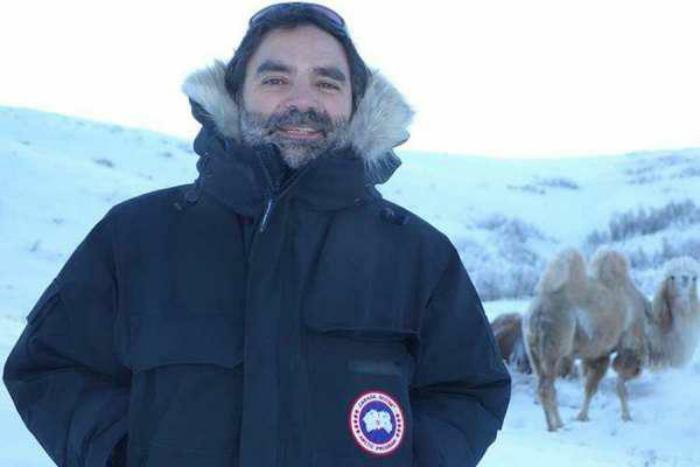
Missionary in Mongolia

While the number of priests have decreased in the western world, they are growing in Africa and Asia.  According to an article:
The Catholic Church has been increasingly turning to Africa and Asia to find priests to staff its parishes in the U.S., Europe and other parts of the world because it's now struggling to find native priests in these areas, according to the Center for Applied Research in the Apostolate at Georgetown University.
"A growing phenomenon within the Church is the use of African and Asian priests in the U.S., Europe, and elsewhere where there are too few native priests to staff parishes," noted CARA in a report highlighted on the Center's blog 1964 Thursday.
Secularism has taken hold of much of the western world.  It appears that the future Catholic Church will be in Africa and Asia.  Below is a story of an RMS priest doing missionary work in Mongolia.  The story can be found here.

---------------------------------------------------------------------------------------------------------

Ulaanbaatar, Mongolia, Apr 30, 2019 CNA.- When Francisco Javier Olivera was born, his mother offered him to the Virgin Mary, praying that he would become a missionary in Asia.

Olivera’s mother told him about the consecration after he was ordained a priest in Japan 22 years ago. Since then, he has served as a missionary, not only in Japan, but in China and Mongolia as well.

Fr. Olivera was born in Salamanca, Spain, 47 years ago. He is a diocesan priest working with the Neocatechumenal Way and has been a missionary for 28 years.

In an interview with Religión En Libertad, Olivera said his priestly and missionary vocation grew “little by little,” influenced by a series of missionaries and catechists who stayed at his family’s house. 

He also believes that his mother’s prayers made a difference.

“She offered me to Our Lady to be a missionary in Asia. I didn't know that, she told me in Takamatsu, [Japan] when the celebration of my ordination was over,” the priest said.
The priest said that Japan has been his toughest assignment, because there “you felt more loneliness, even being in a parish,” while China impressed him very much since “the people have a lot of curiosity and if there were freedom it would be amazing.”

After four years of living in Mongolia, he said he still finds the assignment “quite difficult because of the language, the cold, the pollution, the culture, and especially because of all the legal impediments we have, which are many.”

The Catholic Church arrived in Mongolia in 1992, when three missionaries of the Immaculate Heart of Mary were sent to the country following the arrival of democracy and safeguards for religious liberty in the country’s constitution.

Later, other congregations of priests and religious arrived, as well as lay missionaries. Today, there are just over 1,200 Catholics.

“The parishes are young in every respect, many young people are being drawn to the Church…We already have the first Mongolian priest ordained two years ago and now we have a deacon,” Olivera explained.

Olivera works with a team of lay missionaries and families in the Neocatechumenal Way. He celebrates Mass each day, studies Mongolian, and teaches Japanese at a company where he tries to “take advantage of the occasion to talk about God, especially through songs.” He also teaches biblical catechesis at the local parish.

Conversions are not frequent, he said, but he has seen people “drawing close to the Church, especially through all the various social works being carried out – assistance to the impoverished elderly, poor and abandoned children.”

“Without a doubt, the love the missionaries are showing is gradually attracting the [locals].”

As an example, the priest recalled a young man who “was searching for God in beauty.” One day, the man entered the Catholic cathedral, where he saw a group of elderly women praying. Moved by the beauty of the scene, the young man decided to be baptized.

“Some people think that this life is crazy, but I desire it for myself,” Olivera told Religión en Libertad. “If it's getting a bit crazier, better yet, the more we see that it is God who is behind it.”

This article was originally published by our sister agency, ACI Prensa. It has been translated and adapted by CNA. 

Wednesday, December 26, 2018

Journalist Turned Missionary

The Neocatechumenal Way is well-known for its missionary life-style.  It has mission families and itinerants.  The members of the Way encourage their youth to different vocations.  Some are called to be married while others are called into the religious life.  It is also well-known that in the NCW, many members were called to be missionaries regardless of whether they are married or single.  Below is a story of a woman who left a successful career to become a missionary in Ethiopia.  She is a member of the Neocatechumenal Way.  You can find the story here. 


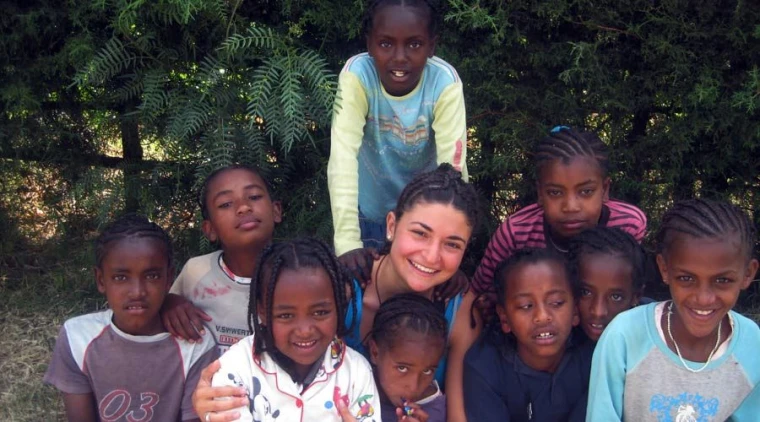
Manrique with local children in Ethiopia. .- Belén Manrique had a promising career in journalism, surrounded by good friends and family. But at age 30, she left her life in Spain behind to become a missionary in Ethiopia.
“I always say that the mission is never boring. It's a thousand times better than what we could imagine. It's a life full of surprises if you put yourself in the Lord's hands,” she told ACI Prensa, CNA's Spanish-language sister agency, during a recent visit to Rome.
“I live in Addis Ababa, the capital of Ethiopia, and my mission is to be a witness to the love of God there where he puts me, to build up the Church because it's very poor there. The Christian community is very weak, and so it is very important to help the people know Jesus Christ,” she explained.
Despite worldly success, “the life I led did not fulfill me,” she said. “The plan God had for me was different, and when I discovered that what he wanted was for me to bring the love of God to people who don't know him, I did not doubt God's call – it wasn't hard for me to leave my job as a journalist or leave Madrid.”
Manrique belongs to the Neocatechumenal Way, an ecclesial movement that focuses on post-baptismal adult formation. She said the movement helped her grow in faith.
“I was able to encounter Jesus Christ and realize that he's the only one who gives happiness to man. I went there where I found the mission the Lord had planned for me.”
Her first destination in Ethiopia was the eastern desert, “where most people are Muslims.”
“I realized it was necessary for the Church to come there to bring the Gospel to those people who don't know [Christ],” she said. “Ethiopia is 50 percent Muslim and 50 percent Christian, but most of them are Orthodox Christians. The Catholic Church is less than 1 percent of the population.”
“We're building a 'missio ad gentes' on the outskirts of Addis Ababa, in a neighborhood where the Catholic Church has no presence. Besides the Orthodox, there are a lot of Protestants,” she said.
Manrique’s work consists of helping out in the parishes, and talking to people. She stressed that success in her mission is “not about gaining followers but of being witnesses and making Jesus Christ known.”
“Not long ago a boy asked me: 'Can you be a Catholic without being a nun or a priest'? Most of the Catholics that have come to Ethiopia are nuns and priests, and so they have that thought.”
She added that she often encounters Ethiopians who want to leave their country, either to flee violence or because they have seen an idealized version of Europe on television, and believe life there to be luxurious and worry-free.
“Every day, there's someone who asks me to bring him to my country, and I tell them that the one who's not going back to her country is me,” she said. “I tell them that I lived in this idyllic world that they want to go to, and I have renounced it.”
“I explain that riches don't give happiness, that I had all that which they long for and it wasn't making me happy.  I'm much happier because God gives happiness and love for one's neighbor.”
This article was originally published by our sister agency, ACI Prensa. It has been translated and adapted by CNA.

Wednesday, October 10, 2018

Catholics in Egypt: We will not leave this country because we have a mission

The following video and article can be found can be found here.  Kudos to the brave RMS priests and the NCW brothers who chose to stay in Egypt.  As you know, Egypt is one of the places in the Middle East where Christians are being persecuted by radical terrorists.  


Thursday, August 16, 2018

NCW in the Archdiocese of Detroit

Before being assigned to Guam, Archbishop Michael Byrnes came from the Archdiocese of Detroit.  It was only last year that the Archdiocese of Detroit had welcomed the Neocatechumenal Way.  According to their website:
On March 2, 2017, Archbishop Allen Vigneron issued a decree establishing a Missio ad gentes of the NeoCatechumenal Way for the Archdiocese of Detroit. The Missio ad gentes was acknowledged by Mr. Francisco Argüello, founder of the NeoCatechumenal Way and representative of the International Responsible Team, on March 8, 2017. A certified copy of the decree may be obtained from the Chancellor’s Office, as well as additional information and assistance in understanding the details of this announcement (chancellor@aod.org)..
As of last year, a missionary family have been assigned to do missionary work in Detroit.  According to news report:

In less than two weeks, Matthew and Stephanie Zinser and their three young sons are leaving everything behind – their families, jobs and Glendale home – to answer the call to live as missionary disciples.
They will relocate to Detroit, Mich., in early September, to join four other families, laywomen and a priest, in forming a community of faith to share the Good News of the Gospel.
“I’m very nervous, but I’m very excited,” Stephanie said. “Because I have seen all of the wonders that God has done in my life and in my parents’ life, I feel like it’s time to go out and announce to those who don’t have any hope, to those who haven’t heard, that God loves them.”
The family belongs to the Neocatechumenal Way, and they feel called to be among the hundreds of families currently carrying out “missio ad gentes,” or a mission to the nations, an effort to evangelize in areas of the world where the Church is not very visible.
Last Sunday, the five members of the Zinser family stood before the congregation at Presentation of the Blessed Virgin Mary Church in Jamaica, and received a blessing for the journey ahead of them.
Father Victor Bolaños, parochial vicar, sprinkled holy water on the couple, and their boys: Matthew, 3, Noah, 2 and Ignacio, nine months.
“It is not every day that we are able to acknowledge in person the hard work that missionaries do,” Father Manuel J. Rodriguez, pastor, said to his congregation.
“When it is a whole family that decides to leave everything… for the sake of spreading God’s Gospel, this is not just uncommon, but tremendously special.”
Father Rodriguez commended the couple on “taking Jesus seriously in their life as a family.”
Matthew and Stephanie are familiar faces in the diocese, serving most recently as co-directors of religious education at St. Benedict Joseph Labre parish, Richmond Hill. Matthew, who grew up in St. Matthias parish, Ridgewood, and attended Cathedral Prep Seminary, Elmhurst, also serves as music director at Our Lady of Victory Church in Floral Park.
The couple, who will celebrate five years of marriage this fall, are members of the Neocatechumenal community at SS. Peter and Paul parish, Williamsburg, where Father Rodriguez previously served as pastor. This past Lent, they led a three-month catechesis at the Jamaica parish.
They discerned their call to become a mission family through prayer and discussion over the last two years. They volunteered with the knowledge that they could be asked to go any city in the world.
But for this family, there was a unique consideration: two of the couple’s sons have Shwachman-Diamond syndrome, a rare disorder that requires regular blood tests and monitoring. It was essential for the boys to have access to the specialists and facilities they have here in the U.S.
Earlier this year, Detroit’s Archbishop Allen H. Vigneron called for a “radical overhaul” of the Church in his diocese. He invited the Neocatechumenal Way to establish a family mission team to aid in the work of the new evangelization. For the Zinsers, it was the perfect fit.
The couple is excited to help with the rebirth of the Catholic Church in Detroit, a city suffering from poverty, racial tensions, crime and urban decay. The Church there has faced substantial challenges in recent years, including declining membership, resulting in parish mergers and closings.
Example of Christian Living
When they arrive, the Zinsers’ role will be to spread the Gospel through their daily example of living as a Christian family. They’ll actively reach out to neighbors in their community, evangelize door-to-door, pray in public squares and share their own testimonies about how God works in their lives.
One of the topics the couple discusses is their sons’ illness, which, Matthew said, could have easily driven him away from God and the Church. But because of the encounter he’s had with God in the Neocatechumenal Way, he is able to look at the situation “through the eyes of faith.”
“My wife and I don’t say, ‘Why us God?’ We’re able to put our lives and everything we do in God’s hands,” he said.
“God has given us these two children for a reason,” Stephanie added. “In the suffering, we see His face.”
Understanding that it takes years to develop relationships and build the church, the Zinsers see their move as a permanent one.
The family has found a place to live, and Matthew hopes to find a position as a parish music director. In the meantime, he says he can get by with construction work.
“We’re going with faith that God will provide for us,” he said.
They realize that doesn’t mean there won’t be struggles and challenges ahead, but they will have each other, and their fellow mission families, and many people, including those back home, supporting them in prayer.
“I’m very happy to bring up my children in this way of living, which is not going to be easy because everyone thinks we’re crazy, even our own families,” Stephanie said. “But maybe one day, with our actions, they can see the love of Christ.”
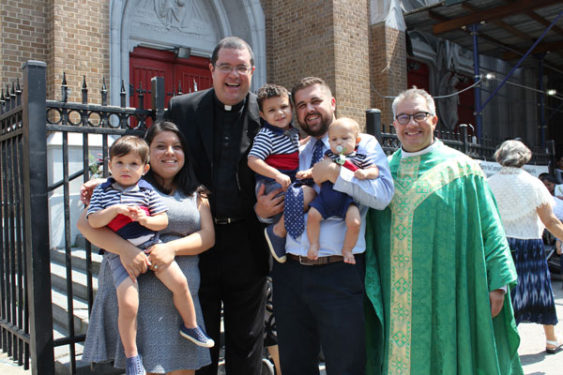
Matthew and Stephanie Zinser and their children are shown with Father Manuel Rodriguez and Father Victor Bolaños, right, after receiving a blessing prior to their leaving for missionary service with the Neocatechumenal Way in Detroit.

Monday, August 6, 2018

2015 the Great Mission

I found this video of the 2015 Great Mission in Guam.  Great video! A community was born in Yigo as a result of the 2015 Great Mission. 

Friday, July 20, 2018

Going Out

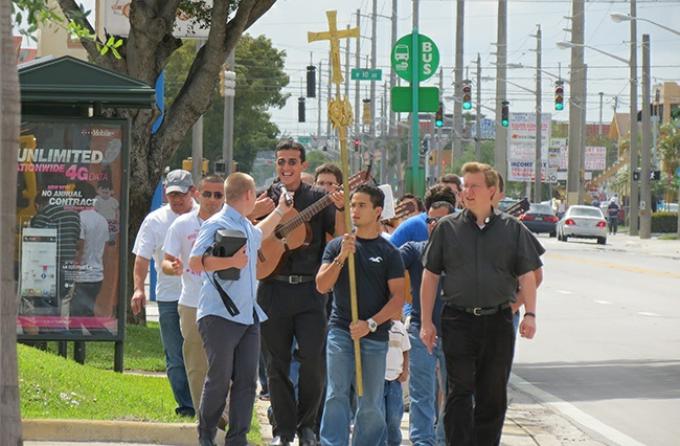
Father Emanuele De Nigris, Right, From St. Cecilia Church In Miami, Leads Singing Members Of The Neocatechumenal Way, Parishioners, And Youths Through The Streets Of Hialeah Before Beginning A Popular Mission On The Streets. LIZSANDRA TRASTOY Photo/Florida Catholic

I do wonder whether, given the unique demands of our time, it might be wise to ask a few questions about our hyper-stress on the parish.

For the past several days, I've been with my Word on Fire team, filming for the Flannery O'Connor and Fulton Sheen episodes of our "Pivotal Players" series. Our journey has taken us from Chicago to New York to Washington, DC, and finally to Savannah and Millidgeville, GA. At every step of the way, we have met numerous people who have been affected by Word on Fire materials: sermons, podcasts, YouTube videos, and the CATHOLICISM series. Many have told me that their exposure to Word on Fire started a process that led them back to the Church. Now I'm telling you this not as an advertisement for my media ministry, but rather as an occasion to muse about what I consider to be a needful change in the way the Church thinks about its essential work.

Throughout all the years of my involvement with the Church, the parish has been taken as the crucial ecclesial institution. Talk to almost anyone involved in Catholic ministry over the past fifty years and you will hear ample criticism of lots of aspects of Church life, but you will, almost without exception, hear praise of the parish. I think here of Fr. Andrew Greeley's lyrical evocations of the parish as a uniquely successful social and religious institution. Certainly within the context of diocesan priesthood, parish work is the unquestioned default position. Ministry outside of the parochial setting--hospital work, seminary work, teaching, administration, etc.--is acceptable, but it is generally seen as not quite what a diocesan priest ought to be doing. I think it's fair to say that the overwhelming amount of our money, time, energy, and personnel go into the maintenance of parish structures. 

Now please don't misunderstand me: I love the parish and believe in its importance passionately. Worship, instruction in discipleship, the building up of the community, formation for mission--all of this happens typically within the parish. I did full-time parish work for several years, and I've been involved in numerous parishes for the full thirty-two years of my priesthood. Now as a regional bishop in the largest Archdiocese in the country, I supervise and regularly visit roughly forty parishes. However, I do wonder whether, given the unique demands of our time, it might be wise to ask a few questions about our hyper-stress on the parish. 

Survey after survey has shown that the number of the "nones," or the religiously unaffiliated, is increasing dramatically in our country. Whereas in the early 1970s, those claiming no religion was around three percent, today it is close to twenty-five percent. And among the young, the figures are even more alarming: forty percent of those under forty have no religious affiliation, and fully fifty percent of Catholics under forty claim to be "nones." For every one person who joins the Catholic Church today, roughly six are leaving. And even those who identify as Catholic are spending very little time in and around parishes. Most studies indicate that perhaps 20 to 25 percent of baptized Catholics attend Mass on a regular basis, and the numbers of those receiving the sacraments--especially baptism, confirmation, marriage--are in noticeable decline. Furthermore, objective analysis reveals--and I can testify from a good deal of personal experience--that a tiny percentage of the already small percentage who attend Mass typically participate in parish programs of education, social service, and spiritual renewal. The point--and again, this is to say absolutely nothing against those who do wonderful work within the parish--is that perhaps we should reconsider our priorities and focus, above all, on active evangelization, the great mission ad extra.

Pope Francis memorably told us to "get out of the sacristies and into the streets," and to go "to the existential margins." Especially in our Western context, the streets and the existential margins are where we find the "nones." Two or three generations ago, we could trust that many people (Catholics certainly) would come to our institutions--schools, seminaries, and parishes--to be evangelized, but we absolutely cannot assume that today. But yet we still seem to devote most of our money, time, and attention to the maintenance of these institutions and their programs. Might it not be wiser to redirect our energies, money, and personnel outward, so that we might move into the space where the un-evangelized, the fallen-away, the unaffiliated dwell? My humble suggestion is that a serious investment in social media and the formation of an army of young priests specifically educated and equipped to evangelize the culture through these means would be a desideratum. But that's a subject for another column.

The last time Cardinal George addressed the priests of Chicago, at a convocation just about nine months before his death, he made a prophetic remark. He told the Chicago presbyterate that, at the beginning of the Church, there were no dioceses, no schools, no seminaries, and no parishes. But there were evangelists. He said that, in light of our present challenges, this is worth thinking about. He was right.


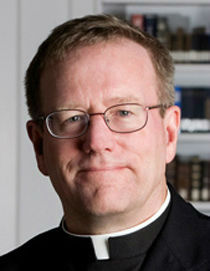
Bishop Robert Barron is the founder of the global ministry, Word on Fire, and is an Auxiliary Bishop in the Archdiocese of Los Angeles.