Showing posts with label Charismatic Catholics. Show all posts

Monday, July 1, 2019

Charismatic Catholics Renewal Statutes Approved

The Statutes of the Neocatechumenal Way was approved by the Holy See in 2008, and its Directory was approved in 2010.  In June 2019, the Statutes of the Charismatic Catholic Renewal was approved during the annual meeting of the ecclesial movements.  Congratulations to the Charismatic Catholics.  By the way, Archbishop Michael Byrnes was also a member of the Charismatic Catholics. You can find the following story here

There are many movements and communities within the Catholic Church because every Catholic is unique.  The Apostle Peter, whom Christ gave the keys to, have always represented the Church.  But the Apostle Paul is the one who represent all the charisms within the Catholic Church.  Paul may have been a Charismatic Catholic, speaking the tongue of angels, as he evangelized the Gentiles in the Neocatechumenal Way.  :)

1 Corinthians 13:1 Though I speak with the tongues of men and of angels, but have not love, I have become a sounding brass or a clanging cymbal. 
----------------------------------------------------------------------------------


Rumold van Geffen reports on a meeting of ecclesial movements which was held recently at the Focolare Centre for Unity in Welwyn Garden City, Herts.
Bishop Sherrington
Bishop Sherrington
At Pentecost 1998, Pope John Paul II invited all the new Movements and Ecclesial Communities to Rome to affirm that they were recognised as a co-essential part of the Church as a whole. Ever since that date representatives of many of the New Movements have started to meet on a regular basis in many countries worldwide. This year's meeting here in Britain was held on 25 June.
As well as from Focolare there were representatives from Charismatic Renewal, Chemin Neuf, Madonna House, Schoenstatt, Sword of the Spirit (Antioch Community), Neocatechumenal Way and the Sion Community.
We rejoiced with Charismatic Renewal in the fact that they are now officially recognised by the Roman Catholic Church during the Pentecost celebrations in the Vatican under the name CHARIS.
The following is a link to their approved statutes: https://drive.google.com/file/d/1vH7wbJDdIon7VwdUyGjFys3IygVsVoQo/view
In the afternoon, the meeting in Welwyn Garden City centred on a sharing of how each Movement was absorbing the Word of God in their daily life. This sharing was introduced by Deacon Adrian Cullen, who spoke about the Bishops of England and Wales' initiative to dedicate the year 2020 to Sacred Scripture under the name: 'The God Who Speaks', and which will take place in cooperation with the Bible Society.
In the morning, the sharing was about the challenge of trying to communicate to the new generations the constant moral teachings of the Church. Bishop John Sherrington presented an overview of the cultural factors which make communication of such truths difficult to be heard and then facilitated the sharing of questions and thoughts from members the Movements who recognise that these can be very difficult teachings to hand onto young people.
Bishop Sherrington quoted St. Oscar Romero who helped us understand that Christianity is not merely a collection of truths to be believed, rules to be followed, or prohibitions. Seen that way, it puts people off. Rather 'Christianity is a person who loves me immensely, who demands and asks for my love. Christianity is Christ.' It therefore becomes necessary that we invite everybody we meet to change from being 'nomads', people who move from one water-hole to the next, (i.e. from one excitement to the other) to becoming 'pilgrims', people who are on the way but already know their goal, (i.e. holiness in Jesus Christ). This means that only if we are able to invite the new generations to come with us on this pilgrimage can we share with them the centuries old wisdom of the Church contained within its moral teaching and together with them find new ways in which it is expressed.
There was a candid and open sharing by all present which felt very much in conformity with the words of the apostle Paul: 'When I am weak, then I am strong' (2 Cor. 12: 10).

Thursday, June 8, 2017

Evangelization

Today, the churches sit mostly empty except on Christmas, Easter, and during the village fiesta.  This is not happening only on Guam, but everywhere. Asia and Africa are the only two continents where one sees a rise in Catholicism. Europe has shown a sharp decline.  While many Catholics stayed at home or joined other Christian denominations, very little was being done to entice or encourage them back to the One, Holy, Catholic, and Apostolic Church. 

Christ entrusted all of us with the mission to go out and spread the Gospel to the ends of the world.  This mission is not given to the priests and bishops alone.  The Charismatic Catholic Renewal is making much headway in Latin America in bringing fallen away Catholics back to the Church.  According to one report:
In the last century, Pew reports, the percentage of the world's Catholics in Latin America and the Caribbean has risen from 24 percent to 39 percent, with an estimated 425 million of the world's nearly 1.1 billion Catholics residing in the region in 2010. 
And part of that Catholic growth in recent decades has come from the rise of Catholic charismatic groups, which from their origins in the late 1960s now attract an estimated more than 70 million followers in Latin America, according to scholars such as Jakob Thorsen of Aarhus University in Denmark. 
 And those followers, unlike many nominal Catholics on the continent are active and committed.
The Catholic Charismatic Renewal movement has led to an internal revival that has seen Mass attendance rise and some of new converts “or reconverts,” Catholics returning to their faith, according to religion scholar Carlos Frederico Barboza de Souza of the Pontifical Catholic University of Minas Gerais. 
Like the Charismatic Catholic Renewal, the Neocatechumenal Way have also brought people back to the One, Holy, Catholic, and Apostolic Church. Worldwide, the NCW consist of some former atheists, fallen away Catholics, and non-Catholics. The goal of the NCW is to bring people closer to Jesus Christ in which they come to know Him intimately. 

Christ is the mediator between God and His Church.  And His Church is the mediator between Christ and the rest of humanity.  In other words, it is the duty of the Church to bring all humanity to Christ.  This is not the duty of the bishops and priests alone.  Thus, the NCW has mission families, itinerants, and mission communities traveling in small groups and in two by twos.  As shown in the photo below, sometimes the priest evangelizes with the laity.     

To evangelize means to go out of the church building.  The message of Pope Francis to the Church:
“But in order to evangelize: ‘Get up and go!’ One doesn’t say: ‘Stay seated, calm, in your house’: No! In order to be faithful to the Lord, the Church should always be on its feet and on the journey: ‘Get up and go.’ A Church that does not rise up, that is not on the journey, is sick.” 
“All men, all women have a restlessness in their hearts – [they may be] good or bad, but there is a restlessness. Listen to that restlessness. It’s not saying: ‘Go out and proselytise.’ No, no! ‘Go and listen.’ Listening is the second step. The first: ‘Get up and go’; the second: ‘Listen.’ That ability to listen: What do people feel? What does the heart of the people feel? What does it think? But do they think mistaken things? But I want to hear these mistaken things, in order to understand where the restlessness is. We all have this restlessness within. The second step for the Church is to find the restlessness of the people.” 
This message is not only to the laity, but to the priests and bishops as well.  Unfortunately, some priests prefer the comforts of their home inside the church building, waiting for the lost sheep to come to them, while others take to the Internet and social media to evangelize.  While technology has its good usage, this is not the proper way to evangelize.  Face to face human contact is the only way for the second step to take place. The second step is to listen to the people. You cannot know the restlessness within the people unless you meet with them. 

Related image 
.  

Monday, June 5, 2017

Celebrating Pentecost Vigil

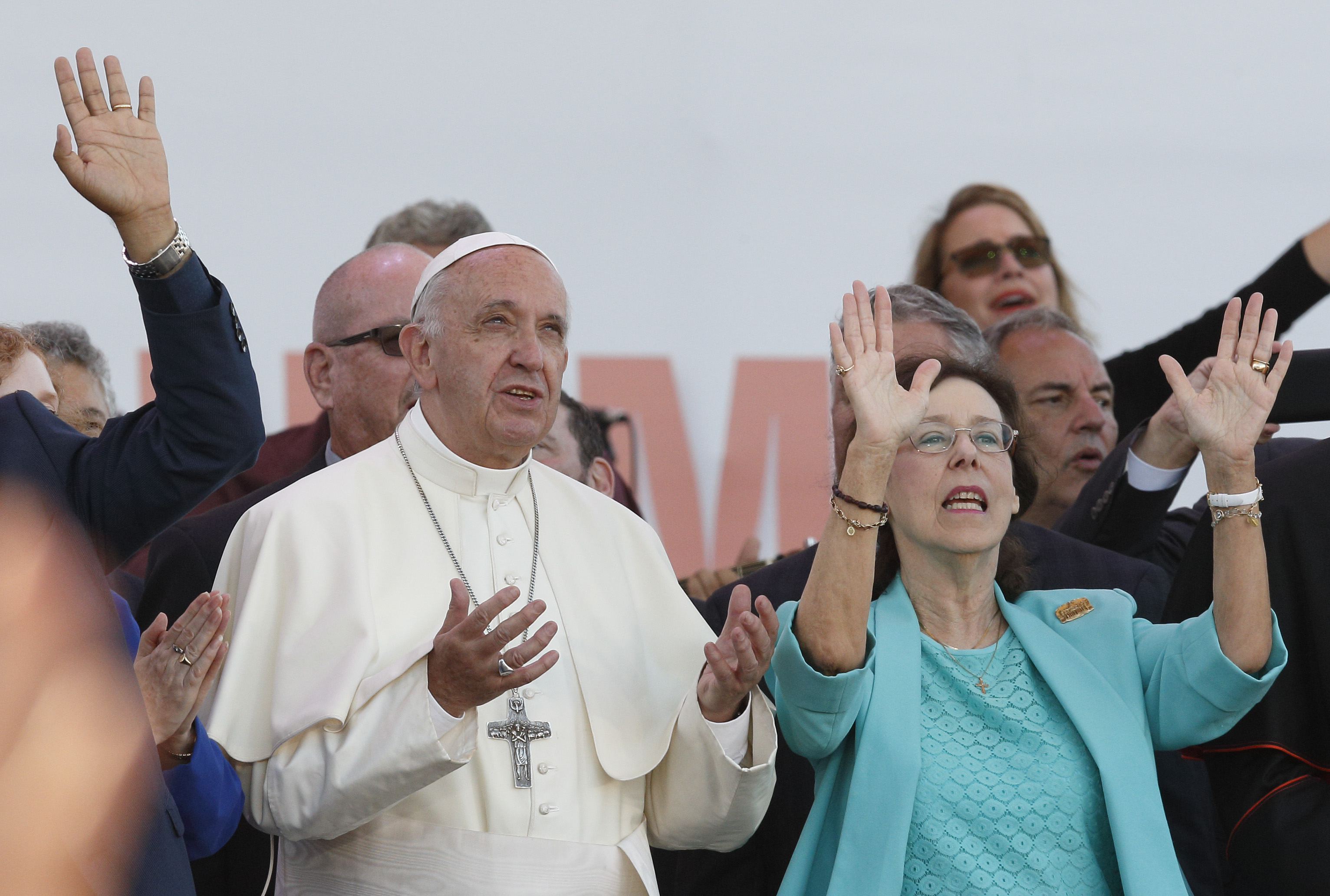
The NCW communities celebrated the Pentecost Vigil, which turned out to be very beautiful.  Some of the communities were combined with others.  In Rome, Pope Francis celebrated the Pentecost Vigil with the Charismatic Catholic Renewal.  Members of the Pentecostal and Evangelical churches in Rome were also invited to the vigil.  Pope Francis gave an inspiring homily, which you can read here.  Pope Francis emphasized on two temptations: diversity without unity and unity without diversity.  

According to one news report:
ROME - Rome this weekend is eerily bereft of Romans and traffic. A four-day weekend, and a hot one to boot, offer compelling reasons to make for the beaches.
Call it the calm before the fire. The roads have been cleared for huge numbers of singing, clapping pilgrims in bright red baseball caps here to celebrate the fiftieth anniversary of the Catholic Charismatic Renewal (CCR).
The big event is the Pentecost vigil tonight in the Circus Maximus, when Pope Francis will pray with some 30,000 pilgrims from 230 countries, offering them guidance and, of course, invoking a fresh outpouring of the Holy Spirit. Among them will be hundreds of Pentecostal and evangelical leaders who form part of CCR communities.
Meanwhile, it’s been a time for looking back and taking stock of the significance of a movement that began - like the Church itself - from a small group of people swept up by an intense experience of the Holy Spirit: Not, this time, in Jerusalem, but on a campus near Pittsburgh in 1967.
From that so-called “Duquesne weekend” the Renewal spread rapidly, as people were baptised in the Spirit, and new groups and movements appeared across the Church, touching millions. Charismatics speak of the greatest spiritual awakening since the early Church, an “outpouring of grace” for all Catholics.
On Thursday morning at the Vatican’s Urbaniana university, some of the CCR’s leading minds were taking stock of the road traveled so far and thinking about what it has meant for the Church.
To describe this as a symposium doesn’t quite capture it. There was “praise” - including singing in tongues - beforehand, and quite a few of the speakers couldn’t resist kerygmatic outbursts that elicited from the audience outbursts of “Alleluia” and “Praise the Lord!”
When the preacher of the papal household, Franciscan friar Fr. Raniero Cantalamessa, happened to mention ‘Amazing Grace’ halfway through his talk, he couldn’t resist getting us all to sing the first verse.
And when the Pentecostal speaker, Vinson Synan, gave a powerful testimony of the fruits of the outpouring of the Spirit in the Catholic Church, the audience rose up to clap and give praise. He sat back in his chair, arms outstretched, shaking his head and giving thanks - smitten in the Spirit.
But as unusual as this may be in an academic hall in Rome, it’s increasingly the new normal in the Church across the world, a sign of how far this extraordinary movement has come in a matter of decades.
The main takeaway for me was that in the Francis pontificate the two currents of renewal in the modern Church - the “conciliar” and the “charismatic” - are meeting in an exciting new moment that many described as a kairos, or “time of special graces.”
Despite all the talk of the Second Vatican Council as a new Pentecost, and its acknowledgement of the charismatic dimension alongside the institutional, the Holy Spirit didn’t occupy a central role in the documents themselves. According to Cantalamessa, the flourishing of what the Protestant theologian Karl Barth called “third-article” - that is, of the Creed - theology came afterwards, and has been the major innovation in theology since then.
More than one speaker recalled how the Renewal was accepted with remarkable speed in the Catholic Church, especially compared with the way the Pentecostal revival had been rejected by mainstream Protestantism. (Synan had a very funny description of arriving in Rome in 1972 alongside a nun who turned out to be baptized in the Spirit.)
The acceptance was modeled by the popes, beginning with Paul VI in 1975, although most bishops were a lot slower to embrace the new outpouring.
One area which Rome for a long time did not recognize was the charismatic work for Christian unity, according to Fr. Peter Hocken, an English priest long involved in the CCR.
The Renewal was born ecumenical - the fruit of Catholics being prayed over by Pentecostals - and from the start went beyond the conventional theological dialogue model that came out of the Second Vatican Council.
Hocken calls this extra element “charismatic ecumenism,” because it involves discerning the action of the Holy Spirit in - and recognizing the gifts poured out by the Spirit on - other denominations. One of its “striking hallmarks,” he says, is “the radical equality of all those baptized in the Holy Spirit,” one that “requires a new formulation of our convictions.”
Despite the embraces of Karl Rahner and Yves Congar, theologians in the 1980s and 1990s were suspicious that charismatic ecumenism was insufficiently ecclesial and too “emotional,” a fear that only began to disappear after St. John Paul II’s 1999 Ut Unum Sint. 
Now, says Hocken, Pope Francis in both word and action “is bringing to an end the lack of connection between official ecumenism and charismatic ecumenism. This is very significant.”
Francis’s outreach to Pentecostals and evangelicals has been marked his insistence that the “current of Grace” represented by the Renewal is fruit of the one Holy Spirit calling the Christian Churches into unity, not through proselytism or purely intellectual dialogue but in revealing their oneness in diversity.
Under Francis, the conciliar and the charismatic renewals are being brought together, Hocken says, in a “Kairos moment of great opportunity.”
Long before he became pope, Cardinal Jorge Mario Bergoglio was practising this “ecumenical ecumenism” in Buenos Aires, giving his support to huge joint Catholic-evangelical meetings in Luna Park stadium.
Two of them were attended by Cantalamessa, who was deeply impressed by the Archbishop of Buenos Aires’s extraordinary openness to the current of Grace. “I’ve never seen a bishop in front of an interconfessional audience declare, ‘this is the Church’,” he told me during a break on Thursday.
In his talk, the preacher to the papal household noted how the longstanding western cultural perception of Christianity as gloomy rather than joyful was the result of a practical reduction of the role of Grace. In effect, western Christianity - less so in the east - over time came to focus almost exclusively on the power of Grace to free from sin, rather than on the new life in Christ it brought.
One of the effects of the the current of grace enabled by the Renewal (and the Pentecostal revival before it), has been to bring back that balance, “allowing us to restore to Christian salvation the rich and inspiring content consisting of the indwelling of the Holy Spirit and the new life in Christ.”
This what what Paul VI meant, said Cantalamessa, when he spoke in 1975 of the Renewal as a “chance for the Church and the world.”
What Cantalamessa called “a joyous, contagious Christianity in the power and anointing of the Holy Spirit without the gloom Neitzsche reproached Christianity for” is captured, of course, in the titles of Francis’s two exhortations, ‘The Joy of the Gospel’ and ‘The Joy of Love.’
In Francis, says Hocken, there is a “new emphasis on the creativity of the Holy Spirit,” reminding people that while some things may stay the same, nothing is ever merely repeated, and that God is constantly doing new things.
That can often be missed, he says, by Catholics anxious to find a precedent for everything in past tradition - yet tradition is precisely made up of the new things God has done for His Church.
But maybe it takes the Holy Spirit to see that.

Monday, May 15, 2017

Conversion Of An Atheist

Below is a very beautiful article on how one of the movements in the Catholic Church was able to convert an atheist into Catholicism. After joining the Charismatic Catholic Renewal (a movement within the Catholic Church), the atheist have come to know God and that He was calling him to the priesthood.  The following article can be found here.

-------------------------------------------------------------------------------- 

Priest. Public Domain via Pixabay..- After an anti-clerical childhood and adolescence, filled with hatred for the Church, Fr. Juan José Martínez says he discovered “that God exists and wants me as his priest.”
“Sunday mornings I would peer out of the balcony of my house, and when the people were going by on their way to Mass, I would spit on them. I told them that the Church was a sect that wanted their money,” explained the priest, who ministers in the Diocese of Almeria, Spain.
Fr. Juan José's parents were not believers, and he had received no religious formation, but he said they did not raise him to be intolerant. In fact, he says he does not know where he got all those ideas, because the perception he had of the Church and God was that of a “multinational corporation with branches in every neighborhood to extract money, like a sect.”
“I was absolutely anticlerical, I was the first student in my school and the town of Carboneras, Almeria Province, to never be taught Religion because when I was 8 or 9, I chose the alternative course which was Ethics. In the following years, I went on convincing my friends to quit Religion classes and to take Ethics with me. In the end, my whole class ended up being taught Ethics and none of them Religion.”
But what he never imagined is that the end of his journey would be to help his friends to come back to the Church. Fr. Juan José remembers quite well that the first day he went into a Catholic church, “I went to make fun of those who had invited me.”
“It was in January 1995, some friends from class invited me to a Catholic Charismatic Renewal prayer group at the parish. Obviously I told them I wasn't planning on going because I didn't want them to brainwash me. For a whole month they persisted. I finally gave in – it was a Thursday in February 1995 when I went into a Catholic church for the first time.”
A golden box
A lot of his friends were there, and he was surprised because “they were all looking at a golden box at the back of the church. I didn't know what it was, but I thought it was where the parish priest kept the money.”
That golden box was the Tabernacle.
Fr. Juan José says that he came to make fun of them because “I thought they were crazy. Inside, I was laughing at them a lot, but I was polite and concealed it.  But I decided to come back the following Thursday to laugh at them some more.”
And so one Thursday after another, Fr. Juan José was letting go of his prejudices against the Church and religion.
“The pastor seemed to me to be a very wise man who was helping the people,” he told CNA. And little by little, the love of God was penetrating his heart: “I was 15 years old and I started to sing at Mass, which meant I would attend Mass on Saturdays. I liked being in front of the tabernacle and little by little, I realized that God existed and loved me. I felt the love of God. The Charismatic Renewal group, which I had come to make fun of, helped me a lot.”
“My eyes were being opened and I saw that God was not a legend or story for the weak, but that he existed and that he was supporting and guiding me. I experienced that he loved me so much that he wanted me for himself and was calling me,” he recalled.
“I am yours for whatever you need”
Fr. Juan José had been baptized and made his First Communion because of his grandparents' wishes, but he did not have a relationship with God after that. “I made my Confirmation as I was right in the midst of the process of conversion, and it was a genuine gift. That day I told the Lord, 'I am yours for whatever you need.' My mother came but my father did not. It was a unique moment in my life to receive the Holy Spirit and to put my trust in the Lord.”
For months, the young Juan José was resisting the call to the priesthood. “I told the Lord that I didn't want any hassles and to quit talking to me. Until I had to make a decision and it was to follow him, becoming a priest.”
One Saturday afternoon when he was 17, Fr. Juan José told his father he wanted to go to the seminary. His father beat him and said that “he would be a priest over his dead body.”
“They did not understand that I would want to be a priest. In fact, my father offered to pay for me to go to college in the United States but (he told me) he would never pay for the seminary.”
In such a difficult moment, Fr.  Juan José recalled that all he could think of was the prayer of Saint Teresa of Avila: “Let nothing disturb you, nothing frighten you. All you need is God” and when his father stopped rebuking him, the young man gave him a hug and said to him, “I knew you were going to react like that, but I also knew that one day you'd understand.”
“Welcome”
In fact, his father went so far as to threaten to report the pastor to the police if kept helping his son discern his vocation. “My father was trying everything, but the Lord is stronger,” he said.
To obey his father, Fr. Juan José could not start the seminary, and so he began to study teaching at the University of Almeria. For years he was patient, and continued to be faithful to his vocation to the priesthood. Until one day in May 1999, as he recalled, his mother told him that she had spoken to his father and that finally he would let him enter the seminary. “I began to cry and cry. I remember when I told the pastor about it he said “welcome” and gave me a great big hug.”
In September 2000, he finally entered the seminary.
In 2006, Fr.Juan José was ordained in the Almeria cathedral and his father even attended the ceremony. “In no way did he want me to become a priest, but he saw that I was happy and even though he was totally anticlerical, he decided that the happiness of his son came before his ideology and if I was happy, even though he didn't understand it, he would have to accept it. “
In fact, he recalled that two years ago, “before dying, my father received the Anointing of the Sick. And it was I who administered it to him.”
“When somebody tells me he doesn't believe in God, I always tell him that neither did I believe in Him, but I was mistaken, because I have discovered the genuine happiness that Jesus has given to me. If you're not completely happy, ask the Lord to help you, because only He will give you the happiness that your heart needs.” 

Friday, April 3, 2015

Good Friday


It is Good Friday.....the day Christ died.  More than 2000 years ago, on this day, many of his followers mourned his death.  Today is a solemn and holy day for Christians.  Yet, it is called "Good Friday" despite that killing an innocent man was an evil thing.  But out of this evil, God brought out something good.....mankind's redemption.  He died because of our sins, but his death brought forgiveness of sins and redemption so that we may have eternal life with Him. Just as the song says, we too will rise just as Christ was raised from the dead.  


Wednesday, December 10, 2014

Kiko Arguello and Salvatore Martinez

On December 5, 2014, Pope Francis received a private audience with Kiko Arguello (the Founder of the Neocatechumenal Way) and Salvatore Martinez (President of the Renewal in Spirit in Italy). 


Pope Francis held two private audiences with the heads of Renewal in the Spirit (Charismatic) movement and the Neocatechumenal Way.

In a statement released today, Martinez, the President of Renewal in the Spirit in Italy, said that both recalled the national meeting which took place in June at Rome’s Olympic Stadium.

Martinez also stated that the Holy Father expressed his gratitude for the Family of Nazareth International Center, which is run by Renewal in the Spirit. The foundation took part in the recent Synod on the Families, giving out copies of their book “Rosario della Famiglia” (Family Rosary).

“‘Move without caging the Holy Spirit’”, Martinez said, recalling the Pope’s words. The Pope has shown great joy for the commitment of the Movement in translating a new service of missionary responsibility, the pastoral teachings contained in the Apostolic Exhortation “Evangelii Gaudium”.
He also stated that the Pope encouraged the members of Renewal in the Spirit to carry on the “spiritual and social renewal of our time.”

Communities in Mission

Kiko Argüello, founder of the Neocatechumenal Way, met with the Holy Father shortly after in which he explained several new initiatives.

In an interview with Vatican Radio, Argüello said the Pope recognized and appreciated the fruits born of the Way which “do much good for the Church” and “for vocations.”

“I spoke to him about the Communities in mission and of this meeting which we will do to send families in mission from the Way,” he said.

According to its statutes, the Neocatechumenal Way is not a movement or an association, but an itinerary of Catholic formation “in the parishes at the service of the bishop to return to faith many of those who abandoned it.”

“We have roughly 40 communities who have finished the itinerary of the Neocatechumenal Way and offer themselves to the Church to be sent out to the peripheries, to parishes that are in need of help,” Argüello said.

The founder of the Neocatechumenal Way went on to explain that the “communities in mission” help parishes look for those are far from the Church by visiting neighbourhoods in difficult or de-christianized areas. There are currently 15 communities in mission throughout the diocese of Rome who were sent by Pope Benedict XVI on January 10, 2009.

Pope Francis meets with Arguello and Martinez

Monday, June 9, 2014

Oceans Will Part Nations Come


It is not very often that I post a Charismatic Catholic song.  Most of the time, I would post the songs of the Neocatechumenal Way.  In the Way, we say that music is twice the prayer.  Most of the songs in the Way come from the Book of Psalms.  At any rate, this is one Charismatic Catholic song.  Music is a power that can evangelize when used properly. 

The Apostle Paul may have been a Charismatic because he spoke in the tongues of angels.  St. Paul says that even if he speaks with the tongues of men and of angels, if he has no love in him, he is nothing: 

1 Corinthians 13:1-2  Though I speak with the tongues of men and of angels, and have not charity, I am become as sounding brass, or a tinkling cymbal.
And though I have the gift of prophecy, and understand all mysteries, and all knowledge; and though I have all faith, so that I could remove mountains, and have not charity, I am nothing.


Sunday, June 8, 2014

Charismatic Catholics in Latin America


Of the many movements in the Catholic Church, I admire the Charismatic Catholics despite that I walk in the Neocatechumenal Way.  As I once said, music has a power to evangelize.  Music appeals to people of all ages especially the youths.  The Pope looks to the youths for they are the future disciples.  Below is an article I found on the Charismatic Catholics dated 2011:

The Rise of Charismatic Catholics in Latin America

-------------------------------------------------------------------------

Much has been made of the dramatic rise of Protestantism in Latin America. Many view this as a sign that Catholicism’s primacy in the region is at last beginning to wane. Overlooked by journalists and scholars has been the parallel growth of Charismatic, or Pentecostal, Catholicism in the region. Edward Cleary offers the first comprehensive treatment of this movement, revealing its importance to the Catholic Church as well as the people of Latin America.

Catholic Charismatics have grown worldwide to several hundred million, among whom Latin Americans number approximately 73 million participants. These individuals are helping the church become more extroverted by drawing many into evangelizing and mission work. The movement has rapidly acquired an indigenous Latin American character and is now returning to the United States through migration and is affecting Catholicism in the United States.

Cleary has witnessed firsthand the birth and maturing of the Catholic Charismatic Renewal in Latin America as both a social scientist and a Dominican missionary. Drawing upon important findings of Latin American scholars and researchers, he explores and analyzes the origins of the most important Catholic movement in Latin America and its notable expansion to all countries of the region, bringing with it unusual vitality and notable controversy about its practices.


Thursday, June 5, 2014

Charismatic Catholics Pray Over Pope Francis


Pentecost is just around the corner, and I found another interesting article on the Charismatic Catholics.  Pope Francis invited them to the Vatican in 2017 to celebrate their 50th anniversary.  It seems that the Neocatechumenal Way is much older.  We started in 1964 and the Charismatic Renewals started in 1967.  We're only three years apart. 

At any rate, Pope Francis admitted that he was not always comfortable with the way the Charismatic Catholics prayed; nevertheless, he knelt on stage as they prayed over him, singing and speaking in tongues.  Over time, Pope Francis came to accept the Charismatic Catholics and invited them to the Vatican on 2017.  According to the weblink below: 

In a speech, Pope Francis told the charismatics that they their movement was begun by the Holy Spirit as "a current of grace in the church and for the church."

He pleaded with charismatic groups not to try to organize everything or create a bureaucracy that attempts to tame the Holy Spirit.

The temptation "to become 'controllers' of the grace of God" is a danger, the pope said. Group leaders, sometimes without even meaning to, become "administrators of grace," deciding who should exercise which gifts of the Holy Spirit. "Don't do this anymore," Pope Francis said. "Be dispensers of God's grace, not controllers. Don't be the Holy Spirit's customs agents."

From the beginning, he said, charismatics were known for their love of and familiarity with the Scriptures; the pope asked those who lost the habit of carrying their Bible with them everywhere to "return to this first love, always have the word of God in your pocket or purse."

Pope Francis also said Catholic charismatics have a special role to play in healing divisions among Christians by exercising "spiritual ecumenism" or praying with members of other Christian churches and communities who share a belief in Jesus as lord and savior.


Charismatic Catholics Pray Over Pope Fancis


Saturday, February 15, 2014

Charismatic Catholics No. 2

I am not a Charismatic Catholic, but they intrigued me mainly because of my love for music.  They say that music can soothe the savage beast.  In the Way, music is twice the prayer.  The Way also have their own music.  Most of the Way's music came from the Bible while a few were created by Kiko.  

The Charismatic Catholics are proving to be a competition for the Pentecostals in South America.  Like the Neocatechumenal Way, the Charismatic Catholics are also being persecuted by fellow Catholics.  However, they are on the rise in many places in South America and Asia.  Former Catholics are reverting to the Catholic Church in South America and joining the prayer groups of the Charismatic Catholics  The advantage that South America have in revitalizing Catholicism was the election of Pope Francis who came from Argentina.  

The video below was from a Charismatic Catholic conference that was held in the Czech Republic in 2007. I love listening to the song despite that I don't know the language.  


Monday, February 10, 2014

Charismatic Catholics

I was very impressed with Pope Francis when he held Pentecost Mass last year.  He was addressing members of the Neocatechumenal Way, the Charismatic Renewal, Focolare Movement, Regnum Christi, Communion and Liberation, and others.  

He stated that diversity is a blessing, and I find this to be true.  The Body of Christ is one, but there is diversity among its many members.  The gifts of the Holy Spirit are many.  

I am not a Charismatic Catholic, but I was intrigued by them when I first heard of them.  I learned that they sing a lot.  The Neocatechumenal Way has a lot of songs - most of them from the Holy Bible, but that certainly doesn't make the Neocatechumenal Way "charistmatic". There are many Christian songs that are very beautiful. This year, I learned that Pope Francis appointed a charismatic priest in one of Brazil's struggling churches.  It turned out that this charismatic priest is actually reviving the church in that the pews are now filling up.  This is a fruit of the Holy Spirit.  

Music has its own way of speaking and preaching to people, especially when used in the right way.  It is also twice the prayer.  At any rate, I found a short video of that charismatic priest who was able to use his gift from the Holy Spirit to bring people back into the Catholic Church.  

Also, it is interesting to note this biblical verse in the Holy Bible:  

1 Corinthians 13:1  If I speak in the tongues of men or of angel, but do not have love, I am only a resounding gong or a clanging cymbal.    

Tongues of angels???  I guess the Apostle Paul was a Charismatic.