Friday, August 7, 2020

God Provides

It has been a while since I published some of Father Gordon's articles.  Two days ago, he sent me an excellent article about an elderly woman.  We should never forget the elderly who are the most vulnerable during this pandemic, and sometimes even the most lonely. 

However, I entitled this post "God Provides" because of what our Lord did through this elderly woman.  She took in a homeless and elderly priest who was discarded by the Catholic Church and shunned even by her extended family.  Shocking of all is a bishop sending the elderly woman a letter, reprimanding her for sheltering the homeless priest.  According to These Stone Walls:
Twenty years ago, her husband died from cancer after she cared for him at home every day until the end. They had no children. Five years after his death, she courageously defied our Puritanical social mores when she took in a 62-year-old homeless man suffering from chronic heart disease.
That man was also her parish priest. She had been burdened with chronic depression and the anxiety of being alone when his plight intersected with hers. He had been summarily discarded during the purge of 2002 when (then) Cardinal Theodore McCarrick, (then) Bishop Wilton Gregory, and (then) SNAP Director David Clohessy convinced the panicked U.S. Bishops that accusation is sufficient probable cause for execution. The priest in question, 34 years ordained, was given 24 hours to remove himself from church property.............
Mrs. South faced substantial pressure when she provided a home for that discarded priest who, though twelve years younger, suffered from a debilitating decline in cardiac functioning. Some of her extended family sent her notes inviting her to holiday gatherings, but made it clear that her “friend” was not invited. His bishop once sent her a letter of reprimand for taking him in.
As you can see, God does not forget even those who were discarded by the Church.  He still loves them and provides for them.  That homeless elderly priest will not forget the woman who gave him shelter and neither will God.  Those who are rejected are cared for by God. God provides.    

Matthew 25:34-36  "Then the King will say to those on his right, 'Come, you who are blessed by my Father, take your inheritance, the kingdom prepared for you since the creation of the world.  For I was hungry and you gave me something to eat, I was thirsty and you gave me something to drink, I was a stranger and you invited me in, I needed clothes and you clothed me, I was sick and you looked after me, I was in prison and you visited me.'" 

The rest of the story below is found here:
----------------------------------------------------------------------------------

In a Pandemic, Elders Out of Sight Must Not Be Out of Mind

If the state of the world has you in a state of anxiety, if politics and this pandemic find you frazzled, reach out to our elders in solitary confinement.
“Semper Ubi Sub Ubi.” Those Latin words came up in casual conversation recently. I’ll explain why in a moment. I learned that Latin phrase from Miss Ruggiero, my tenth grade public school Latin teacher at age 14 in 1967. I never forgot them. She had been attempting to explain that the sound of words can take on a different meaning than how they appear in print.
“Semper Ubi Sub Ubi” literally means “Always Where Under Where,” which makes no sense of course. If you say it aloud to yourself, however, it becomes a snippet of wisdom passed on by generations of mothers to their reckless adolescent sons.
When the global Covid-19 pandemic descended upon us in early 2020, I wrote a post that tried to bring some perspective to our plight. Its title was, “Holy Week, Coronavirus, Loneliness, Politics, Yikes!” That title now reads like a summary of the last six months as 2020 rolled along heavily burdened by both politics and a pandemic, and the urban riots of “Cancel Culture.”
In that post, I briefly mentioned that I cope with all this stress by reaching out to someone more stressed and vulnerable than myself. I am a prisoner, as you know, and as of this posting I have been so for twenty-five years, ten months, and seven days. All this time has passed unjustly in a state with “Live Free or Die” as its motto and in a country that calls itself the cradle of liberty and justice for all. Living with such contradiction is the most stressful thing I have ever encountered.
Until, that is, I encountered “Mrs. South,” an 87-year-old friend with whom I pass the last thirty minutes of each day. This friend faces our pandemic in solitary confinement in a small Cincinnati apartment hundreds of miles from this prison. Twenty years ago, her husband died from cancer after she cared for him at home every day until the end. They had no children. Five years after his death, she courageously defied our Puritanical social mores when she took in a 62-year-old homeless man suffering from chronic heart disease.
That man was also her parish priest. She had been burdened with chronic depression and the anxiety of being alone when his plight intersected with hers. He had been summarily discarded during the purge of 2002 when (then) Cardinal Theodore McCarrick, (then) Bishop Wilton Gregory, and (then) SNAP Director David Clohessy convinced the panicked U.S. Bishops that accusation is sufficient probable cause for execution. The priest in question, 34 years ordained, was given 24 hours to remove himself from church property.
In 2005, when Dorothy Rabinowitz and The Wall Street Journal published “A Priest’s Story,” a groundbreaking series about my imprisonment, Mrs. South also reached out to me by mail after weeks of trying to discover my address. Over the next fifteen years, we spoke occasionally by telephone. In 2007, before the visiting period here was reduced to 90 minutes, they visited me.
In November of 2019, after providing that priest with a home for fifteen years, my friend found him dead in his room. It was catastrophic and traumatic, and now, at age 87, she is alone again, facing this pandemic without even the consolation of a human voice. So, for the previous months since his death, I call her from my prison cell in the last half hour of my day.
A PREVENTION WORSE THAN THE DISEASE
Be patient, please, for I am getting to the point about my Latin phrase that began this post. Covid-19 has caused over 56,000 deaths among our elders in long-term care facilities. When you add to that number those who lived self-sufficient and alone who became infected with this virus, the death toll is astronomical. An estimated 85-percent of U.S. deaths have been people over the age of 75.
But the picture is more complicated than that. A multitude of studies have shown that isolation and loneliness are detrimental, not only to one’s mental and spiritual well-being, but to physical health as well. Chronic loneliness diminishes the immune system. Depression is linked to weight loss, and, in many elderly, malnutrition. A lack of human companionship and interpersonal communication impairs cognitive functioning, and exacerbates the natural decline that aging brings to mental capacity. Mrs. South never imagined that she would outlive her friend.
Mrs. South faced substantial pressure when she provided a home for that discarded priest who, though twelve years younger, suffered from a debilitating decline in cardiac functioning. Some of her extended family sent her notes inviting her to holiday gatherings, but made it clear that her “friend” was not invited. His bishop once sent her a letter of reprimand for taking him in. However, her saving him from homelessness had the unintended consequence of also saving her from her greatest fear: being alone.
When he suddenly died in her home fifteen years later, she was devastated. It took Mrs. South several days to contact me, and when I finally received her letter I telephoned her immediately. The trauma of what happened and what it meant to her was clear.
It was also clear that she was facing it alone. In the ensuing months, she could no longer keep up her home and had to move to a small rented apartment. Just as she moved in, the global pandemic was unleashed, trapping her in a prison of loneliness and isolation. She sent me a selfie-photo of herself sitting on the small apartment’s balcony. Her weight loss was alarming.
After my first conversation with her following the sudden death of “Father Ken,” it was clear to me that she neither could nor should face this alone. She broke down in tears while describing that it took her three days to reach me. So I told her that I would call each night at 9:30 PM. The thought of her alone in the prison of that apartment during this pandemic haunted me.
Because of the introduction of GTL tablets in this prison two years ago, I am able to make telephone calls directly from inside my cell. So I suppose you could say that I have a cell phone, something that three years ago would have earned me a stint in the hole. I can only place outgoing calls until 10:00 PM so I decided to give Mrs. South the last half hour of my day.
The importance of this was clear from the start. She would often tell me that mine was the only human voice she heard that day. Inevitably, many calls resulted in her tears as she grieved. She described each day alone waiting for my call as the plight of a fellow prisoner.
Because her apartment complex was limited to senior housing, its residents were required during the shutdown to remain in their apartments and not interact in the hallways. She was discouraged from leaving for any reason except the use of a common laundry room. Because Mrs. South was” the new kid on the block,” and the fact that she rarely saw her neighbors, she was unaware that some of them had a schedule for use of the laundry room. Her first venture to it resulted in a post-it note on her door: “The Laundry Room is for Everyone. Please Don’t Hog It.”
THE PRISON LAUNDRY CHRONICLES
When a person’s inner resources are already depleted, such things become magnified to the point of painful obsession. Mrs. South was in tears as she told me that night about the anonymous note on her door. I encouraged her not to dwell on it, but I also knew that was impossible. For the next two long sleepless nights the note loomed ever larger and more sinister. Then on the third day, a new twist in the story occurred.
Hundreds of miles from Cincinnati, in the cell block where I live, is a five-gallon bucket where prisoners wash laundry. I had two T-shirts soaking in it when I forgot about it while typing a post. When I went back to start the “rinse cycle” someone had taped a note to the bucket: “This laundry bucket is for everyone’s use. Please don’t hog it.” I could not wait to tell Mrs. South that I have joined her on the public registry of misdemeanor laundry hogging. There was a long pause when I told her the story, and then she burst into a hearty laugh, the first I had heard from her in months. Then she asked me why we use a bucket for laundry.
Prisoners here have clothing that falls into only one of two categories: greens and whites. “Greens” refer to our outer uniform, dark green slacks and a matching long-sleeve shirt. We are allowed three sets of each with names and numbers imprinted on them. On laundry day, we throw them into a large bin where they are taken for washing in the prison laundry.
“Whites” are another matter altogether. Every 12 months, we can turn in three pairs of boxer shorts and T-shirts to obtain replacements. They are of very poor quality and often mis-labled. So those who can do so purchase their own “inner” clothing from a catalog company, Union Supply, that markets to prisoners. We can also purchase three towels and three pair of socks. To wash all of these items, we must stuff them into a laundry net bag) tie it with an old sock with our name and location, and then throw it into a huge bin with 300 other laundry bags. The entire load is then put into huge washing machines.
Because the white laundry is washed while still balled up in the net bags, it sometimes comes back damp, and smelling worse than it did when it went in. Sometimes, if it contains newly purchased “higher end” T-Shirts and underwear, It does not come back at all. Who steals underwear? Anyway, it isn’t really snobbish of me, but I have a natural aversion to putting on a T-shirt that smells like a wet dog. So both Pornchai Moontri and I put only our socks and towels into the net bags. It is amazing that the cosmic mystery of missing socks is a phenomenon even in prison, and even when a net bag with no holes is tied in a very tight knot.
We wash our own underwear and T-Shirts by hand in a five-gallon bucket. I never really liked the idea of my underwear tumbling around with the underwear of 299 other prisoners, some of whom send theirs to the laundry not quite as often as they should. Our electric dryer is a shoe string extended In front of a fan.
When I conveyed all of this to Mrs. South, it was met with alternating rounds of shock and laughter. I told her that this all reminds me of the Latin exercise in misunderstanding language that Miss Ruggiero taught me at age 14, fifty-three years ago: “Semper Ubi Sub Ubi,” “Always Where Under Where.” Mrs. South laughed long and hard, and said, “I sure hope you will write about this.”
And so I did. 

Sunday, August 2, 2020

Sons of Guam Were Not Deserters

Junglewatch said some false things about the former Guam RMS and its local seminarians, which you can find here.    


First of all, the former Guam RMS was never a fake seminary.  That's what the mob wanted people to believe.  Anyone who had done their research on the former Guam RMS would have found that the seminary was approved and accredited by the Pontifical Lateran University of Rome (also called the Pope's University). 

Secondly, the seminarians from Samoa and American Samoa did not withdrew their seminarians because their bishops believed it was a fake seminary.  Their bishops pulled them out from the Guam seminary because they did not want their seminarians embroiled in the continuous attacks by the mob of angry protesters. After all, the protesters invading the RM Seminary was a great concern for the bishops of Samoa and American Samoa (See story here).    

And finally, the RMS seminarians did not abandon Guam.  They were rejected and exiled by the mob in Junglewatch Nation and by Archbishop Michael who was pressured by the mob.  The only reason the Umatuna and the Archdiocese of Agana published the story on Darren Tomas and Preston Perez was because they were "sons of Guam".  According to a former seminarian who has come forward: 
 AnonymousAugust 2, 2020 at 1:50 AM 
Tim Rohr has deleted my post that contradicted this statement: 
"Chancery give public media prominence to two individuals from Guam who deserted Guam to serve as priests elsewhere? They had a choice to go to a seminary in California and thereafter return to Guam to serve our people. Instead they chose to go to an NCW seminary and serve somewhere else."

First of all, let me introduce myself: I am one of the last 12 Seminarians from the former RM Seminary of Guam. We did not desert Guam --- Guam was our mission and home. In 2017m we were told to meet with the "Office of Vocations" director and liason to the NCW who would give us "options" on how to continue formation post-Redemptoris Mater. 
The truth was: there were no options. They proposed to us a deal they couldn't shake on, saying it would cost too much money that they didn't have. To the theologians, they said the proposal was for those who were beginning the Seminary. To those in Philosophy, he said the opposite --- the proposal was meant for those finishing the Seminary.
They told both groups of seminarians the proposal was for the other --- when neither were offered anything at the table. This is the truth. It needs to be said. No more "one-sided" truth. 
We did not desert Guam. The Church, under the INTENSE PRESSURE from CCOG and the Jungle, succumbed and kicked us out. We were not a fake seminary, as over 10 ordinations within the first 3 years have shown.
Again, my people of Guam, we did not abandon you. We were rejected and exiled with no option of remaining. Although, of course, those in charge will say an option was discussed....but it was all a puff of smoke. 
Archbishop Michael was under pressure by the mob (See the story here).  Four seminarians from RMS Guam were local men.  These Chamorro men wanted to become priests for Guam and met with Archbishop Michael according to an anonymous poster who posted on my blog on March 23, 2018.  According to that anonymous poster : 
AnonymousMarch 23, 2018 at 9:31 PM 
CLARIFICATION: The four Chamorro Seminarians who graduated from the Yona Seminary were college students and because they were never ordained by AB Byrnes, they never officially belonged to the Archdiocese of Agana.  
In fact, here is Byrnes' statement from an October 4, 2017 article in the Guam PDN: "Archbishop Michael Jude Byrnes announced on Wednesday the Redemptoris Mater Seminary, which is controlled by the Neocatechumenal Way, will close by the end of the year because its model of priest formation is not sustainable for an island like Guam." (https://www.guampdn.com/story/news/2017/10/04/archbishop-byrnes-yona-seminary-close/730118001/) 
The four Chamorro Seminarians met one on one with AB Byrnes and it was his decision not to ordain them under the Archdiocese of Agana because he felt the RMS was not the acceptable model of priest formation for GuamGuam has lost these four Chamorro Seminarians to U.S. mainland Archdioceses during a time when Guam really needed younger priests to begin replacing some of the aging and sickly priests on Guam. Sad, Sad Decision by AB Byrnes.
The four Chamorro seminarians were Juan Gomez, Darren Tomas, Preston Perez, and Gabriel Camacho.  Three of them are now priests in the United States, and one is presently a deacon.  These Chamorro men were not deserters.  They were rejected and exiled by the Archdiocese of Agana under intense pressure from the mob of the Junglewatch Nation.  

If there is anything to be learned, it is that one should never give in to mob rule.  Just look at what happened in Democrat-run cities of the United States who gave in to the mob. The citizens and businesses in those cities are hurting.  Violence have also increased in those cities.  And in the end, the mob turned against the mayors of those cities by demanding their resignations and defacing their homes.  As a result of giving in to the mob, Guam lost four sons of Guam, three of whom are priests and one a deacon, and Guam moved backwards into "borrowing" priests mainly from the Philippines.  And in the end, the mob branded these Chamorro men as "deserters" and even criticized the Archdiocese for recognizing two "sons of Guam."    

Friday, July 24, 2020

Pope Encourages Boy With Disabilities

Alvaro Calvente is a 15-year-old boy from Spain with mental disabilities.  He is the seventh of ten children and walks in the Neocatechumenal Way.  Absolutely amazing!  A young boy with mental disabilities who is capable of going on a pilgrimage and even becomes an active member in his parish. His story was published in Vatican News:

------------------------------------------------------------------------------

Pope encourages boy with disabilities on Camino de Santiago pilgrimage

Pope Francis writes a letter to a young man with disabilities after he completes the Camino de Santiago pilgrimage in Spain, praising his courage during the Covid-19 pandemic.

By Devin Watkins
Alvaro Calvente, a 15-year-old with a mental health condition from Malaga, Spain, completed the Camino de Santiago pilgrimage last week.
He was accompanied by a family friend and his father, who documented the journey of faith on Twitter (@CaminodeAlvaro).
Alvaro’s bio says he has “capabilities that you can’t even imagine.” He also says his dream is “to meet the Pope.”

Pilgrimage of prayers


Pope Francis went some way to making that dream a reality, with a letter dated 20 July which was published on the Diocese of Malaga’s website.
“Dear Alvaro,” wrote the Pope, “I received a letter from your father in which he told me that you have finished the Camino de Santiago and that, in your backpack, you carried not only your intentions, but also those of the many people who ‘joined you’ on the pilgrimage and asked you for prayers.”
The Holy Father admired the young man’s courage in undertaking the journey during the Covid-19 crisis.
“Thank you for daring to walk and for inviting many others to walk with you,” Pope Francis wrote. “In the midst of the pandemic we are forced to live with, you succeeded – with your sincerity, joy, and cheerfulness – to spark hope in the many people you met along the way or through social media.”

‘We never walk alone’


Pope Francis said Alvaro’s pilgrimage taught others “not to be afraid and to rediscover their joy, because we never walk alone.”
“The Lord,” he added, “always walks beside us. Thank you for your witness and prayers.”
Finally, the Holy Father blessed Alvaro and asked Our Lady of Mount Carmel to watch over him.
“Give my greetings to your parents and brothers and sisters,” concluded Pope Francis. “And please do not forget to pray for me.”

Active parish member


According to the Diocese of Malaga, Alvaro Calvente is the seventh of ten children, and belongs to the Neocatechumenal Way of St. Patrick’s Parish.
“His intellectual disability is not an impediment to participating actively in parish life, and his joyful experience of faith is a witness to all who know him,” wrote the Diocese.

Friday, July 3, 2020

Newark Archdiocese Ordains 10 Priests

The year 2020 will always be remembered as the year starting with the pandemic of the corona virus and then the massive protests resulting from the George Floyd murder. The priests today are faced with many new challenges. The following article can be found here.
-------------------------------------------------------------------------------
When Cardinal Joseph Tobin ordained 10 new priests during an hours long ceremony inside the Cathedral Basilica of Sacred Heart in Newark, the room filled with cheers.
The men, who will be dispersed to churches throughout the Archdiocese of Newark, range from locals born in Bergen County to men who have found their way to the Garden State from as far as way as Guam or Colombia.
The annual ceremony, which this year fell on Father's Day, was held on the first weekend when local churches within the state's largest Catholic archdiocese were given the green light to celebrate Sunday Mass at limited capacity, as restrictions set in place to curb the spread of COVID-19 are slowly lifted.
"Someone observed recently that the future is not what it used to be," Tobin told the small group of churchgoers on Sunday. "Together with the whole society over the last months, every sector of our church has had to respond to unforeseen challenges — even as restrictions begin to ease. And we thank God that today, this weekend for the first time, our people in limited numbers can gather." 
The new priests were ordained in a small ceremony that was also livestreamed on YouTube by hundreds of viewers from across the globe, in what has become a new norm for religious gatherings. In 2019, when Tobin ordained six priests into service, a large crowd filled the pews of the Newark cathedral.

“This is an uplifting moment for the archdiocese," Father Eugenio de la Rama, director of the archdiocese's priestly vocations, said in a statement. "In the face of civil unrest and uncertainty surrounding the global health pandemic, the ministerial priesthood is an opportunity to be a strong tower of hope that can pave the way for Jesus to heal and unite. It’s heartwarming to see these young men want to become priests.” 
The newly ordained priests range from 26 to 61 years old, and each traversed a unique path toward priesthood, according to biographies in The Catholic Advocate. The new priests are: Diego Arce Aricapa, Kamil Jacek Belling, John Paul Ginty, Drazen Hosi, Edmond Philip Ilg, Jae H. Joo, Anthony Joseph Palombo, Preston Daniel Peredo Perez, Darren Matthew Santo Tomas and Nicholas Charles Sertich.
The youngest of the class, Sertich, 26, was born in Englewood. His home parish is in Cliffside Park. After studying at Seton Hall, he continued his spiritual journey in Rome, before returning to Bergen County. 
Santo Tomas, 32, whose parish is in Bergenfield, was born in Guam, where at 19 he worked at a restaurant. In 2018, he joined the Redemptoris Mater Seminary before relocating to Kearny. Peredo Perez, 32 and born in California, was also raised in Guam, before entering the seminary in 2006.
Born in Brooklyn, Palombo, 34, said he has wanted to become a priest since he was a child. However, his faith was shaken when his father, a firefighter, died on Sept. 11. Palombo credits a trip to Israel with restoring his faith. The challenges continued after he entered the seminary, when his mother succumbed to cancer in 2013. "Only in the church have I found a relevant answer to my sufferings, and I want to minister to those who are suffering,” Palombo told The Catholic Advocate
A Bronx native, Ginty, 55, is a former nuclear engineer with the United States Navy as well as an auditor, a financial analyst and a Rutgers Law School graduate. His home parish is in Ridgewood. 
Ilg, 61, is also a New York native and a former chemical engineer. He shifted to the priesthood after the death of his wife in 2011, following his son's footsteps. 
A chunk of the priests in this year's class are foreign-born. Joo, 28, whose home parish is in Saddle Brook, hails from South Korea. Hosi, 44, was born in Croatia. Belling, 37, with a home parish in Linden, is originally from Poland. Arce Aricapa, 38, was born in Colombia, and his parish is in Jersey City.
"We welcome all of you to the ordination of our 10 brothers to the priesthood," Tobin said to those following virtually. "We welcome especially all the members of their families that cannot join with us today physically because of the restraints from COVID-19."
The ordination of these new priests — four more than last year — comes at a time when the Catholic Church is struggling with a priest shortage that has left many New Jersey churches without a full-time pastor. The archdioceses of Newark and New York have about half as many diocesan priests as they did during the heyday of the 1960s and 1970s.

Tuesday, June 30, 2020

Congratulations Gabriel Camacho: Another Son of Guam

On June 27th, Cardinal Tobin, Archbishop of Newark, ordained five men as deacons.  One of the five men is Gabriel Camacho from Guam.  The ordination took place at the Cathedral Bascilica of the Sacred Sacred Heart in Newark, New Jersey.  Congratualtions, Gabriel!  We continue to pray for you and for all the priests and clergy.  You can find information on Deacon Gabriel's diaconate here


Thursday, June 25, 2020

Recent Ordinations in the U.S. Mainland

Congratuations to the fruits of the Guam RMS.  They were recently ordained into the priesthood. 


Father's Day

Many of you probably remembered Edmond Ilg, who was part of Guam RMS.  He and his son are both priests.  You can find the following article here.

-----------------------------------------------------------------------------

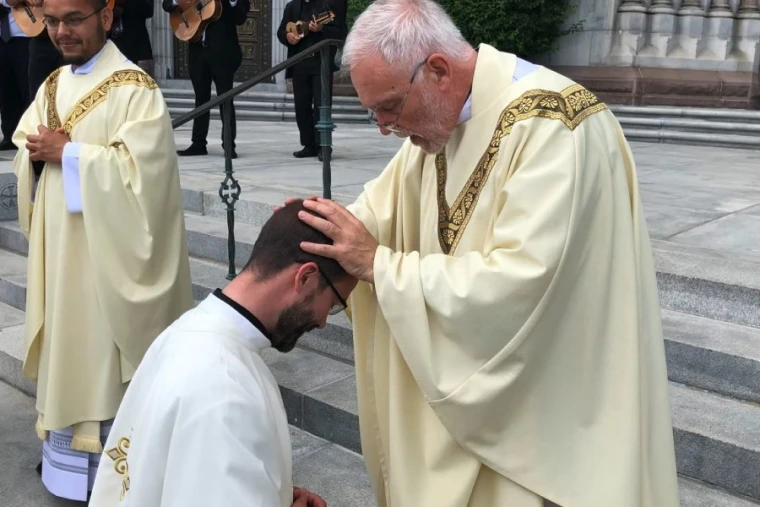
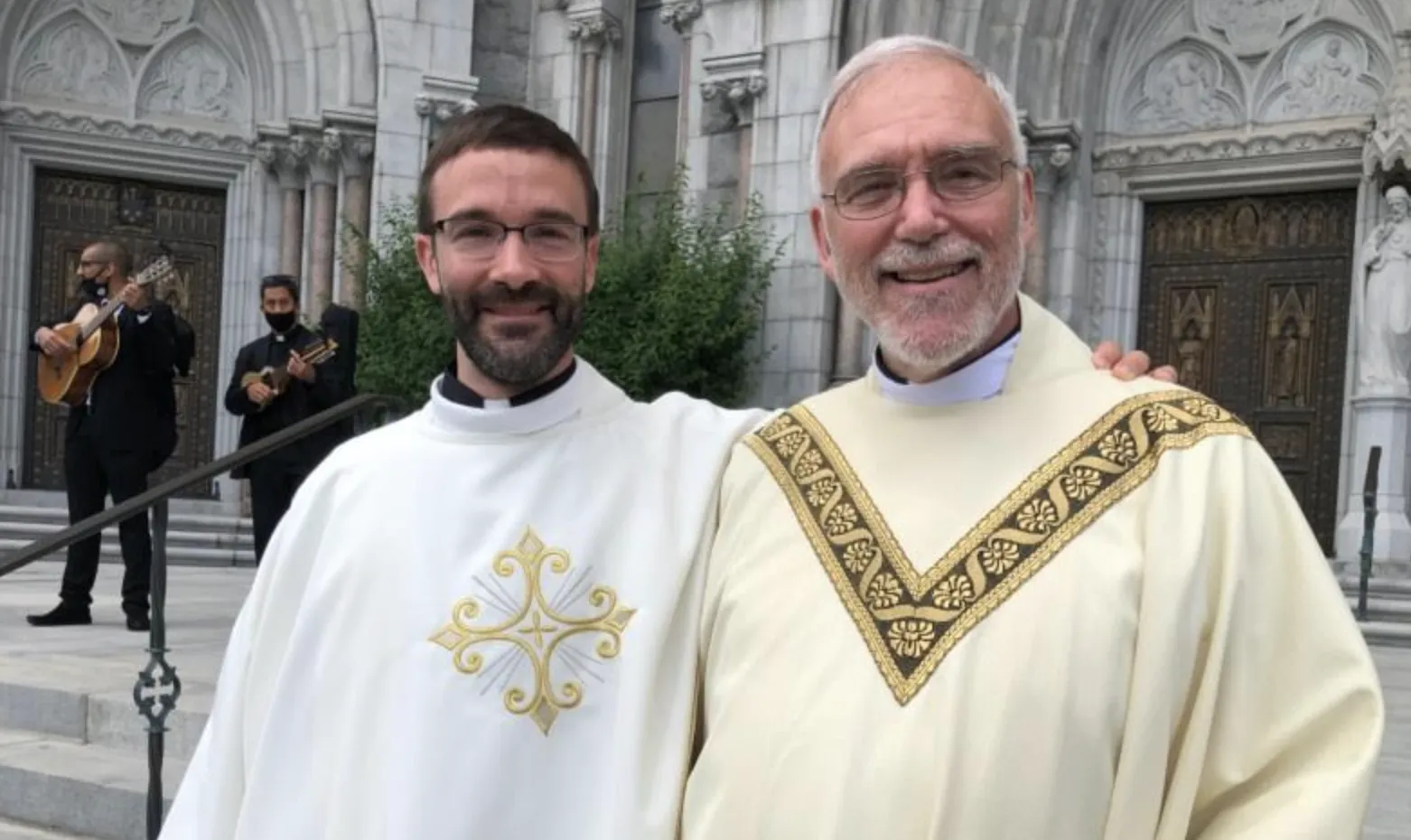
Father Edmond Ilg gives his first blessing to his son, Fr. Philip Ilg, outside Cathedral Basilica of the Sacred Heart in Newark, NJ. Image courtesy of the Ilg family.

Father Edmond Ilg gives his first blessing to his son, Fr. Philip Ilg, outside Cathedral Basilica of the Sacred Heart in Newark, NJ. Image courtesy of the Ilg family.

.- Edmond Ilg, 62, has been a father since the birth of his son in 1986. 
But on June 21, he became a “father” in a whole new sense: Edmond was ordained a priest of the Archdiocese of Newark. 
It was Father’s Day. And making the day more special, it was Edmond’s son -- Fr. Philip -- who vested his father at ordination. 
“To be with Philip is a tremendous gift,  and to have him pray over me and invest me is the greatest gift,” said Edmond. His son was ordained in 2016 for the Archdiocese of Washington, D.C., and travelled to Newark for the day. 
Fr. Edmond never thought he would become a priest. He had a wife, a chemical engineering degree, and a successful career. But after his wife died of cancer in 2011, he began to consider a new vocation. 
At his wife’s wake, a family friend wondered out loud that “maybe Ed will become a priest,” Fr. Edmond told CNA. That day, it seemed like a crazy suggestion, but Fr. Edmond now calls the encounter “extremely prophetic,” and said the remark planted an idea in his mind. 
Edmond did not grow up Catholic. He was baptized a Lutheran, and he told CNA that he went to religious services “about half a dozen times” until he was 20. He met his wife at a bar, and they began a long-distance relationship. 
While they dated, he became a Catholic and attended Mass with his future wife, Constance - everyone called her Connie. They married in 1982. 
After Connie died, Edmond, who along with his family participates in the Neocatechumenal Way, quit his job and embarked on what is called an “itinerancy,” a period of travelling missionary work organized by the Neocatechumenate. Edmond told CNA that, at least in the beginning, “priesthood was never anything in my mind.” 
During his time as a missionary, Edmond was assigned to help in a New Jersey parish, and also worked in prison ministry. While he lived as a missionary, he began to feel the pull of the priesthood. 
After helping lead a trip to the 2013 World Youth Day in Rio de Janeiro, where he prayed for and continued to discern his vocation, Edmond called his catechist, telling him, “I think I have the call [to priesthood].” 
He was sent to a seminary affiliated with the Neocatechumenal Way in the Archdiocese of Agaña, Guam, and was eventually transferred to the Redemptoris Mater Seminary in the Archdiocese of Newark to complete his studies. 
Fr. Philip told CNA that after his mom died, he had sometimes wondered if his newly-widowed father would become a priest. 

“I don't know if I ever said this--because I wanted to wait until it actually happened--but the first thought that crossed through my mind in the room there, when Mom died was that ‘my dad would become a priest,’” Philip said. 
“I can’t explain where it came from.” 
Philip said that he knew his father “couldn’t kind of just sit around and make money,” and that “I knew he had a mission.” 
Philip never told anyone about his thoughts, he said, instead choosing to place his trust in God. 
“I never said a single word about that thought. Because if it came from the Lord, it would bear fruit,” said Philip. 
During his transitional diaconate year, Edmond was assigned to serve at the same parish where he had spent time as a missionary. His first temporary assignment, which begins on July 1, will also be at the parish. 
“I arrived [at the parish] with no plans for the priesthood, and the cardinal and the other people had no idea of where they were going to assign me, but that is where they wound up sending me -- to the place where my vocation started,” he told CNA. 
Because of the ongoing COVID-19 pandemic, Fr. Edmond will not find out his permanent assignment until later in the summer. Normally, priestly assignments in the Archdiocese of Newark begin on July 1, but that will be delayed this year until September 1. 
The father and son priests told CNA that they are particularly grateful for the community of the Neocatechumenal Way, which Philip described as “the instrument that God used to save my family.”
The Ilgs were introduced to the Catholic program of spiritual renewal during a tumultuous time in their marriage, shortly after the loss of an infant son in childbirth. 
The father and son vocations “didn’t just happen sort of in an isolated setting,” Philip explained. “It happened because there was a community which nourished faith and allowed faith to grow.” 
“Throughout the years, I really have seen the faithfulness of God through the Neocatechumenal Way,” said Philip. Without the community’s support, Philip told CNA that he does not think neither he nor his father would be priests. 
“If it weren't for a community of faith, which nourished us in faith and formed the body in which it was able to handle us,” he said, they would not have had such a remarkable Father’s Day. 
Father Edmond and to his son, Fr. Philip.

Wednesday, June 17, 2020

The Death of George Floyd: Breaking News and Broken Trust

It has been awhile since I had published an article from These Stone Walls.  Father Gordon emails me his articles every week, and I have published some of them in my blog.  I have decided to publish his latest article, which you can find here.  His article depicts the current crisis America is facing in her streets today.

---------------------------------------------------------------------------------

The Death of George Floyd: Breaking News and Broken Trust


News media and police have crucial roles in civil society, but politically biased media and corrupt police are instigators of social injustice, not a remedy for it.
“No one hates a bad cop more than a good cop.” Shortly before I started this post, that was said to me by a law enforcement officer who reads These Stone Walls. I had a subject for a post in mind this week and I asked his opinion about it. I have some rather strong feelings about the apparent abuse by a police officer that so unjustly took the life of Minneapolis resident, George Floyd over an allegedly fake $20 bill. My reputation and freedom were also summarily destroyed by a corrupt police officer, but I have my life intact, even if unjustly in prison.
But the “good cop” who spoke to me (and he is a good cop) convinced me that now is not the time to pounce on the bandwagon of public anxiety to air my own grievance about corrupt police and their enablers. It would get a lot of attention, but it also feels exploitive. I simply cannot hang my grievance on the egregious injustice that took the life of George Floyd and triggered the worst riots seen in America in decades.
As I write this, the American president is calling for a strong, possibly even military defense to end the violence, rioting and lawlessness that gripped our cities. It does not help my frame of mind at all that I came upon a letter to the editor published in a left-leaning New Hampshire newspaper. The writer asserts:
  • “I disagree that U.S. military aggression is honorable or effective. The U.S. … has wasted trillions of dollars in borrowed money to kill, maim, impoverish and displace millions of innocent people…” (Arthur Brennan, The Concord Monitor)
The author of the letter is retired NH Superior Court Judge Arthur Brennan, the same judge who, with no evidence at all, displaced at least one innocent person’s life with a prison sentence of 67 years after the accused refused a plea bargain offer to serve only one year. That person was me.
So yes, I, too, am angry beyond words about what befell George Floyd, and at a system that allows a police officer who amassed 18 abuse complaints in his record — as is reportedly the case Officer Derek Chauvin – to continue in a position of power. I watched, for at least the fifth time, as the news media hyped the nine minute video of this poor man dying before our eyes.
Most of the 24/7 news media covering this story have omitted certain inconvenient truths. Minneapolis is a progressive city with a liberal Democrat government. The previous 18 complaints filed against Officer Derek Chauvin were filed away beyond public scrutiny because its police union, like many civil service unions in liberal cities, protects its members against public oversight and accountability by amassing political clout.
Minneapolis has seen more than 2,600 complaints lodged against its police officers since 2012. Only 12 have resulted in disciplinary action. This “progressive” city’s income gap between white and African-American households is among the widest in the country, says Wall Street Journal columnist William A. Galston in “I’ve Never Been so Afraid for America” (wsj.com, June 3, 2020).
A SPIRITUAL ICON IN A CITY UNDER SIEGE
Just days before writing this, I listened as President Trump addressed the nation from outside the White House. He spoke of the difference between legitimate protests and riots, citing the fact that this nation has a long and formidable history of protecting our citizens’ right to protest. But no nation should be held hostage by riots and mob rule.
The President called upon state governors to empower the National Guard to protect innocent civilians and property, and said he will empower the military if necessary using the rarely cited Insurrection Act. There has been a lot of controversy about his strong stance against the violence which some in the news media falsely report as a stance against protesters in general.
President Trump had a very busy June 2. Earlier that day, he and Melania Trump visited the St. John Paul II Shrine in Washington, DC where he signed an Executive Order calling for a guarantee of religious liberty in America and internationally. The visit had been planned in advance and had no connection to the protests and riots that gripped Washington and other cities.
After his appearance at the White House on June 2nd, the President then appeared in front of St. John’s Episcopal Church, a Washington, D.C. historical and spiritual landmark that was attacked by a destructive mob on the night before. Within minutes CNN was reporting that the President had innocent protesters attacked with tear gas and rubber bullets to clear them away so he “could have a ‘photo op’ in front of the church.”
Others echoed the CNN version, some verbatim. One outspoken detractor who entered the partisan fray was Washington’s Catholic Archbishop Wilton Gregory. He criticized the President’s use of a sacred site – the St. John Paul II Shrine – for “a political event,” and went on to chastise the President for using force on protesters to clear the way for “a photo opportunity” at the Episcopal church.
It seemed lost on Archbishop Gregory that signing the long planned International Declaration on Religious Freedom at the St. John Paul II Shrine had immense symbolic meaning for Catholics and all those oppressed by attacks on religious freedom across the globe. With help, I posted a rebuttal at the Catholic News Agency Facebook Group for which I am a member and contributor:
  • “With respect to Archbishop Gregory, I interpreted the President’s appearance at St. John’s Episcopal church very differently. His presence at the heavily damaged church was for the purpose of showing the nation its boarded up windows and other damage left in the wake of a lawless mob. Archbishop Gregory must have been watching CNN because he drew the same conclusion using the same words. Having faced Communism and heroically confronted its grip on the people of Europe, I believe St. John Paul II would be among the first to say that a free nation cannot tolerate the anarchy of a lawless mob manipulated by nefarious agendas pulling its strings.”
All this chaos has thrust America into darkness in a presidential election year which has itself become part of the chaos. The combined elements of a Covid-19 pandemic, out of control race riots in the streets, and a deeply divided and divisive political arena have left America at a tipping point. Many fear that we are seeing the unraveling of culture and civilization as we know it. But this has all happened before, and not so long ago.
A LITTLE HISTORY GOES A LONG WAY TOWARD PERSPECTIVE
I turned 15 years old on April 9, 1968. The nation was in smoldering ruins because, just five days previously on April 4, Rev. Martin Luther King, Jr. was assassinated by a sniper bullet. In the days to follow, the tragedy resulted in national shock and anger spawning massive protests which evolved into riots in more than 100 U.S. cities. President Lyndon Johnson, a Democrat, invoked the Insurrection Act to empower the military to restore order to the cities. No one called it unconstitutional.
Long after the riots were quelled, King’s life came to represent African American courage and achievement, high moral leadership, and the ability of Americans to overcome racial divisions. His soaring rhetoric calling for racial justice and an integrated society became almost as familiar to subsequent generations of Americans as the Declaration of Independence. I have written several tributes to him and his cause in these pages.
The rest of 1968 just continued the vortex of public anxiety, rioting and destruction that were actually far worse than what we are seeing now. The Presidential election of 1968 was so divisive and contentious that the nation seemed on the verge of civil war. As the war in Vietnam was rapidly escalating, the TET Offensive resulted in a small U.S. victory at the cost of tens of thousands of young American lives – both black and white because war is color blind just as all America should be.
In 1968 this was all politicized in a Presidential election year just as the current storms are today. Lyndon B. Johnson, who pushed through the late John F. Kennedy’s signature agenda, the Civil Rights Act, decided not to run for reelection. JFK’S brother, Robert Kennedy threw his hat in the ring after some of the major primaries were already fought unseating the liberal Senator Eugene McCarthy as the leading Democrat.
Bobby Kennedy was then assassinated on June 6, 1968 just four days after winning the California primary and becoming the presumptive Democratic nominee. It was the nation’s second major assassination in three months, and it again blew the lid off America’s self-restraint.
The Democratic National Convention of 1968 was held in Chicago where it erupted in unprecedented violence between mobs of rioters and police. Inside the convention hall, delegates debated the party’s position on the Vietnam War. Outside, supporters of the anti-Vietnam War movement clashed with police in the streets. Millions of Americans watched as the drama outside the Convention overshadowed what was happening inside. What they saw on their television screens was demoralizing.
The convention was supposed to renominate President Lyndon Johnson, but he shocked the nation on March 31 by announcing that he would not run for reelection. Johnson had thrown his support to Vice President Hubert Humphrey who had been favored to win among Convention delegates despite the fact that Bobby Kennedy won much of the popular vote in the primaries before his death.
On the night Hubert Humphrey was nominated, the Democratic National Convention was under siege. Protesters clogged the streets and started taunting police who violently attacked the mobs in an effort to clear the streets. They threw tear gas, clubbed and arrested not only protesters but reporters, camera operators, and bystanders. Protesters chanted, “The whole world is watching,” as television cameras broadcast the violence to millions of Americans shocked by what their country was becoming.
And in the strangest twist from what is happening today in 2020, it was Democrat Hubert Humphrey who called for a strong law and order response to the riots in 1968, and the possibility of using the Insurrection Act for the military to restore order. The Democrats’ weak response to disorder paved the way to for a November 1968 Republican victory and the election of President Richard Nixon.
IN 2020, A NEWS MEDIA THAT FANS THE FLAMES
The word “anarchy”, coming to us through the Latin from the Greek αναρχία has been tossed around a lot in all this. Anarchy literally means “without a ruler.” It refers to agendas that disrupt politics with chaos. There has been evidence of anarchy and the conspiracy of anarchists in the riots that have overtaken peaceful protests across America.
This has included rampant manipulation of the demonstrations and protests by organized anarchists. New York Governor Cuomo stated, for example, that a construction site was burglarized but all that was stolen were the bricks. The piles of bricks were then counted out and stored ahead of time at strategic points along a planned protest route by unknown parties. On CNN, I witnessed an agitator herding groups of protesters toward a CNN TV camera in what appeared to be a choreographed demonstration of violence.
Police in multiple cities have reported that groups of young agitators, both black and white, have staked out protest routes during the day and then returned at night for pre-planned looting raids on specific storefronts and other businesses. This has not been the work of peaceful protesters, many of whom – again both black and white – have been seen trying to protect people and businesses from marauding looters.
Five police officers doing their duty have been killed by mobs. A 77-year-old retired African American police captain was murdered as he tried to stop an attack on an innocent woman. This has all happened in the streets of America while some of the 24/7 news outlets have omitted such footage. In Democrat controlled Minneapolis, police officers just stood and watched as massive looting and assaults took place before their eyes. They simply did not know what to do.
News organizations resist being called “left of center” because they believe they are the center. Their open loathing of the current president since his lawful election in 2016 has pushed the media even further left beyond a mere liberal agenda toward socialism. CNN and MSNBC have developed a brand characterized as “The Resistance” in its opposition to Trump.
This is now so ingrained in their news reporting that they would risk viewer ire and advertising dollars just by reporting with fairness and equity anything regarding Donald Trump. They – and several print outlets like The New York Times and The Washington Post – are sacrificing journalistic ethics, respect, and credibility for their sacred mission: to rid the nation of the President it lawfully elected. They have become uninterested in their own bias in favor of their real mission – to “get Trump.”
One candidate has shamelessly turned the anxiety and anger of African Americans into a source of political points. Some of these points would be highly insulting if not drowned out by the sheer noise of people on the edge. In a radio interview, former Vice President Joe Biden responded to a simple question. Asked if he had an agenda for black voters who feel that politicians take them for granted, Mr. Biden launched this incoherent rant with racially demeaning overtones:
  • “What would I say? Remember when I said Biden can’t win? The primaries? I kicked everybody’s ass. Excuse me, I won overwhelming. I won a larger share of the black vote than anybody has including Barack. Look, what people don’t know about me is I come from a state has the eighth largest black population in America, eighth largest! I got 96-percent of that vote for the last forty years. They’re the folks what brung me to the dance! That’s how I get elected every single time and everybody’s shocked.”
Aside from the fact that Joe Biden comes from Delaware which has the nation’s thirty-third largest black population, not the eighth, the lack of any coherent response to the initial question is disturbing. But there are other elements here that should be far more disturbing for black voters. African Americans represent just 12.5 percent of the U.S. population, but 40 percent of the U.S. prison population. This is not the work of President Trump.
Racial disparities in prison sentencing have been unaddressed for decades, and Joe Biden himself created some of these disparities according to a compelling article in the left-leaning Prison Legal News. The article, by David M. Reutter, is “Biden’s Current Prison Reform Stance Counter to His Abysmal Record.”
Black Lives Matter! Indeed, they do. Black infant lives matter, too. This nation’s African-American population should by now be about ten percentage points higher than it is. This is driven by agendas far more nefarious than economics. In some traditionally liberal Democrat districts such as New York City, African American abortions have exceeded live births for the first time in history. This, too, is not the work of President Trump. [ Editor: see http://blackgenocide.org/home.html ]
In a recent interview, Mr. Biden stated rather alarmingly that “this country is crying out for leadership that can unite us.” Mr Biden then referred to African American communities as having “a knee on their neck for a long time.” This is not the language of unity the nation needs right now. Not exactly the bridge-building America needs at this moment as history repeats itself.

Friday, June 12, 2020

Congratulations to Four More from Former Guam RMS

Four more seminarians from the former Guam RMS will be ordained into the priesthood on June 21st, and their ordination streamlived.  Two of them are locally from Guam.  These men will be priests.  Continue to pray for them and for all priests and clergy. These men are Drazen Hosi from Croatia, Edmond Philip Ig from New York, Darren Tomas from Guam, and Preston Perez also from Guam.  Congratulations to these men on their upcoming ordination for the priesthood!  WAY TO GO!!!  Guam RMS has produced so many priestly vocation for the United States.  You can read their biographies here.   


Sunday, June 7, 2020

Congratulations Wilmer Chirino Gonzalez

Deacon Wilmer Chirino Gonzalez will be ordained into the priesthood on June 20th.  How many good priests Guam has lost and others have gained.  The following article can be found here.
--------------------------------------------------------------------------


There are journeys in time and there are journeys in space.
Transitional Deacon Wilmer Chirino Gonzalez will have completed long journeys in both time and space when he is ordained a priest for the Archdiocese of Philadelphia by Archbishop Nelson Perez on Saturday, June 20 at the Cathedral Basilica of SS. Peter and Paul.
Across more than 2,000 miles from his native Venezuela to Philadelphia, with stops along the way over the years, now at age 49 his sacred vocation will soon be realized.
Growing up in Carabobo, Venezuela, the third of the seven children of Jose Ramon and Andrea, the family was relatively poor. As a young man he was not personally religious, but he always remembers his mother praying the rosary. Through his own initiative he trained as a printer and opened his own shop.

He did well, and his life was good. “I was making money,” he recalls. “I thought, ‘People will love you when you make money.'” But gradually he came to realize that wasn’t really true, and “God loves us all, rich and poor,” he said.
Deacon Chirino started going to church. Also he came upon the Neocatechumenal Way, a movement in the Catholic Church founded in 1965 and dedicated to Christian formation.
As he became more and more involved with the movement, he decided to  enter the seminary. At first he studied through local Neocatechumenal Way programs but then was transferred to Guam for further formation at the seminary conducted by the Archdiocese of Agana.
Guam is, of course, an American protectorate but with several languages including Spanish and English. Many of the residents are bilingual, which made it easier for a Spanish-speaking seminarian to navigate.
But two years ago he and fellow seminarian Cesar Izaguirre were, at the invitation of Archbishop Charles Chaput, transferred to Philadelphia to complete their studies at St. Charles Borromeo Seminary and ultimately to be ordained and incardinated for service in this archdiocese.
As is the Philadelphia custom, this past year since his ordination as a transitional deacon in May 2019 at St. Charles, he has been assigned to an archdiocesan parish to learn further exactly what a parish priest does. In his case he has been serving at Our Lady of Grace Parish in Penndel under the tutelage of Msgr. Joseph Prior, who he considers has been an excellent mentor.
“I like the people in Penndel, they opened their hearts to me,” Deacon Chirino said. “I’m grateful especially because my English is not very good.”
That has been his biggest handicap. As an older man, changing languages has not been easy, but everyone at the parish has been encouraging.
“I have found people that don’t know me are open to me because they are open to the voice of God. Little by little God has helped me to open up,” Deacon Chirino said.


Through his years in seminaries his spiritual life has expanded. His favorite prayers are to St. Joseph and the Blessed Virgin as well as the Litany of the Saints and the Lord’s Prayer. And he also has special devotion to St. Teresa of Kolkata and St. Maria Goretti.
Now on the cusp of his priestly ordination, Deacon Chirino’s only regret is his family probably will not be able to attend because of pandemic quarantines. “I love them so much,” he said.
After ordination he will be assigned to a new parish in the archdiocese. Where, he doesn’t know, but that doesn’t matter. “I just want to be open to God’s will,” he said.
His first Mass will be celebrated Sunday, June 21 at Our Lady of Grace, and then his new life as a priest — a new journey through space, time and eternity — really begins.