Monday, August 20, 2018

Radical Liberalism

This line "for the good of the Church" has been the excuse used by many bishops to cover up crimes or unfair practices.  Innocents were sacrificed by some bishops because they thought they were protecting the Church when in reality they were following the wiles of Satan who influenced them to do it "for the good of the Church."  A bishop who sacrifices an individual "for the good of the Church" is not following Jesus Christ because Christ never sacrificed anyone for the "good of the Church."  Rather, he sacrificed HIMSELF and only HIMSELF for the good of the Church. The bishop would have done better had he stood up for the truth and turned in the priest to the civil authorities for committing a crime.  Likewise, a bishop who sacrificed an innocent priest to appease a hateful mob "for the good of the Church" is no better.  He would have done better had he stood up for the truth and taught the mob to oppose hatred, which is a sin offensive to God. 

Some priests have now come out to tell their stories anonymously.  According to Catholic News Agency:
Seminarians and priests from ordination classes spanning 30 years, during the terms of McCarrick and Myers, reported to CNA that they had observed an active homosexual subculture of priest and seminarians within Newark’s Immaculate Conception Seminary.  
One priest ordained in the early years of McCarrick’s term in Newark said that “a lot of people lost their innocence in the seminary.”
He told CNA that there were two distinct groups of students. “You had the men who were there because they had a deep love of the Lord and a vocation to serve his Church,” he said, adding that those men were the majority of seminarians.
“But there was a subculture, with its own group of men, that was openly homosexual and petty and vindictive with everyone else,” he explained.
In his book entitled Goodbye Good Men: How Liberals Brought Corruption Into The Catholic Church, published in 2015, investigative reporter Michael S. Ross uncovered how radical liberalism had infiltrated the Catholic Church, attenpting to overthrow traditional beliefs and doctrines, especially the Church teachings on human sexuality.  This book went on to become a bestseller.  By the way, I read the book.  

Radical liberalism and the gay activists have not only infiltrated our Church, but also our government and schools.  In fact, the Guam Legislature has already introduced a bill to allow transgenders to change the gender in their birth certificate despite the fact that they never went through a sex change.  According to KUAM news (the bold is mine):
Legislation has been introduced that would allow individuals who identify as transgender to change their birth certificates without having to undergo a sex change operation. Supporters say similar laws have now been passed in 19 states and 200 cities across the country.  
Bill sponsor Senator Fernando Esteves explained, saying, "It allows them to do this and make the amendment to their birth certificate without having to undergo the surgical procedure. And so with that, it allows them to live and be recognized as the gender that they identify with, which I believe is inherent in their ability to live freely, and live happily with who they are."
Senatorial candidate Lasia Casil, who identifies as transgender herself, says it's a tool for empowerment that can help lift them up in the face of discrimination. "It is a means for gaining employment, health care, housing and safety. I was fired from a job in 1993 because of these ID problems. Not being able to get a job put me out homeless and working on the street. As many, many people, transyouth are subject to cause they can't get the right ID," she said.
But one woman testified against the bill citing concerns about individuals who have not undergone a sex change who might use the same public restroom as their child. Esteves says the bill requires name change applicants to undergo a psychological evaluation, and a criminal record check.
These are my comments regarding what I placed in bold.  Ms. Casil who identifies as transgender claimed she was fired from a job in 1993 because of these ID problems.  Was the ID really the issue or was it because she checked marked herself on the application and document forms as "male" instead of female?  Guam's ID only specifies "male" and "female" on the form.  As long as your physical gender is female, it should be marked "female" regardless of whether you THINK you are male, Superman, or Santa Claus.  Senatorial candidate Lasia Casil is physically a female and should enter the women's restroom.  After she gets a physical sex change, then he can enter the men's restroom.       

One woman testified against the bill citing concerns about individuals who have not undergone a sex change who might use the same public restroom as their child.  Her concerns are legitimate.  Once the bill is passed, a person can change their ID, passport, and other forms of identification to the gender they identify with despite the fact that they have not had a sex change.  This certainly means that a male person can enter a female restroom.  And to prove it, he has a ID labeling his gender as "female" despite that his physical gender is still a male.  

Are our senators thinking ahead?  Are they aware of the consequences of this bill if they choose to pass it into law?  Don't you think it would be wiser to first install a "transgender" restroom before even considering that bill into law?  After all, how is a psychological exam going to be helpful in a society that is starting to accept homosexuals and transgenders as "normal" rather than as an "intrinsic disorder."  

We are seeing the consequences of accepting homosexual seminarians into a Catholic seminary today.  It caused a depravity in our Church.  Do we want to see depravity in the rest of our society starting with the restrooms of men and women?  Are our senators thinking ahead?  Are they thinking of the consequences of this bill if passed into law? If passed into law, law enforcement will be unable to stop a male who holds a "female" ID from using the women's restroom. When the Guam Legislature introduced a same-sex union bill, Archbishop Apuron vehemently opposed the bill.  Now that a bill has been introduced, allowing transgenders to change the gender in their birth  certificate despite that they have not gone through a sex change, where is Archbishop Byrnes on this issue?  And where is CCOG?  Are they not concern of a man being in a woman's restroom with their mothers and daughters and vice versa?                   

Friday, August 17, 2018

Letter From Archbishop Samuel J. Aquila, S.T.L.

The following letter was written by Archbishop Samuel J. Aquila, which was published in the website of the Archdiocese of Denver.  Although we are not from Denver, his letter touched our hearts.  His letter is published here


Letter to the Archdiocese of Denver on the abuse crisis

At its root, this is a spiritual crisis that requires fidelity, reparation, and reliance on Christ for the grace and path to true, lasting freedom.


My dear brothers and sisters in Christ,
This past week I was on my annual silent retreat and the accusations against Archbishop McCarrick were a part of my prayer. Faithful have written to me and have asked questions about the situation. Some have felt that the Lord has abandoned the Church. Other bishops have spoken out on this tragedy, and today I offer to you, the faithful of the archdiocese and my brother priests and deacons, the following reflections.
As noted by Cardinal DiNardo, president of the U.S. bishops conference, the revelations about Archbishop McCarrick have caused both bishops and the laity “anger, sadness, and shame.” Personally, I am deeply sorry that both laity and clergy have had to experience this type of betrayal. In response, I am asking every priest in the archdiocese to offer a Mass each month in reparation for the sins committed by cardinals, bishops, priests and deacons, and for all sins committed by clergy and lay people against the commandments of our Lord, as well as to pray for healing for the victims of sin. This Mass is to be announced publicly so the lay faithful can attend and offer prayers in reparation for these grave sins that have wounded so many and for their own sins.
The staff of the Archdiocese of Denver and I strive to make every effort to ensure that such things do not occur here. Our preventative measures include: background checks, safe environment classes, mandatory reporter training, creating a conduct response team that is primarily made up of lay people, an annual independent audit of our abuse reporting structures, having a laywoman (Christi Sullivan, 303-715-3241 or Christi.Sullivan@ArchDen.org) serve as the coordinator of our Safe Environment Office, which deals with all cases of any type of abuse against minors by clergy or laity, and providing psychological screening for candidates for the priesthood.
We also have a Victim’s Assistance Coordinator, Jim Langley, Psy.D., who can be contacted at 720-239-2832 or Victim.Assistance@ArchDen.org. If anyone in the archdiocese has an abuse situation concerning any member of the clergy or a lay employee of the archdiocese with a minor or the elderly, they may contact one of them. Both Bishop Rodriguez and I take these matters with the utmost seriousness.
During my retreat, my director encouraged me to pray with the calls of Isaiah, Jeremiah and Samuel. In praying with the call of Samuel, I was struck by the Lord’s words to Samuel concerning Eli. The Lord told Samuel to tell Eli, “…I will fulfill against Eli all that I have spoken concerning his house from beginning to end. And I tell him that I am about to punish his house forever, for the iniquity which he knew, because his sons were blaspheming, and he did not restrain them. (1 Samuel 3: 12-13, emphasis added). Too many seminarians, priests and bishops knew of Archbishop McCarrick’s behavior and did not restrain him.
Due to this, I call on the U.S. bishops’ conference to ask for and allow an independent investigation that includes members of the lay faithful and those clergy who had nothing to do with the matter. Since the oversight of bishops and cardinals falls under the jurisdiction of Rome, I humbly ask Pope Francis to conduct an independent investigation like he did in Chile.
Like Jesus weeping over Jerusalem, so have I wept for the Church and for the innocent victims. I remember when I visited Auschwitz for the first time in 1988. As I walked with horror in my heart over the palpable evil present, pondering how could human beings do this to other human beings, I heard in prayer, only Jesus Christ and he alone can redeem this evil. The same is true with the sexual abuse crisis of today, as well as with the emptying of our pews, and the abandonment of God by the world. So, what must we do?
We must recognize that complacency about evil and sin is present both in the Church and the world and has led us to where we are today. This culture of complacency among clergy and laity must come to an end!
We have also failed to recognize that the spiritual battle is real. Some say the Lord has forsaken the Church, but this is not true. Rather, there are some within the Church who have forsaken Jesus and the Gospel. Pope Francis speaks often in his homilies of the devil and his workings. The devil is real and pulls us away from the ways of Jesus and the love of the Father. The devil uses confusion, chaos, discouragement, and negative thinking to draw us away from Jesus. When one looks at salvation history one sees, beginning with Adam and Eve, moving through the Old and New Testaments, and down through the centuries to now, that it is human beings who abandon the ways of God. When the ways of God are abandoned, God lets human beings go their own way and there are always dire consequences.
Jesus tells his disciples in John 15 that “apart from me you can do nothing” and he further tells us that if we separate ourselves from the vine, Jesus, we will wither. Perhaps the reason for our empty pews, the sharp decline of the faith in Europe and the west, the decimation of many religious orders, and the sexual abuse crisis is that we are not attached to Jesus, the true vine. At the heart of this crisis today is a spiritual crisis that depends more on the solutions of men than on the Gospel and Jesus. The cost of discipleship is real and it includes dying to ourselves, a complete surrender to Jesus, who loves us and desires only our good and joy (Lk 9: 23-26; Lk 14: 25-35; Mt 16: 24; Jn 15:11).
Thus, our response to this complacency must be a return to the ways of God, which lays out the path of grace that preserves us from the real dangers of sin and the attacks of the evil one. The Father has given us his son Jesus, the Beatitudes, the Gospels, the truth, and his commandments out of love for us to keep us on the narrow way of love. He is merciful in all that he has given to us. Charity and truth must always go together. A disciple should never lead someone into sin or condone sin. Jesus never condoned sin! But rather taught that for the unrepentant, the consequence for doing so is hell (Mk 9:42, Lk 17: 1-4). Just as a parent provides boundaries for their children for their own good and protection, so has the Lord provided for us.
All of us within the Church, including the Holy Father, cardinals, bishops, priests, deacons, consecrated and laypersons need to examine our consciences and ask ourselves: Do I truly know, love and serve the Father, Jesus, and the Holy Spirit? And do I follow the ways of Jesus or the ways of the world? In the formation of my conscience do I listen to the voice of God, the voice of the world, or my own voice, and do I test the voice I hear to make sure that it is in accord with the Gospel? Have I personally put my faith in Jesus Christ, and in this time of tribulation do I keep my eyes fixed on “Jesus the leader and perfecter of faith” (Heb 12: 2)? Do I know where I have come from; that God loves me and knew me before I was born (Ps 139)? Do I know where I am going, that I am created for eternal life and to know the Father, as Jesus knows him (Jn 8:14)? Do I truly believe that intimacy with Jesus can heal the wounds of my sins, weakness, or brokenness? And finally, as Jesus so frequently reminds his disciples in John 14 and 15, those who love him keep the commandments, just as he kept the Father’s commandments. Do I do that?
Pope Francis and every pope since Blessed Paul VI, has called us to a deeper encounter with Jesus Christ. This encounter leads to faith in Jesus Christ and a deep personal relationship with him, who in turn leads us to the Father and the Holy Spirit. His desire is for each disciple to be one with the Father and him. Once we put our faith in Jesus, love him and keep the commandments, then the Father and the Son will make their home in our hearts (Jn 14:23). Each one of us must pray for a deeper faith in Jesus each day, the faith that will move mountains (Mt 17:20) and make us into missionary disciples. With God “all things are possible,” (Mk 10:27) and that includes the forgiveness of our sins, the healing of our wounds, becoming a saint, and living a life of holiness and virtue, including chastity. And that brings me to another important aspect of this crisis.
Cardinal DiNardo noted in his statement that “the Church is suffering from a crisis of sexual morality” and it is not just the Church, it is the world. Sadly, too many, both clergy and lay, have listened more to the world than to Christ and the Church when it comes to human sexuality. The consequences of the worldly approach to sexuality are clear in the distortion of this precious gift and the confusion about sexuality that grows daily.
The teaching of the Church on human sexuality has been clear over the centuries, and St. John Paul II helped tremendously with his positive message about the Theology of the Body. Furthermore, those who have received the teaching of the Church and have been accompanied in a loving and merciful way, both young and old, have testified to the truth contained in this teaching, as well as the healing, freedom and joy it brings. This is observed in many of the young people whom I have encountered through the Fellowship of Catholic University Students program, those who have walked in the Neocatechumenal Way, those who have shared in Living Waters or Courage retreats, or participated in Sexaholics Anonymous. Their witness, joy and freedom are real, and it embraces the truth of who they are in the merciful eyes of the God. The God who heals and restores order.
Amidst the darkness of the sexual revolution and all that it has brought about, the Church must decisively return to the truth, dignity and beauty of human sexuality.
We must teach that every sexual act that takes place outside of a marriage between a man and woman, is not in keeping with God’s plan for our happiness. When one separates the procreative aspect from sex, one can justify just about any sexual act. As Blessed Paul VI noted in Humanae Vitae, this separation has had and will continue to have negative consequences on the Church and society.
We must also teach that, according to the Sacred Scripture and tradition, “homosexual acts are intrinsically disordered.” They are contrary to the natural law and they “do not proceed from a genuine affective and sexual complementarity.” (Catechism of the Catholic Church, 2357).
We must also be sure to carefully form seminarians, as we have been doing in the archdiocese for quite some time. However, all seminaries need to devote special attention to the formation of our future priests and their education in chastity, so that they can develop an authentic maturity, and embrace celibacy for the Kingdom of God, respecting and fostering the nuptial meaning of their bodies (Pastores Dabo Vobis, 44). Chastity is a great good that needs to be lived!
The sexual revolution occurring in our culture, which essentially says, “Anything goes if adults consent to it,” is not the way of God and only leads to where we are today. We must be willing to accompany people into the truth of Jesus Christ who will set them free to live the virtues, which bring true freedom, peace and joy.
In closing, I ask all of us to remember to pray and stay close to the heart of Jesus, to ask for the humility of Jesus and the gift of loving others as Jesus loves (Jn 13:34). Every disciple must pray for the gift of faith and a deeper trust and confidence in Jesus, most especially in his healing power. We must pray for all victims of sexual abuse in our culture today, for their healing and their encounter with Jesus Christ, who can bring healing to them.
We must pray for the clergy of the Church, the Pope, cardinals, bishops, priests and deacons, that the Holy Spirit will stir into flame the gifts he has bestowed on them, help them to be faithful to Christ and the Gospel, and to be true servants of the faithful with the heart of Christ. We must pray for the Church, our Mother, that is holy, though having sinners in her midst, and suffers for the offenses of all her members.
Let us pray for the virtue of hope, so that we come to the awareness that we can do all things in Christ, who gives us the strength to be saints (Phil 4:13). Let us ask for the gift of piety, so that we truly behave as God’s children and reverence our own and each other’s bodies as temples of the Spirit. Let us beg for the grace to have pure hearts (Mt 5: 7).
Finally, as those who belong to Jesus, we must pray for our enemies and those who persecute us. We can never wish evil or seek vengeance on another (PV 24:29; Mt 5: 44-48; Col 3:13; Rom 12:19-21). Every human being is a sinner whom Jesus loves and is in need of the mercy of Jesus. Jesus forgave every human being from the Cross when he said, “Father forgive them for they know not what they do.” No matter how egregious the sin, the Lord is willing to forgive us if we “repent and believe in the Gospel” (Mk 1:15). This forgiveness, like his love, must be received.  He reminds us to be merciful as his Father is merciful and that the Father loves both the just and unjust (Mt 5:44-48). In this time of darkness, may we put our faith, trust and love in Jesus who is our Savior and Redeemer, the one who will free us, and may we live in his truth and light!
With the love of Jesus Christ, the Good Shepherd,


Most Reverend Samuel J. Aquila, S.T.L.
Archbishop of Denver

Thursday, August 16, 2018

NCW in the Archdiocese of Detroit

Before being assigned to Guam, Archbishop Michael Byrnes came from the Archdiocese of Detroit.  It was only last year that the Archdiocese of Detroit had welcomed the Neocatechumenal Way.  According to their website:
On March 2, 2017, Archbishop Allen Vigneron issued a decree establishing a Missio ad gentes of the NeoCatechumenal Way for the Archdiocese of Detroit. The Missio ad gentes was acknowledged by Mr. Francisco Argüello, founder of the NeoCatechumenal Way and representative of the International Responsible Team, on March 8, 2017. A certified copy of the decree may be obtained from the Chancellor’s Office, as well as additional information and assistance in understanding the details of this announcement (chancellor@aod.org)..
As of last year, a missionary family have been assigned to do missionary work in Detroit.  According to news report:

In less than two weeks, Matthew and Stephanie Zinser and their three young sons are leaving everything behind – their families, jobs and Glendale home – to answer the call to live as missionary disciples.
They will relocate to Detroit, Mich., in early September, to join four other families, laywomen and a priest, in forming a community of faith to share the Good News of the Gospel.
“I’m very nervous, but I’m very excited,” Stephanie said. “Because I have seen all of the wonders that God has done in my life and in my parents’ life, I feel like it’s time to go out and announce to those who don’t have any hope, to those who haven’t heard, that God loves them.”
The family belongs to the Neocatechumenal Way, and they feel called to be among the hundreds of families currently carrying out “missio ad gentes,” or a mission to the nations, an effort to evangelize in areas of the world where the Church is not very visible.
Last Sunday, the five members of the Zinser family stood before the congregation at Presentation of the Blessed Virgin Mary Church in Jamaica, and received a blessing for the journey ahead of them.
Father Victor Bolaños, parochial vicar, sprinkled holy water on the couple, and their boys: Matthew, 3, Noah, 2 and Ignacio, nine months.
“It is not every day that we are able to acknowledge in person the hard work that missionaries do,” Father Manuel J. Rodriguez, pastor, said to his congregation.
“When it is a whole family that decides to leave everything… for the sake of spreading God’s Gospel, this is not just uncommon, but tremendously special.”
Father Rodriguez commended the couple on “taking Jesus seriously in their life as a family.”
Matthew and Stephanie are familiar faces in the diocese, serving most recently as co-directors of religious education at St. Benedict Joseph Labre parish, Richmond Hill. Matthew, who grew up in St. Matthias parish, Ridgewood, and attended Cathedral Prep Seminary, Elmhurst, also serves as music director at Our Lady of Victory Church in Floral Park.
The couple, who will celebrate five years of marriage this fall, are members of the Neocatechumenal community at SS. Peter and Paul parish, Williamsburg, where Father Rodriguez previously served as pastor. This past Lent, they led a three-month catechesis at the Jamaica parish.
They discerned their call to become a mission family through prayer and discussion over the last two years. They volunteered with the knowledge that they could be asked to go any city in the world.
But for this family, there was a unique consideration: two of the couple’s sons have Shwachman-Diamond syndrome, a rare disorder that requires regular blood tests and monitoring. It was essential for the boys to have access to the specialists and facilities they have here in the U.S.
Earlier this year, Detroit’s Archbishop Allen H. Vigneron called for a “radical overhaul” of the Church in his diocese. He invited the Neocatechumenal Way to establish a family mission team to aid in the work of the new evangelization. For the Zinsers, it was the perfect fit.
The couple is excited to help with the rebirth of the Catholic Church in Detroit, a city suffering from poverty, racial tensions, crime and urban decay. The Church there has faced substantial challenges in recent years, including declining membership, resulting in parish mergers and closings.
Example of Christian Living
When they arrive, the Zinsers’ role will be to spread the Gospel through their daily example of living as a Christian family. They’ll actively reach out to neighbors in their community, evangelize door-to-door, pray in public squares and share their own testimonies about how God works in their lives.
One of the topics the couple discusses is their sons’ illness, which, Matthew said, could have easily driven him away from God and the Church. But because of the encounter he’s had with God in the Neocatechumenal Way, he is able to look at the situation “through the eyes of faith.”
“My wife and I don’t say, ‘Why us God?’ We’re able to put our lives and everything we do in God’s hands,” he said.
“God has given us these two children for a reason,” Stephanie added. “In the suffering, we see His face.”
Understanding that it takes years to develop relationships and build the church, the Zinsers see their move as a permanent one.
The family has found a place to live, and Matthew hopes to find a position as a parish music director. In the meantime, he says he can get by with construction work.
“We’re going with faith that God will provide for us,” he said.
They realize that doesn’t mean there won’t be struggles and challenges ahead, but they will have each other, and their fellow mission families, and many people, including those back home, supporting them in prayer.
“I’m very happy to bring up my children in this way of living, which is not going to be easy because everyone thinks we’re crazy, even our own families,” Stephanie said. “But maybe one day, with our actions, they can see the love of Christ.”
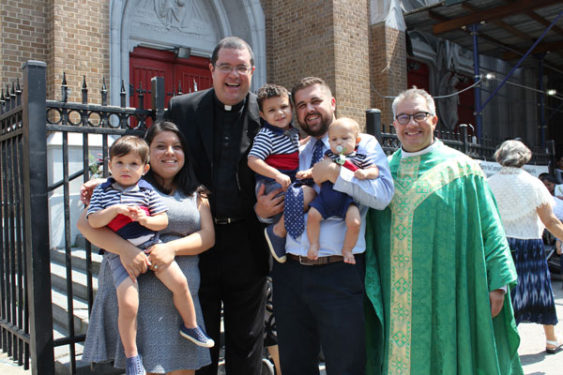
Matthew and Stephanie Zinser and their children are shown with Father Manuel Rodriguez and Father Victor Bolaños, right, after receiving a blessing prior to their leaving for missionary service with the Neocatechumenal Way in Detroit.

Wednesday, August 15, 2018

Announcement on Comments

Dear Readers, 

There has been a large number of positive comments on either a post or this blog.  Although I appreciate the positive comments, it gives no depth or substance to the discussion. Therefore, these comments have not been published.  This blog is a place for discussion.  Please stick to the OP.    

Thank you, 
Diana  

Friday, August 10, 2018

New allegation surfaces against Archbishop Anthony Apuron

This post is in response to a question made by an anonymous poster.   According to his/her comment: 
AnonymousAugust 10, 2018 at 2:14 PMDiana, how would you know that this new allegation is related to JW's doing?
First of all, the document shown in the jungle was a document stamped "filed August 8, 2018 at 2:45 p.m." by the clerk court.  Nowhere in that document does it show that it was stamped "Received."  See Rohr's blog

The document was not stamped "received" until 3:30 p.m.  This is the document that KUAM showed in its news report.  As you can see, the document used in the news report and made public was stamped "received August 8, 2018 at 3:30 p.m." by the Office of John Terlaje. See the news report below: 


So, what does this mean?  It means that Tim Rohr obtained a document filed by D.M. BEFORE it was stamped "Received at 3:30 p.m” by the Office of John Terlaje. Who gave him this document?  Would the court of Guam give him a copy of the document?  Surely, it would be against the ethics of any lawyer to give a document to someone who is not his client. Only his client should have that document.    

Nevertheless, it seemed that Tim had a copy of the filed document.  He simply published it even before the news media did.  In fact, Tim published that post about 3:00 A.M.  Yes, he stayed up very late in the wee hours of the morning to publish his post.  A friend of mine emailed this screenshot below taken from Rohr's Facebook page.  Noticed the time he posted it.  He posted the new allegation against Archbishop Apuron on his Facebook on August 9th at 3:37 a.m. before any news media reported it.  


Therefore, it would not be surprising if Tim Rohr already knew the identity of D.M.  One may even question how did he obtain a copy of the filed lawsuit?  The fact that he knew the filing of a new allegation BEFORE it transpired makes it suspect. Tim may change his stories, but his character remains the same.  After all, he also knew that some accusers against Archbishop Apuron would say they confided in Father Jack.  He knew this information 9 months before they came out in public with their accusations.   See the story here.

Pope Francis on Capital Punishment

There are some people who argue that having the death penalty is a Catholic doctrine and cannot be overturned.  See the weblink here.  The teachings of the Church have always advocated and upheld the value of human life and human dignity.  This moral teaching has not changed for over 2000 years. This moral teaching is still being taught. What has changed and can change is "tradition." Traditionally, it has been taught that the State has the divine authority to safeguard public safety even if it means to pass capital punishment. However, that trend is changing in today's society. According to Cardinal Dulles (the bold is mine):
 The respected Italian Franciscan Gino Concetti, writing in L'Osservatore Romano in 1977, made the following powerful statement:
In light of the word of God, and thus of faith, life all human life is sacred and untouchable. No matter how heinous the crimes . . . [the criminal] does not lose his fundamental right to life, for it is primordial, inviolable, and inalienable, and thus comes under the power of no one whatsoever.
If this right and its attributes are so ab solute, it is because of the image which, at creation, God impressed on human nature itself. No force, no violence, no passion can erase or destroy it. By virtue of this divine image, man is a person endowed with dignity and rights.
To warrant this radical revision one might almost say reversal of the Catholic tradition, Father Concetti and others explain that the Church from biblical times until our own day has failed to perceive the true significance of the image of God in man, which implies that even the terrestrial life of each individual person is sacred and inviolable. In past centuries, it is alleged, Jews and Christians failed to think through the consequences of this revealed doctrine. They were caught up in a barbaric culture of violence and in an absolutist theory of political power, both handed down from the ancient world. But in our day, a new recognition of the dignity and inalienable rights of the human person has dawned. Those who recognize the signs of the times will move beyond the outmoded doctrines that the State has a divinely delegated power to kill and that criminals forfeit their fundamental human rights. The teaching on capital punishment must today undergo a dramatic development corresponding to these new insights.
As a result, there has been a change to the Catechism of the Catholic Church.  According to the Catholic Education Resource Center:
In a statement published Thursday morning, the Vatican announced an emendation to the section of the Catholic Catechism that deals with the death penalty, which will now read:
Recourse to the death penalty on the part of legitimate authority, following a fair trial, was long considered an appropriate response to the gravity of certain crimes and an acceptable, albeit extreme, means of safeguarding the common good. Today, however, there is an increasing awareness that the dignity of the person is not lost even after the commission of very serious crimes. In addition, a new understanding has emerged of the significance of penal sanctions imposed by the state. Lastly, more effective systems of detention have been developed, which ensure the due protection of citizens but, at the same time, do not definitively deprive the guilty of the possibility of redemption.”
Quoting a 2017 speech given by Pope Francis during a pontifical council, the document continues: “Consequently, the Church teaches, in the light of the Gospel, that ‘the death penalty is inadmissible because it is an attack on the inviolability and dignity of the person,’ and she works with determination for its abolition worldwide.”
In a letter released Thursday, Cardinal Luis Ladaria, the Vatican’s prefect of the Congregation for the Doctrine of the Faith, characterized the change as an “authentic development of doctrine” in keeping with prior church teaching. Earlier, Ladaria wrote, more ambiguous approaches to the death penalty could be rationalized by the responsibility of governments to defend people against offenders. Ladaria confirmed in his letter that Pope Francis had specifically requested the changes.
This is not the first time that the catechism on the death penalty was changed.  According to that same article:
That said, the catechism itself is relatively recent, dating back to 1992 under John Paul II as part of a wider program to codify and clarify church teaching after the Second Vatican Council of 1962-’65. The 1992 version of the catechism noted that governments had the right to apply the death penalty under specific circumstances, but only when “bloodless means” are not “sufficient to defend human lives against an aggressor” or “to protect public order.”
In 1997, an emendation to the catechism was published under Cardinal Joseph Ratzinger (who would later become Pope Benedict XVI), clarifying that circumstances under which the death penalty might be acceptable were so rare, they were potentially nonexistent.
The final 1997 text states that the church traditionally “does not exclude recourse to the death penalty,” but with the caveat that it acknowledges the death penalty as legitimate only “if this is the only possible way of effectively defending human lives against the unjust aggressor.” However, the catechism goes on to say that in today’s society, “the cases in which the execution of the offender is an absolute necessity are very rare, if not practically nonexistent.”
The language of the latest update, therefore, builds on the 1997 document, citing, in part, the universal development of adequate prison systems as proof that the death penalty is no longer necessary in rare cases to ensure public safety.

Monday, August 6, 2018

2015 the Great Mission

I found this video of the 2015 Great Mission in Guam.  Great video! A community was born in Yigo as a result of the 2015 Great Mission. 

Friday, August 3, 2018

The Homosexual Matrix

Father Gordon MacRae wrote more on the Cardinal McCarrick case.  His perspective takes a much broader view regarding those who attack the Catholic Church. In 2009, the Holy See stated that the vast majority of Catholic clergy who had committed sexual abuse acts against minors should not be viewed as pedophiles, but as homosexuals because most of the alleged victims were over the age of 12. A 2008 study done by Cartor, Cimbolic and Tallon found that 6 percent of the cleric offenders in the John Jay Report are pedophiles.  Naturally, the research study and statements from the Vatican angered many gay activists. 

In his book entitled Catholic Priests Falsely Accused: The Facts, The Fraud, The Stories, David E Pierre, Jr. wrote:
"Child welfare advocates and experts in child abuse have long argued that false accusations of child abuse are rare.  Historically, this is certainly true, and readers must be aware of this.  
However, recent data clearly shows that the number of false accusations against Catholic priests have grown dramatically.  The news of large monetary settlements, as well as the realization that public disgust about these crimes can be criminally exploited, have resulted in an explosion of fraudulent allegations. " 
The following article can be found here.
----------------------------------------------------------------------------------


Now that President Donald Trump has nominated Brett Kavanaugh, a respected Constitutional scholar and devout Catholic to the U.S. Supreme Court, we can expect some anti-Catholic rhetoric in months to come. In a recent Wall Street Journal op-ed about one of the other finalists (“Inside Amy Coney Barrett’s Cult,” WSJ, July 7, 2018), I wrote this comment for the WSJ Online edition:
“The greatest tragedy to befall the Catholic Church in America was to accommodate itself too much to the culture in which it lives. Its leaders became comfortable in America, then amassed power, and then tried to hide the corruption that always accompanies the need to retain power. But the humbling of Catholic leaders has run its course, and now, from the bottom of pop culture popularity, it is time to come back swinging.
Imagine the outcries if Islamic or Jewish nominees to the Supreme Court were publicly discredited by Senator Dianne Feinstein for actually living and believing the faith they profess. It is time for Catholic leaders to reconnect with their spines. This disdain for authentic Catholicism in America was brought to the fore when “Wikileaks Found Catholics in the Basket of Deplorables.”
It was premature of me to write, “But the humbling of Catholic leaders has run its course….”Immediately after I wrote it, news surfaced that Cardinal Theodore McCarrick, former Archbishop of Washington, DC, was accused in what is described as a “credible and substantiated” claim of sexual abuse of a 16-year-old male.
My first thought was, “How can I possibly write about this?” How can I not write about it? This story has been the elephant in the sacristy for weeks. Cardinal Theodore McCarrick, age 88,
has been accused of groping a 16-year-old boy in the sacristy of St. Patrick’s Cathedral in New York City when he was a priest in that archdiocese in 1971, long before he became a bishop.
But before anyone recoils in horror, the story needs a dose of perspective. I tried to bring some of that perspective in a comment on “McCarrick Accused,” a news story by Joan Frawley Desmond, a Senior Editor for the National Catholic Register.
The Register article raised many questions about who knew what and when in ‘the Cardinal McCarrick story, including whether his alleged homosexual predation was known to Pope John Paul II before McCarrick was appointed Archbishop of Washington and elevated to Cardinal. Here is my comment on that article:
“There can be no transparency on this topic as long as its cast of characters continues to wield the sex abuse story as a weapon in support of varying agendas. I have several issues with this story:
1) It is nearly a half-century old. Does anyone wonder why it surfaces only now just as a new conservative nominee to the Supreme Court is about to be named? What better way to stifle a Catholic voice than a renewed sex abuse scandal?
2) I was a first-year seminarian forty years ago and heard many stories about the homosexual exploits of then Bishop McCarrick. The stories were not passed around by seminarians who saw themselves as victims, but by young gay men who boasted of currying narcissistic favor with a bishop. I knew decades ago that Cardinal McCarrick had been strongly advised by the Apostolic Nuncio to sell his scandalous beach house.
3) There is no reason at all to believe that Pope John Paul II knew about any of this before elevating McCarrick to Cardinal Archbishop of Washington. The U.S. bishops treated this story with a wink and a nod for years and had each others’ backs.
4) What makes this newest claim of a minor “credible and substantiated?” He is not 16. He is 63, and McCarrick denies it. By what magic is this 47-year-old claim of groping “substantiated?”
5) And lastly, the BIG question: Why would American Catholic leaders go to such extreme lengths for so long to shield homosexual priests from being implicated in The Scandal? It is a monument to the power of reaction formation [a classic Freudian defense mechanism] when an entire institution prefers the term “pedophile scandal” to “homosexual scandal” even when the facts say otherwise. (Fr Gordon J. MacRae, NC Register)
THE MIRROR OF JUSTICE CRACKED
One of the many stinging rebukes of both Cardinal McCarrick and the American church coming out of this story was by Anthony Esolan in “Vesting in Lavender,” a blog post for The Catholic Thing. Professor Esolan wrote:
“And now this, about Cardinal McCarrick. The cardinal, choosing his words precisely, says he has no memory of ever having engaged in the sexual abuse of the erstwhile young man [who happens to be 63] who is now accusing him…
The cardinal has cautiously denied one sin, while not bothering to address the thousand others. For all these years, according to witnesses at last speaking out, he has been vesting in lavender, compromising young men in his charge… He has pointedly not said, ‘I have never had sexual relations with a seminarian or a priest.’”
Apologies to Anthony Esolan whom I much respect, but all I could think of when reading this was President Bill Clinton’s famous obfuscation, “I did not have sexual relations with that woman!”(referring to Monica Lewinski), and his later, more measured response, “It depends on what you mean by sex.”
We, too, must choose our words carefully. A man accused of a crime – like the sexual abuse of a 16-year-old – must be judged on the evidence of the crime and not on his reputation. This is why our legal system has so-called “rape shield laws.” A woman who is a victim of assault is protected from having her sexual history placed on trial. The same must be true of a defendant.
Cardinal McCarrick will not be a defendant in this story. There will be no trial of facts because American criminal law does not allow for one 47 years after such an offense was alleged to have happened. But there will be a canonical procedure because “prescription,” canon law’s version of a statute of limitations, was dispensed with after the U.S. Bishops’ “Dallas Charter.”
It’s ironic that Cardinal McCarrick was one of the Dallas Charter’s main proponents pushing it through. “Zero tolerance” and the due process rights that the Charter has so severely eroded for a multitude of accused priests will now also apply to Cardinal McCarrick. We learned a lot about the flaws in that process in Father Stuart MacDonald’s recent very popular post, “Last Rights: Canon Law in a Mirror of Justice Cracked.”
Nonetheless, Cardinal McCarrick should still be due the rights that have been denied to others. One canon lawyer who read my comment in the Register sent me a message thanking me for it adding, “Your point number four should be shouted from the rooftops again and again.” Let me reiterate point number four:
“What makes this newest claim of a minor ‘credible and substantiated?’ He is not 16. He is 63, and McCarrick denies it. By what magic is this 47-year-old claim of groping ‘substantiated?’”
I do not think that we should be so quick to accept that this is “credible and substantiated” as claimed. The 197l claim surfaced for the first time only after the Archdiocese of New York announced the existence of a fund to compensate victims of sexual abuse related to the ministry of the Archdiocese. There was a time when possible financial motives for bringing such claims were examined in a critical light.
The person who brought this claim – after waiting 47 years – is not 16 years old. He is 63. Additionally, the claim is unlike every other claim of homosexual misconduct now alleged against Cardinal McCarrick. This claim alleges force and a story that the unnamed victim had to “fight off” an alleged second assault in the sacristy of one of the busiest cathedrals on the planet.
It is also important to understand what the bishops and their Dallas Charter now mean by “credible.” It is not nearly the same “reasonable doubt” standard that should (but isn’t always) be present in a criminal trial. “Credible” simply means that it cannot immediately be disproven. If the young man lived in NYC at age 16 and did attend a specific Catholic school, then the claims could have happened. “Credible” means no more than that.
“Substantiated” is a very different standard. It requires (or at least should require) an admission of the accused. Cardinal McCarrick vehemently denies this claim. Or it should require the statement of a corroborating witness. If there is one, why would it take 47 years for that person to come forward? And why would the integrity of this snippet of memory be accepted at face value? This is why statutes of limitations exist in legal systems. They exist to promote justice, not defy it.
None of the above means that Cardinal McCarrick is not culpable for the much broader history now being claimed of him in light of this incident from nearly a half-century ago. My issue with this is that the claims are presented as though they have only now surfaced. These claims are not newly discovered.. There is nothing new here. For decades, McCarrick had been rumored to be involved in grooming seminarians and others, casting suspicion on his own sexuality. I will return to this in a moment.
THE HOMOSEXUAL MATRIX
In a coming post, I plan to write about some recent statements of Pope Francis and his supposedly “progressive” views. For now, I want to point out something that he recently said that was about as counter-progressive as a pope could get. The news media played this down to the point of ignoring it, but Pope Francis has said something revolutionary about homosexuality and the priesthood.
He told the Italian bishops in May that they should not accept seminary candidates who exhibit same-sex attraction because “it could end in scandal.” It amazes me that the news media would hype Amoris laetitia and its suggestion of a dialog on reception of the Eucharist for those in an invalid marriage while keeping a media blackout about his statements on same-sex marriage and barring homosexual candidates from priesthood.
Prior to my current state in life, I served as Director of Admissions for a residential center that provided spiritual rehabilitation and psychological care for priests, brothers, and seminarians. The facility and its sponsoring religious order, the Servants of the Paraclete, were a profound source of good in the lives of many wounded priests.
I hope it no longer comes as a shock that there are indeed Catholic priests who have experienced same-sex attraction. Along with other conditions with the potential to compromise ministry and fidelity to priesthood, many of them had come to face this openly, and for the first time in their lives, under the care of the Servants of the Paraclete.
No one in that setting promoted homosexuality. No one condoned it. There was no “wink and nod” or looking the other way. Fidelity to the Church’s teaching was upheld and embraced while also embracing the human realities and limits we all face and cope with. Our shared inability to live an ideal is never an excuse for disposing the ideal.
I think most Catholics are beyond feeling scandalized by the mere existence of same-sex attraction in the life of a priest. I remember being told by one priest that he could not bear the shock of others in his life learning of this. I told him that the real shock may be his revelation to them that he thought they did not already know.
For many of these men, this aspect of themselves existed only in the internal forum, wrestled with by their consciences but not involving what anyone could call a “lifestyle.” Many of these
priests sought out spiritual and psychological support to address this because of their fidelity, not in spite of it.
What we tried to convey, and helped them to apply, was their responsibility for discerning and maintaining the boundaries – physical, psychological, and spiritual – between having such an attraction and acting upon it. It was my position, and a well-received one, that heterosexual priests had to discern and maintain those very same boundaries. Celibacy and other requirements of priesthood are not dispensable options.
Some priests and seminarians struggle with same-sex attraction, and those who are spiritually strengthened by their own struggle can be fine priests who live celibate lives with accountability and transparency. But I have also encountered another condition among many – but certainly not all – homosexual seminarians and priests. I found the prevalence of narcissistic personality disorder among them to be inordinately high. Perhaps it is inordinately high in the wider “gay community” as well.
I believe it is this disorder, and not simply same-sex attraction, that is the real impediment to Holy Orders. It is this that must be detected and treated as an impediment for seminary candidates. Narcissistic personality disorder is one of the most difficult personality disorders to treat and modify. One of its symptoms is the objectification of others for one’s own gratification.
Narcissistic personality disorder is manifested in a tendency to be grandiose and exhibit inflated self-importance. It is manifested in a lack of genuine empathy, seeks to be exploitive, tends toward a sense of entitlement, and takes advantage of others who are objectified and groomed with no account of what might be in their best interest.
When coupled with same-sex attraction, narcissistic personality disorder creates what I call a “homosexual matrix.” In science, a matrix is “a situation or surrounding substance within which something else originates, develops, or is contained.” There are priests with same-sex attraction who struggle for and attain fidelity and equilibrium in their lives as men and as priests.
There are others, however, for whom an identity as “gay” is the core of their being. It is their matrix, and all other aspects of their lives – including priesthood – must accommodate it and become subjugated in service to it. It becomes the centerpiece of one’s identity and renders a man incapable of living the charisms of priesthood.
A REVOLTING REVOLUTION
I do not pretend to psychoanalyze Cardinal McCarrick – and it would be a grave injustice to do so – but I remember being a seminarian in the late 1970s when he was an auxiliary bishop of New York, and in 1981 when he became Bishop of Metuchin, New Jersey. I remember the stories about him told by young men who did not present themselves as victims, but as predators in their own right. They did not present as McCarrick’s conquests, but often rather the other way around.
Some of Bishop McCarrick’s seminarians and their friends openly boasted of what they concluded was his attraction to them. They spoke of how they fostered it, were invited to his beach house, even slept in the same bed at times, but there were no stories of overt sexual predation or force until the lure of money was at the other end of the story.
I did not travel within the seminary circles that reveled in the trading of such accounts. As a seminarian, I was in a smaller circle of men who were repulsed by them. But my instinct was clear. These young men objectified themselves, measuring their own self-worth by the quality and quantity of attention from someone like Bishop McCarrick. Some went on to ordination in a state of narcissism and objectification of others.
In his “Scandal Time” series of essays in First Things in 2002, the late Father Richard John Neuhaus described the seminary climate of the time. None of this is newly discovered news:
“Today’s newspaper brings another report, this one about a seminary in the Southwest where the influence of the ‘lavender mafia’ and the consequent and predictable scandals are coming to light. ‘I have no control over the seminary,’ the bishop is reported as saying. That is simply false…”
Now there is Michael Rose’s forthcoming book, Goodbye, Good Men (2002) which I have had a chance to read… A large part of the book is based on interviews with men who were repelled by seminaries dominated by the ‘lavender mafia.’ Rose names names…”
Cardinal McCarrick was surrounded by priests and bishops who knew the path he was on, treated it with “a wink and a nod” typical of the 1970s, and did little to foster accountability. For reasons of their own, they promote an image today that these matters are coming to light for the first time. They are not.
But this is another time, and now Theodore McCarrick is stripped of his Red Hat. Hindsight is not always the best sight. Fifty years after the brave Pope Paul VI signed Humanae vitae, we should bravely face the legacy of the sexual revolution and how it has stripped many of honor, fidelity, and dignity. Hindsight does expose one glaring truth: It was, in fact, revolting.
There is more to be said of all this, but I must repeat point number five in my National Catholic Register comment above:
“And lastly, the BIG question:Why would American Catholic leaders go to such extreme lengths for so long to shield homosexual priests from being implicated in The Scandal? It is a monument to the power of reaction formation when an entire institution prefers the term “pedohile, scandal” to homosexual scandal” even when the facts say otherwise.

Wednesday, August 1, 2018

The McCarrick Case and Future of the Church

In his article, Last Rights: Canon Law in a Mirror of Justice Cracked, Father Gordon MacRae stated: 
It’s not just priests who worry about being removed from ministry and tossed on the streets. It’s all ironic because bishops, in one sense, have even fewer rights enshrined in law than priests about these things.
Archbishop Emeritus of Washington Theodore McCarrick was accused of child sexual abuse that allegedly happened a decade ago.  The cardinal is 88 years old.  From 2001 to 2006, McCarrick helped developed church policies to protect children from sexual abuse within the Church.  Nevertheless, he was not immune, and he also was charged with child sexual abuse. Responding to the alleged child sexual abuse, Cardinal McCarrick claimed that he was innocent.  You can read McCarricks response to the sexual abuse allegations here 

An anonymous poster brought a story of Cardinal McCarrick to my attention. You can read the full story here. I will not publish the entire story in this post, but what caught my attention in the story was the following statement: 

A friend said this week that the McCarrick scandal might be the final nail in the coffin of “beige cultural Catholicism” in America. 
He meant that the scandal could lead to much broader recognition that much about the current model of Church organization and parish management doesn’t seem to be working- that many people leave the practice of Catholicism because of a broad crisis in catechesis, formation, and community and parish life. 
This idea was part of the thrust of John Paul II’s “new evangelization” paradigm, which called Catholics to “remake the Christian fabric of the ecclesial community itself.” 
It is certainly true that the growth areas in the Catholic Church in America are those that seem to have a clear missionary identity, or a particularly focused or intentional approach to Catholic life. Movements like Communion and Liberation and the NeoCatechumenal Way are loci of growth and energy. So too are missionary groups like FOCUS, and the communities devoted to traditional liturgy that have sprung up in places like Clear Creek, Oklahoma. 
Those movements are often lay-led, and developed at some distance from chancery and diocesan structures. That means that, if trust in the hierarchy is eroding, they may be seen by many Catholics as having the integrity, authenticity, or transparency that some see as lacking among hierarchs in the wake of the McCarrick scandal. 
The question now is, if decline in more typical parishes continues or hastens, whether bishops will see those groups and movements as mechanism of the “new evangelization” and welcome them, even at the cost of relinquishing some institutional and structural control.
I smiled when I read the above statement made in the Catholic News Agency.  The Catholic Church can never be destroyed because Christ promised He will be with His Church until the end of time. However, Christ has a way of purifying His Church.  Perhaps, the opponents of the Catholic Church should have paid more attention to the prophecy made by Cardinal Ratzinger (Pope Benedict XVI) of what the future Catholic Church would look like after it has been purified by God.  According to Ratzinger's prediction (the bold is mine):
Ratzinger said he was convinced the Church was going through an era similar to the Enlightenment and the French Revolution. “We are at a huge turning point – he explained – in the evolution of mankind. This moment makes the move from Medieval to modern times seem insignificant.” Professor Ratzinger compared the current era to that of Pope Pius VI who was abducted by troops of the French Republic and died in prison in 1799. The Church was fighting against a force which intended to annihilate it definitively, confiscating its property and dissolving religious orders. 
Today's Church could be faced with a similar situation, undermined, according to Ratzinger, by the temptation to reduce priests to “social workers” and it and all its work reduced to a mere political presence. “From today's crisis, will emerge a Church that has lost a great deal,” he affirmed. 
“It will become small and will have to start pretty much all over again. It will no longer have use of the structures it built in its years of prosperity. The reduction in the number of faithful will lead to it losing an important part of its social privileges.” It will start off with small groups and movements and a minority that will make faith central to experience again. “It will be a more spiritual Church, and will not claim a political mandate flirting with the Right one minute and the Left the next. It will be poor and will become the Church of the destitute.”